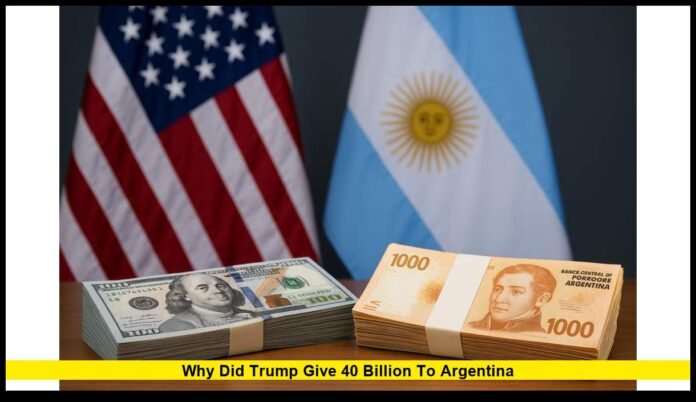

Why did Trump give 40 billion to Argentina became one of the most debated geopolitical questions in recent U.S. political and economic conversations. The decision involved a combined financial support package aimed at stabilizing Argentina’s struggling economy during a period of severe inflation and currency decline. The package totaled up to $40 billion, including a $20 billion currency-swap arrangement and an additional $20 billion in private-sector financing efforts. This move quickly stirred questions relating to national interest, foreign policy priorities, and domestic political reactions within the United States.
Argentina, facing a deep economic crisis, was experiencing one of the highest inflation rates in the world, currency devaluation, and reduced access to global credit markets. The U.S. provided financial backing during this period while Argentina was under the leadership of President Javier Milei, a figure known for his ideological alignment with Donald Trump and his support of free-market reforms. The assistance was framed as both an economic stabilization effort and a geopolitical strategy designed to influence economic balance in the Western Hemisphere.
Argentina’s Economic Crisis Context
Argentina has experienced repeated cycles of debt, inflation, and currency instability. Years of fiscal deficits, reliance on foreign debt, and political disputes over economic reform contributed to a prolonged downturn. To stabilize the economy, Argentina required access to foreign reserves that could support its currency and reassure investors. However, traditional global lenders were cautious, viewing the country’s history of defaults and shifting economic policies as high risk.
The United States stepped in with financing mechanisms designed to:
- Strengthen Argentina’s central bank reserves
- Stabilize the peso during market turbulence
- Provide financial breathing room for domestic reforms
- Restore investor confidence and slow inflationary pressure
This was not direct aid in the form of grants; rather, it involved currency support and investment facilities meant to be repaid under specific conditions.
Strategic Reasons Behind the U.S. Decision
The decision was not based solely on economic relief. Several strategic considerations influenced the move.
1. Strengthening Relations with a Friendly Administration
President Javier Milei publicly aligned himself with Donald Trump’s policies and political messaging. The relationship between the two leaders created an environment where the U.S. saw supporting Argentina as reinforcing an ideological partnership. Backing Milei’s government signaled U.S. support for free-market reforms and deregulation efforts within Latin America.
2. Maintaining U.S. Influence in Latin America
Argentina’s economic instability made it more likely to seek financial support from other global powers, including China. China has expanded its economic presence in South America through infrastructure investments, mining contracts, and currency swap agreements. The U.S. financial package helped counterbalance Chinese influence and reinforced the United States’ role as a primary economic partner in the region.
3. Protecting U.S. Investor Exposure
U.S. financial institutions and private investment funds held significant interests in Argentine bonds and other assets. A complete economic collapse in Argentina could have resulted in major financial losses. Stabilizing Argentina reduced the risk of widespread defaults and protected American investor positions.
4. Preventing Broader Regional Instability
Argentina is one of the largest economies in Latin America. A deeper collapse could have triggered financial shockwaves affecting neighboring economies. Supporting Argentina was seen as preventing a broader economic ripple effect in the region.
Breakdown of the $40 Billion Package
| Component | Amount | Purpose |
|---|---|---|
| Currency Swap Support | $20 Billion | Strengthen Argentina’s central bank reserves and stabilize the peso |
| Private-Sector Debt Facility | $20 Billion (in development) | Offer access to financing for Argentine industry, infrastructure, and economic reforms |
The currency swap did not function as a cash giveaway. Instead, it allowed Argentina to temporarily use U.S. dollar reserves to defend its currency during market pressure. The private-sector financing portion involved U.S. financial partners providing structured lending with return expectations.
Domestic Reactions in the United States
The decision sparked debate across U.S. political and economic circles:
- Supporters argued that the package was a strategic move ensuring U.S. influence, stabilizing a major regional economy, and preventing increased Chinese penetration in the Western Hemisphere.
- Critics claimed that the move contradicted the “America First” message, particularly among voters skeptical of foreign financial assistance. Some American agricultural sectors, especially soybean producers, were frustrated that Argentina—one of their export competitors—received support while domestic concerns persisted.
The discussion highlighted a broader national debate: when and how the U.S. should intervene in international financial crises.
Argentina’s Perspective and Political Implications
For Argentina, the U.S. support was a significant lifeline. The backing provided short-term currency stability and helped strengthen the credibility of Milei’s reform agenda. However, it also came with expectations: continued economic discipline, reduced state spending, and openness to private investment.
Some political opposition groups in Argentina viewed the U.S. support as foreign interference tied to ideology rather than long-term stability. This debate continues to shape domestic perception of the financial package.
What This Means Moving Forward
Whether the financial support will succeed depends on several ongoing factors:
- Argentina’s ability to continue structural economic reforms
- Stability of the political environment
- Global commodity prices and export revenue
- Investor confidence in Argentina’s long-term repayment ability
The question of why did Trump give 40 billion to Argentina ultimately reflects a broader strategic calculation involving diplomacy, regional influence, financial stability, and political alignment. The decision was not purely economic nor purely political—it was a layered move blending national interest with global economic policy.
Share your thoughts below — do you view this move as strategic leadership or financial overreach? Your perspective helps shape the discussion.