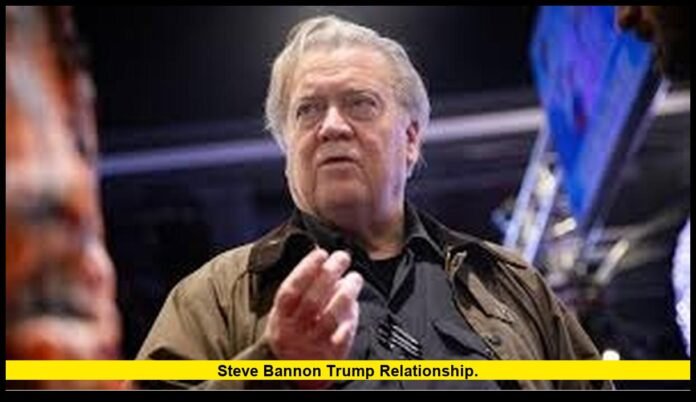

The Steve Bannon Trump relationship remains a central axis of conservative politics in 2025, combining ideological alignment, strategic maneuvering, and evolving roles within the MAGA movement. From their breakthrough 2016 partnership to periods of tension and realignment, their dynamic continues to influence how the Republican Party thinks about power, governance, and legacy.
How the Steve Bannon Trump Relationship Began
Their alliance first ignited in August 2016 when Donald Trump tapped Steve Bannon to serve as campaign CEO. Bannon’s populist messaging and tactical instincts galvanized Trump’s appeal to working-class and anti-establishment voters. After the victory that November, Trump appointed Bannon as his White House Chief Strategist in January 2017, giving him unprecedented access and influence.
In those early months, the Steve Bannon Trump relationship seemed inseparable: a veteran campaigner, a volatile candidate, and a shared belief in remaking Washington. Their collaboration produced landmark moments for the movement: the inauguration, controversial executive orders, and a reorganized Republican messaging machine.
The Rift and Recalibration
By mid-2017 the relationship hit turbulence. After the events in Charlottesville and public backlash, Trump parted ways with Bannon, removing him from the White House in August. The move was publicly dramatic. Bannon returned to conservative media, while Trump sought to stabilize his presidency without his campaign mastermind in the Oval Office.
Their split made headlines, but it did not mean the end of the Steve Bannon Trump relationship. Rather, it shifted from formal to informal—strategy behind the scenes, ideologically in sync but institutionally separated. Bannon continued to critique Washington and promote populist causes, while Trump moved ahead with his presidency and subsequent campaigns.
The 2025 Reconnection
In 2025, the Steve Bannon Trump relationship appears to be in a renewed phase of alignment. Bannon has publicly declared that there is a plan for Trump to run again—or serve another term in 2028—despite constitutional challenges. He insists that Trump is “going to be president in ’28” and that their shared movement has to continue.
Trump, for his part, has not overtly named Bannon as a formal advisor again, but has avoided criticism of him and has benefited from Bannon’s media advocacy and public narrative support. The relationship has reverted to a partnership of mutual benefit: Trump supplies broad popularity and political brand power; Bannon supplies ideological direction, messaging discipline, and grassroots activation.
Shared Ideals, Different Operating Styles
The Steve Bannon Trump relationship thrives on overlapping ideology—but each brings distinct strengths:
- Bannon focuses on institutional change, preparing for personnel shifts and long-term strategy.
- Trump focuses on electoral dynamics, public spectacle, and shifting narratives.
When they align, their impact is amplified. When they diverge, tension surfaces. For example, Bannon’s emphasis on a full structural overhaul of federal agencies may not always align with Trump’s more incremental or commercially-oriented approaches. Yet their shared commitment to an “America First” worldview remains intact.
Recent Flashpoints and Indicators
Some of the most revealing recent moments in the Steve Bannon Trump relationship include:
- Bannon’s repeated public assertions that a third term for Trump is possible and part of their vision—a bold claim that echoes ambition and test of constitutional limits.
- Trump’s decision not to rebuff those statements or distance himself from Bannon, suggesting tacit endorsement or at least tolerance of Bannon’s messaging.
- Conservative staffing discussions referencing Bannon-linked frameworks like Project 2025, which reflect how the Steve Bannon Trump relationship extends into personnel planning and governance strategy.
These signals suggest their alliance is no longer about day-to-day coordination in the White House, but about shaping the next phase of Republican power.
Why This Relationship Matters for American Politics
Understanding the Steve Bannon Trump relationship is critical for anyone tracking politics because:
- It provides insight into how policy and power may be structured in a future administration aligned with their vision.
- It affects staffing and appointment strategies: loyalists within agencies could shift priorities in line with Bannon-influenced frameworks.
- It signals how the movement behind Trump may evolve beyond the candidate into a governing ecosystem with ideological continuity.
- It presents both opportunity and risk: their combined influence can mobilize voters but also provoke institutional resistance and legal scrutiny.
Tensions Behind the Scenes
Despite their alignment, the Steve Bannon Trump relationship is not without its fault lines:
- Bannon’s talk of constitutional bypasses and third-term strategy may create internal friction for Trump, who has publicly refrained from explicitly embracing those ideas.
- Bannon’s emphasis on ideological purity may at times clash with Trump’s broader strategic flexibility.
- The informal nature of their relationship leaves room for competing influence from other figures who may sideline Bannon.
These tensions matter because they could affect how effectively the alliance translates into political outcomes.
What to Watch Going Forward
Keep an eye on these signals of how the Steve Bannon Trump relationship may evolve:
- Public endorsements: Does Trump formally bring Bannon back into his campaign or advisory team?
- Staff appointments: Are Bannon-linked figures appointed to significant roles in the Republican movement or future administration?
- Messaging shifts: Do Trump’s future campaigns reflect Bannon’s ideological priorities, such as structural government reform or expanded executive power?
- Movement training programs: Bannon’s networks are already preparing appointees and activists—how will Trump engage with them?
Broader Implications for the GOP and Governance
The Steve Bannon Trump relationship has implications that extend well beyond the two men. It signals a potential model of governance rooted in populist strategy, grassroots mobilization, and executive strength. For the Republican Party, it suggests an axis of power built less on legislative achievement and more on movement discipline and ideological infrastructure.
For the institutions of government, it raises questions about civil-service protections, agency independence, and how political loyalty may shape the federal workforce. These are structural issues that go beyond electoral cycles.
Final Thoughts
The Steve Bannon Trump relationship has survived ups and downs. From campaign triumphs to public breakups, from informal alliance to near-strategic partnership, the two figures continue to shape each other’s paths—and with them, the trajectory of the conservative movement. Their ongoing coordination, even if loosely defined, signals a commitment to influence not only elections, but governance itself.
We’d love to hear your perspective—how do you view the Steve Bannon Trump relationship and its impact on American politics moving forward?