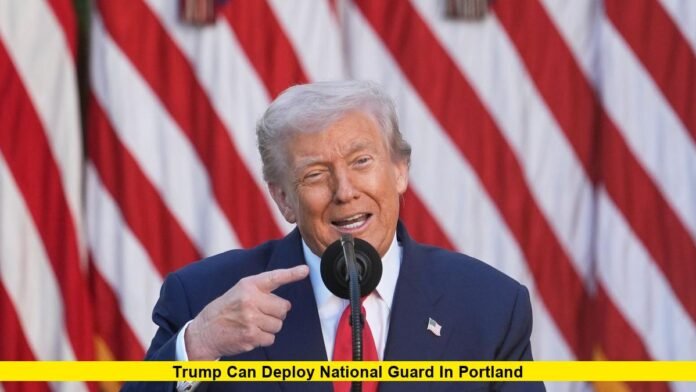

In a pivotal development, a federal appeals court has ruled that Trump can deploy National Guard in Portland, clearing a major legal obstacle that had blocked the former president’s attempt to send troops into the city. The decision, issued by the Ninth U.S. Circuit Court of Appeals, marks a significant moment in the ongoing battle over presidential powers and state sovereignty.
The ruling allows Donald Trump to federalize members of the Oregon National Guard and deploy them in Portland — despite strong opposition from state and local officials. The court concluded that the president acted within his authority under federal law when determining that local and state agencies were unable to maintain order.
The Court’s Decision
In a 2-1 decision, the appeals court reversed an earlier restraining order that had temporarily prevented Trump from using Oregon’s National Guard. The panel emphasized that the president’s authority to federalize the Guard is grounded in his constitutional duty to “execute the laws of the United States” when local enforcement is deemed insufficient.
The judges ruled that courts should defer to the president’s factual determinations in such national security or civil unrest cases. The majority opinion stated that the lower court “substituted its own judgment for that of the executive,” a move the appellate court found inconsistent with established precedent.
However, the ruling did not lift a separate restraining order that still prevents the deployment of troops from outside Oregon. This means the final implementation of the president’s order remains partially on hold while further legal reviews proceed.
Background: How the Case Began
The conflict traces back to ongoing protests and demonstrations in Portland that intensified earlier this year. The Trump administration cited escalating property damage, clashes with law enforcement, and threats to federal facilities as justification for federalizing the Oregon National Guard.
Oregon Governor Tina Kotek and Portland city leaders strongly opposed the move, arguing that the situation was under control and that federal involvement would only inflame tensions. Their lawsuit contended that Trump’s actions violated state sovereignty and overstepped constitutional limits.
A federal district judge initially sided with the state, issuing a temporary restraining order blocking the federalization order. But the appeals court has now overturned that decision — saying the president’s national security judgment deserves deference.
Reactions from Officials
The ruling sparked immediate and polarized reactions across Oregon and beyond:
- Governor Tina Kotek criticized the decision, warning it sets a dangerous precedent that could undermine state authority in future disputes.
- Portland’s mayor reiterated that the city did not request federal assistance and emphasized that local law enforcement remains capable of maintaining public order.
- White House officials hailed the decision as a victory for executive authority and the rule of law, stating that the president has an obligation to protect federal property and ensure peace when local efforts fail.
Legal Significance and Implications
The case touches on one of the most sensitive constitutional questions: How far can a president go in deploying military or paramilitary forces inside the United States without state consent?
The ruling reinforces a broad interpretation of presidential power under the Insurrection Act and related federal statutes. It suggests that the executive branch can, under certain conditions, override state objections when determining that domestic peace is at risk.
Legal analysts warn, however, that the decision could have far-reaching implications for future administrations. If upheld, it might allow presidents to deploy National Guard troops in any state facing large-scale protests or civil disturbances — even without a governor’s approval.
Key Points from the Decision
- Majority Opinion: The president’s decision to federalize the National Guard is entitled to deference unless it is clearly unconstitutional.
- Dissenting Opinion: One judge argued the decision undermines federalism and could erode the balance of power between the states and Washington, D.C.
- Partial Enforcement: The court’s ruling allows Trump to take command of Oregon’s Guard troops but maintains restrictions on out-of-state troop deployments.
Impact on Portland
If the second restraining order is lifted, Oregon’s National Guard could soon operate under federal command within Portland. Troops would likely assist in securing federal buildings, monitoring demonstrations, and supporting local law enforcement operations.
Many Portland residents have expressed concern that such a deployment could heighten tensions rather than reduce them. Civil rights groups have warned of potential overreach, pointing to past confrontations between protesters and federal agents during earlier periods of unrest.
For now, Oregon officials are considering their next legal steps — including a possible request for the full Ninth Circuit to review the case en banc, which could delay or alter the outcome once more.
What Comes Next
The battle is far from over. While Trump’s legal team celebrated the ruling as validation of presidential authority, Oregon leaders have vowed to continue fighting in court. The governor’s office confirmed that it will seek a full review and may appeal to the Supreme Court if necessary.
If the decision stands, it could pave the way for broader use of federalized Guard units in other states under similar justifications — particularly in instances of large-scale protests or security threats.
Observers note that the case’s implications extend beyond Portland, shaping how future presidents might interpret their powers in domestic crises.
The Bigger Picture
This ruling underscores the ongoing tension between federal control and state autonomy — a theme deeply rooted in American governance. It revives debates about the limits of executive power, especially in times of national unrest.
Whether viewed as a necessary act to restore order or as federal overreach into state affairs, the decision that Trump can deploy National Guard in Portland will likely become a defining legal and political moment of the year.
As the legal process continues, both sides prepare for what could become a landmark Supreme Court battle over the boundaries of presidential power and states’ rights.
Conclusion
The appellate court’s decision that Trump can deploy National Guard in Portland represents a significant expansion of executive authority, even as legal challenges continue. With tensions high and further appeals expected, Portland remains at the center of a historic confrontation between state and federal power.
Stay tuned for updates, and share your thoughts below — how do you feel about this ruling and what it could mean for the future of federal authority in America?