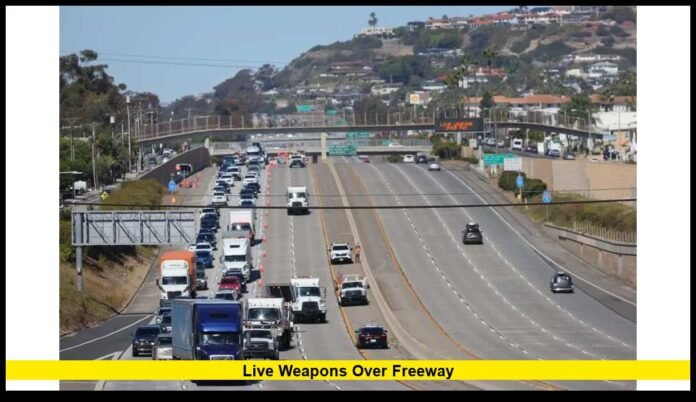

In an extraordinary display that captured national attention, a military demonstration involving live weapons over freeway forced the closure of a 17-mile section of Interstate 5 (I-5) in Southern California. The closure occurred on Saturday, October 18, 2025, as part of the 250th anniversary of the U.S. Marine Corps, prompting widespread debate about safety, authority, and the intersection of national defense with civilian infrastructure.
The Incident
The operation began late Saturday morning when state traffic officials issued an emergency alert warning motorists of live-fire activity above the freeway. Signs across the corridor read: “Live weapons over freeway.”
Traffic was diverted between Harbor Drive in Oceanside and Basilone Road near San Clemente, effectively cutting off a vital artery connecting San Diego and Los Angeles. The closure lasted nearly four hours, from 11 a.m. to 3 p.m., as the Marine Corps staged a large-scale live-fire demonstration featuring artillery and aerial maneuvers.
The event, titled “From Sea to Shore — A Review of Amphibious Strength,” was designed to commemorate the Marine Corps’ two and a half centuries of service. High-ranking officials, including Vice President J.D. Vance and Defense Secretary Pete Hegseth, attended the demonstration, while Governor Gavin Newsom condemned it as unsafe and unnecessary.
Why the Freeway Was Closed
The decision to shut down I-5 stemmed from concerns raised by state officials after observing live munitions being fired near the freeway corridor during practice runs earlier in the week. Authorities concluded that the trajectory of some artillery shells could pose a danger to motorists if the road remained open.
Governor Newsom ordered the closure, citing “a life-safety risk and a clear danger to the traveling public.” The California Highway Patrol enforced the order, halting traffic at multiple interchanges and rerouting vehicles to alternate highways.
While military leaders insisted all safety measures had been met, state authorities maintained that no level of precaution could justify allowing live explosives to be fired over an active freeway. The phrase “live weapons over freeway” was therefore used literally, not metaphorically, marking one of the rarest public-safety scenarios in modern U.S. history.
The Military’s Stance
The Marine Corps defended the event as a controlled, pre-planned demonstration on secured range grounds. Officials stated that munitions were fired into designated impact zones and that public safety protocols were followed precisely.
The Corps emphasized that such live-fire events are not uncommon at Camp Pendleton, one of the nation’s largest amphibious training bases. However, what made this demonstration unique was its proximity to I-5 — one of the busiest freeways in America.
Military officials also noted that the anniversary event aimed to “honor tradition, showcase readiness, and inspire public confidence in America’s armed forces.”
They rejected accusations that the demonstration was politically motivated, framing it instead as part of a broader celebration of Marine heritage and national defense capability.
Governor Newsom’s Reaction
California Governor Gavin Newsom strongly criticized the federal government’s coordination of the event, calling it “reckless” and “politically charged.” He emphasized that the state was not properly informed about the full extent of the live-fire component until days before the event, prompting last-minute emergency planning.
In a public statement, Newsom said:
“Firing live rounds over a major interstate highway isn’t just a security concern — it’s a matter of basic public safety. California will never gamble with the lives of our residents.”
He further accused federal officials of prioritizing spectacle over safety and politicizing the military for public display.
Traffic Chaos and Public Response
The closure created massive gridlock across Southern California. Traffic backed up for miles in both directions, and local authorities reported detours extending into San Bernardino and Riverside counties. Some travelers reported being delayed by up to five hours while trying to reach destinations in San Diego or Orange County.
Freight companies and long-haul truckers were particularly affected. That section of I-5 carries nearly $100 million in freight traffic daily, and logistics operators said the closure disrupted deliveries across several western states.
Motorists took to social media to express frustration, with some posting videos of empty stretches of freeway blocked by barricades and warning signs flashing the now-infamous phrase “Live weapons over freeway.”
Others expressed fascination with the event, sharing footage of jets and helicopters performing maneuvers over the Pacific Coast as artillery thundered from Camp Pendleton.
Political Fallout
The controversy quickly escalated into a political flashpoint.
- Governor Newsom accused the federal administration of using the military to stage political theater.
- Republican officials, including Southern California Congressman Darrell Issa, countered that the governor’s decision to shut the freeway was a “publicity stunt.”
Vice President Vance defended the event as “a proud display of American strength,” while critics questioned whether any demonstration — regardless of intent — should risk endangering civilians or interrupt major infrastructure.
The debate has since spread nationwide, sparking renewed conversations about the limits of federal authority during domestic military events and the protocols for coordinating with state governments.
The Phrase “Live Weapons Over Freeway”: What It Really Means
The phrase “live weapons over freeway” became viral because it was both shocking and literal. The signage and alerts used by state transportation agencies were not hyperbolic; they directly referred to munitions being fired over the airspace near I-5.
Live weapons refers to operational, explosive munitions — not blanks or simulated rounds. These included artillery shells and aerial bombs fired as part of the live-fire exercise.
Over freeway denoted the fact that the flight path of certain projectiles, though aimed at safe impact zones, would pass above or near the I-5 corridor. This created an unprecedented situation in which a federal military event overlapped with civilian infrastructure, prompting the full shutdown.
Safety Protocols and Risk Management
Military officials claimed that all necessary precautions were implemented:
- Strict airspace control was maintained during the demonstration.
- Artillery trajectories were pre-calculated to ensure no impact near public zones.
- All civilian and freight traffic was cleared from the area.
- Emergency services were on standby along the freeway and at nearby bases.
State authorities, however, maintained that mathematical assurances could not replace real-world unpredictability. They cited potential risks from equipment malfunction, wind variation, and misfire — any of which could have disastrous consequences if the freeway had remained open.
Public and Legal Implications
The event has opened broader discussions about civilian exposure to military activity. Legal experts have raised questions about whether federal authorities must obtain state approval for live-fire events that could impact civilian areas.
Transportation advocates also called for clearer communication channels between military bases and local governments. Many pointed out that the initial advisories were confusing and vague, leaving residents unsure of the extent of danger or the length of the closure.
There are early discussions in Sacramento about drafting legislation that would:
- Require advance public notice for any future live-fire operations near major roadways.
- Establish clear jurisdictional boundaries for military demonstrations involving public airspace.
- Strengthen coordination between state emergency agencies and federal military branches.
Broader Impact on Military-Civil Relations
This incident highlights the delicate balance between national defense priorities and state sovereignty. The Marines’ mission to demonstrate combat readiness collided with California’s responsibility to safeguard its residents.
Analysts suggest that future celebrations or demonstrations will likely involve tighter restrictions, including greater separation between active-fire zones and civilian transport routes.
While military displays often aim to foster patriotism, the optics of “live weapons over freeway” have left many uneasy about where safety ends and symbolism begins.
Community Reactions
Local residents expressed mixed feelings. Many acknowledged pride in the Marines stationed at Camp Pendleton but felt the event was poorly timed and communicated.
Some residents near Oceanside reported feeling their homes shake from the artillery blasts, comparing the sounds to small earthquakes.
Others supported the event, noting that such demonstrations are a reminder of military readiness and the sacrifices made by service members.
For those stuck in traffic or forced to alter weekend plans, however, the sentiment was frustration and disbelief that one of America’s busiest highways could be closed for a live-fire spectacle.
Looking Ahead
As the dust settles, both federal and state agencies are reviewing the incident. The Department of Defense has pledged a full after-action report, and California’s Office of Emergency Services plans to examine how future coordination can be improved.
While no injuries or damage occurred, the term “live weapons over freeway” has entered the public lexicon as a stark example of how national celebrations can intersect with public safety.
The debate over the appropriateness of such displays is far from over, but it’s clear that this event will influence how military demonstrations are planned in the years ahead.
What are your thoughts on this unprecedented freeway closure? Should live-fire military events ever be allowed near civilian highways? Share your opinion below and stay updated for further developments.