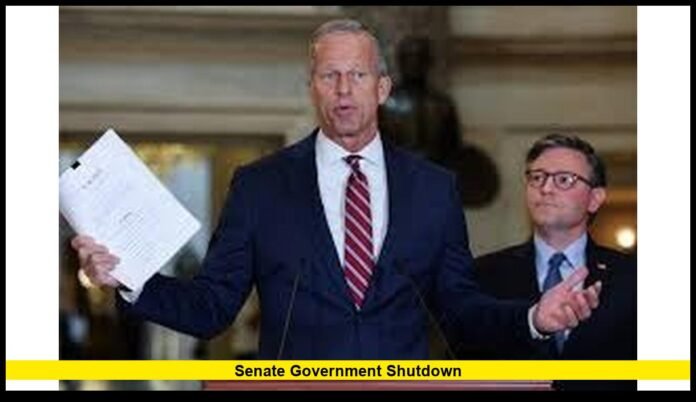

The Senate government shutdown began on October 1, 2025, when negotiations in Congress collapsed over spending and policy demands, and a deal remains elusive as the partial government closure enters its third week.
With Wednesday’s setback marking the tenth failed vote in the Senate on a funding measure, the deadlock shows no sign of resolving soon.
What’s Behind the Shutdown?
At the center of the standoff is a bitter dispute over three core issues:
- Affordable Care Act (ACA) Tax Credits – Democrats insist any reopening includes extensions to subsidies that help millions afford premiums.
- Medicaid and Safety-Net Funding – Democratic leadership refuses to advance a straight funding bill without assurances blurred around Medicaid cuts.
- Filibuster & Vote Thresholds – Senate rules require 60 votes to end debate on most funding bills; Republicans hold 53 seats, so they must secure at least seven Democrat votes to advance any deal.
Despite repeated attempts, the Senate has consistently stalled on continuing resolutions and piecemeal appropriations. In one dramatic vote this week, a defense-only funding bill failed by 51-44 when three Democrats joined the Republicans—still well below the 60-vote threshold.
Senate Majority Leader John Thune (R-SD) offered Democrats a separate vote on extending ACA subsidies if they would reopen the government. Democrat leaders turned him down—calling the deal insincere and demanding broader policy protections.
In the House, Speaker Mike Johnson has kept the chamber out of session and refused to entertain new measures until the Senate moves first, intensifying the sense of gridlock.
How Bad Has It Gotten?
The effects of the Senate government shutdown are no longer theoretical—they are real and mounting. Key impacts:
- ~900,000 federal employees have been furloughed or placed in unpaid work status, while another 700,000 continue working without pay.
- Numerous agencies—including the Environmental Protection Agency, some parts of the National Institutes of Health, and the Centers for Disease Control and Prevention—have scaled back operations or frozen project funding.
- Military personnel remain on duty, but some civilian defense staff have gone unpaid and certain logistical contracts have been suspended.
- With each day of closure, economic analysts estimate the fallout grows: delayed federal contracts, slower small-business applications, and decreasing consumer confidence are on the rise.
This shutdown is now the third-longest government funding lapse in U.S. history. Unlike past impasses, time is no longer a passive factor—it’s accelerating consequences.
Where the Senate Stands Now
Here’s a snapshot of the current situation in Washington:
| Indicator | Current Status |
|---|---|
| Number of Senate failed votes | 10 failed attempts to pass a funding resolution |
| Government funding status | Unfunded since October 1; partial operations continue under “essential only” siege |
| Major sticking points | ACA subsidies, Medicaid reform, defense funding, policy riders |
| Next Senate session | Scheduled for Monday after brief district recess—no vote yet on hold |
What’s clear: neither side has publicly signaled meaningful concession. Thune noted that leadership hopes to avoid the shutdown stretching into Thanksgiving—but offered no firm roadmap.
Why U.S. Viewers Should Care
For most Americans, the phrase Senate government shutdown might seem distant—but the implications are close, personal and growing:
- Federal workers: Household incomes are already under strain; many are seeking short-term loans or unemployment assistance.
- Public services: From passport applications and small-business loans to assistance programs, delays and disruptions are rising.
- Economic ripple effects: Regional businesses that rely on federal contracts or employee presence are seeing drop-offs in revenue and demand.
- Political trust: A drawn-out shutdown erodes confidence in government’s ability to function—not just in Washington, but in the states where people vote, pay taxes and expect basic services.
When the Senate stalls on a funding deal, the costs of that inaction aren’t abstract—they hit families, local economies and national confidence.
What Could Break the Gridlock?
Several scenarios exist for ending the standoff—though each faces serious hurdles.
1. Short-Term Continuing Resolution (CR)
Leaders might pass a funding measure covering just a few weeks—buying time to negotiate the bigger issues. The risk: both sides view it as a deferral, not a solution.
2. Compromise Bill with Policy Riders
Negotiators could bundle in healthcare subsidies, Medicaid protections or even defense funding in exchange for general operations funding. But Republican conservatives resist bundling policy—while many Democrats say they won’t reopen without those protections.
3. Senate Rule Change
Some senators argue changing the 60-vote threshold for funding bills could force progress. However, modifying Senate filibuster rules would mark a massive institutional shift.
4. Public Pressure Catalyst
If federal employee layoffs, stalled agency work or widely publicized personal stories reach critical traction, voter backlash could pressure lawmakers to act.
Each path is risky—yet the longer the shutdown drags on, the fewer options remain viable.
Political Dynamics and Fallout
While the Senate limps through the shutdown, political calculations abound:
- Democrats believe their healthcare leverage offers significant bargaining power—especially with upcoming midterms and public focus on rising premiums.
- Republicans argue the shutdown is being prolonged by Democrats’ refusal to fund the government, framing the impasse as a matter of fiscal responsibility.
- Several moderate senators from both parties are sounding alarm bells—warning the standoff could rupture norms and hurt vulnerable populations.
- Several governors and state officials are scrambling to mitigate impacts—especially in states highly dependent on federal projects and workers.
Public opinion is shifting. Recent polls show that over 60% of Americans blame Congress for the shutdown, with only 19% placing more blame on Democrats alone and 28% on Republicans alone. This is bad news for both parties—and adds pressure in battleground regions for 2026 races.
Economic Outlook: More Than Just Numbers
The consequences of the Senate government shutdown extend far beyond pay checks. Analysts project several risks:
- If the shutdown continues beyond a few more weeks, GDP growth could suffer by as much as 0.3 percentage points in the current quarter.
- Federal contract delays hinder innovation and infrastructure projects, especially in defense, research and rural broadband.
- Consumer sentiment is already dipping—households unsure of pay or borrowing face tighter budgets and lower spending.
- Small businesses dependent on government grants, loans or contracts are vulnerable to cash-flow disruptions and workforce instability.
In effect, the shutdown has morphed from a Washington spectacle into a tangible drag on economic momentum.
How the Shutdown Looked in Real Life
Stories from across the country illustrate how the Senate standoff touches real lives:
- A midwestern national-park guide was scheduled to begin work this week—but now faces unpaid status and uncertainty about season work.
- Military families in Texas, already managing deployments, reported worries about delayed civilian pay and benefits connected to defense contracts.
- A rural health center reliant on federal grants has paused an expansion project, citing funding uncertainty and operational delays.
These aren’t isolated incidents—they reflect the diffuse impact when a national funding gap persists.
Timeline Highlights: What’s Happened So Far
- October 1 – Government funding expires; shutdown begins at 12:01 a.m. EDT.
- October 6 – Senate fails two bills; ~750,000 federal workers affected.
- October 14-16 – 9th and 10th failed votes in the Senate; military-funding bill blocked by Democrats who say broader funding must be included.
- October 16 – Defense-only bill fails 50-44; Senate adjourns for weekend without new plan.
- Today – Shutdown enters third week, the deadlock tightens and personal, economic and political consequences broaden.
Make No Mistake: This Isn’t a Routine Delay
What stands out about the Senate government shutdown now is not just duration—the scale of impact is broader than many previous lapses. The combination of rising federal worker disruption, paused agency activity and heightened public frustration puts the situation beyond standard fiscal impasse.
The most striking difference: this shutdown is unfolding with both major parties firmly dug in, and few signs of compromise. The stakes feel higher, the consequences more tangible, and the political risk more acute.
With the Senate government shutdown stretching into uncharted territory, the nation watches not just for a vote—but for leadership, compromise and the return of government operations. What do you think it will take for Congress to break the deadlock? Share your view below and stay connected as this story develops.