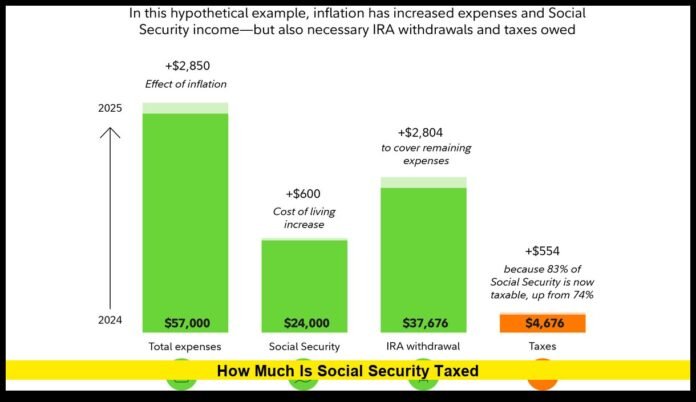

Understanding how much is Social Security taxed is one of the most important parts of retirement planning in the United States. As of 2025, up to 85% of your Social Security benefits may be subject to federal income tax depending on your overall income and filing status. The exact amount varies based on how much you earn from other sources such as wages, investments, pensions, or withdrawals from retirement accounts.
For millions of Americans, Social Security benefits make up a large portion of their retirement income. But when tax season arrives, many are surprised to find that a portion of those benefits may be taxable. Knowing how these taxes work—and how they are calculated—can help you plan ahead, reduce surprises, and potentially keep more of your retirement money.
Understanding How Social Security Benefits Are Taxed
To determine how much Social Security is taxed, the IRS looks at your combined income. Combined income is a specific calculation used only for Social Security taxation purposes. It includes:
- Your adjusted gross income (AGI)
- Nontaxable interest (such as interest from municipal bonds)
- Half of your Social Security benefits
Once you calculate this number, you compare it against specific thresholds that determine whether your benefits are taxed—and if so, what portion is taxable.
Federal Income Tax Thresholds for 2025
The IRS has set income brackets that decide how much of your Social Security benefits can be taxed. These brackets have not changed for several years and remain the same for 2025.
For individual filers:
- $25,000 or less in combined income: No Social Security benefits are taxed.
- Between $25,000 and $34,000 in combined income: Up to 50% of your benefits may be taxable.
- Above $34,000 in combined income: Up to 85% of your benefits may be taxable.
For married couples filing jointly:
- $32,000 or less in combined income: No benefits are taxed.
- Between $32,000 and $44,000 in combined income: Up to 50% of your benefits may be taxable.
- Above $44,000 in combined income: Up to 85% of your benefits may be taxable.
For married individuals filing separately, the rules are stricter. In most cases, up to 85% of benefits are taxable regardless of income level.
These percentages (50% or 85%) represent the maximum portion of your benefits that can be taxed—not the tax rate itself. The actual amount depends on your total income and tax bracket.
How to Calculate the Taxable Portion of Your Benefits
Once you know which threshold you fall into, you can use a worksheet in the IRS instructions for Form 1040 to calculate exactly how much of your benefits are taxable.
Here’s a simplified example:
Example 1:
- Filing Status: Single
- AGI: $22,000
- Nontaxable Interest: $0
- Social Security Benefits: $18,000
Combined Income = $22,000 + $0 + (½ × $18,000) = $31,000
Since $31,000 falls between $25,000 and $34,000, up to 50% of your benefits could be taxable.
Example 2:
- Filing Status: Married Filing Jointly
- AGI: $40,000
- Nontaxable Interest: $1,000
- Social Security Benefits: $30,000
Combined Income = $40,000 + $1,000 + (½ × $30,000) = $56,000
This couple’s combined income is over $44,000, so up to 85% of their benefits could be taxable.
These examples show why retirees often end up paying taxes even when their income seems modest. The inclusion of half of the Social Security benefit in the calculation pushes many households into taxable territory.
Payroll Taxes and Social Security Contributions
When people talk about “Social Security taxes,” they might also mean the payroll tax that funds the Social Security program.
In 2025:
- The Social Security payroll tax rate remains 6.2% for employees and 6.2% for employers, for a total of 12.4%.
- The tax applies to wages up to $176,100. Any income above that amount is not subject to Social Security tax.
- Self-employed individuals pay the full 12.4% because they act as both employer and employee.
These payroll taxes are separate from the income tax on Social Security benefits received during retirement. The payroll taxes you pay during your working years are what fund the system and determine your benefit amount.
State Taxation of Social Security Benefits
In addition to federal taxes, some states also tax Social Security benefits. However, many states have chosen to exempt these benefits entirely to protect retirees from double taxation.
As of 2025, the following states tax Social Security benefits in some form:
- Colorado
- Connecticut
- Kansas
- Minnesota
- Montana
- New Mexico
- Rhode Island
- Utah
- Vermont
- West Virginia
Other states either do not tax income at all (like Florida, Texas, and Nevada) or have specific rules that fully exempt Social Security from state taxes.
Because each state sets its own thresholds and exemptions, the total tax burden can vary widely depending on where you live. For retirees considering relocation, state tax policy on Social Security is an important factor.
Why Social Security Is Taxed
When Social Security was first created in 1935, benefits were not taxed. That changed in 1983, when Congress decided to make part of Social Security taxable for higher-income recipients. Lawmakers argued that the tax would help strengthen the Social Security Trust Fund while maintaining fairness—those with substantial retirement income would contribute more back into the system.
Then in 1993, another law introduced the 85% threshold for higher earners.
Since those thresholds were set, they have never been adjusted for inflation, meaning that over time more and more retirees have become subject to taxation. This is one of the main reasons why retirees today are often surprised to find their benefits taxable, even if they consider their income modest.
Ways to Reduce or Avoid Taxes on Social Security
Although the federal rules are clear, there are legal strategies to reduce how much Social Security is taxed. Here are several effective methods:
- Delay Social Security Benefits
Waiting until age 70 to claim benefits can increase your monthly payments while allowing you to draw from other, more tax-efficient income sources first. - Withdraw from Roth Accounts
Distributions from Roth IRAs or Roth 401(k)s are not included in your AGI, which can help keep your combined income below the taxable thresholds. - Manage Required Minimum Distributions (RMDs)
Plan ahead for RMDs from traditional IRAs or 401(k)s to avoid sudden income spikes that push you into higher taxation tiers. - Use Qualified Charitable Distributions (QCDs)
Donating directly from an IRA to a qualified charity (after age 70½) counts toward your RMD without increasing your taxable income. - Consider Municipal Bonds Carefully
While their interest is nontaxable federally, it still counts toward combined income for Social Security purposes. Too much interest from municipal bonds could unintentionally make more of your benefits taxable. - Track Your Tax Bracket Annually
Small adjustments in your income can make a big difference in how much of your Social Security benefits are taxed. Reviewing your income plan each year can save thousands over time.
How Tax Withholding Works for Social Security
The IRS allows retirees to withhold federal taxes directly from their Social Security payments. This prevents a large bill at tax time.
You can choose to have 7%, 10%, 12%, or 22% of your monthly benefit withheld for federal taxes. You can set this up by completing Form W-4V, “Voluntary Withholding Request,” and submitting it to the Social Security Administration.
Alternatively, you can make quarterly estimated tax payments if you prefer to manage withholding yourself.
Future Outlook for Social Security Taxation
As of late 2025, there are ongoing discussions in Congress about revising the taxation system for Social Security benefits. Many policymakers are considering raising or indexing the income thresholds to reflect inflation. If that happens, fewer middle-income retirees would owe taxes on their benefits.
Another area under discussion involves adjusting the payroll tax cap, which currently limits the amount of wages subject to the 6.2% Social Security tax. Raising this limit could help extend the solvency of the program but would affect higher earners.
While no immediate changes have been enacted yet, it’s important for retirees and workers alike to stay aware of legislative updates, as future reforms could alter how much Social Security is taxed at both the contribution and benefit stages.
Summary Table: Social Security Tax Rules for 2025
| Filing Status | Combined Income Range | Taxable Portion of Benefits |
|---|---|---|
| Single / Head of Household | Up to $25,000 | 0% |
| $25,001 – $34,000 | Up to 50% | |
| Above $34,000 | Up to 85% | |
| Married Filing Jointly | Up to $32,000 | 0% |
| $32,001 – $44,000 | Up to 50% | |
| Above $44,000 | Up to 85% | |
| Married Filing Separately | Most cases | Up to 85% |
Important Takeaways
- Up to 85% of your Social Security benefits may be taxable, depending on your income.
- Combined income includes your AGI, nontaxable interest, and half your Social Security benefits.
- Thresholds have not changed in decades, causing more retirees to pay taxes each year.
- Some states tax Social Security benefits, while others fully exempt them.
- You can reduce your tax burden with careful income planning, Roth withdrawals, and strategic timing of benefits.
Example Scenarios
Scenario 1:
John, age 67, receives $20,000 in Social Security benefits and has $15,000 in pension income and $5,000 in investment income. His combined income is $30,000, so up to 50% of his benefits are taxable.
Scenario 2:
Mary and James, both 70, receive $36,000 in Social Security benefits combined and $30,000 in IRA distributions. Their combined income is $48,000, meaning up to 85% of their benefits may be taxed.
These scenarios demonstrate how even moderate retirement incomes can trigger taxable benefits, underscoring the importance of understanding how much Social Security is taxed in your personal situation.
Final Thoughts
The question of how much is Social Security taxed depends on multiple factors—income level, filing status, and where you live. While up to 85% of benefits can be taxed, smart financial planning can significantly reduce or even eliminate that liability. For retirees, knowing these rules is essential to maximize after-tax income and maintain financial stability throughout retirement.
Understanding your Social Security taxes is key to protecting your retirement income. Share your experience or questions below and stay informed about future updates that may impact your benefits.