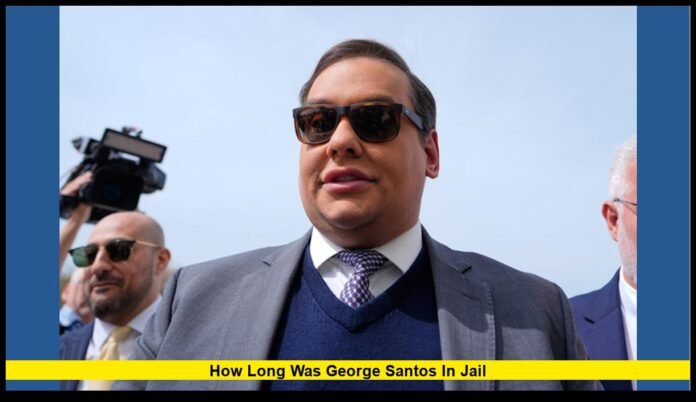

How long was George Santos in jail? As of October 2025, the answer is clear: former U.S. Representative George Santos spent 84 days in federal custody before being released. Although he was sentenced to more than seven years in prison, his term was commuted after less than three months by former President Donald Trump, marking one of the most talked-about political and legal stories of the year.
George Santos’s Sentence and Prison Time
George Santos, who represented New York’s 3rd Congressional District before being expelled from Congress in December 2023, was convicted on several federal charges in 2024, including wire fraud and aggravated identity theft. These charges stemmed from allegations that he used false identities and campaign funds for personal expenses.
In April 2025, a federal judge sentenced him to 87 months in prison, equivalent to seven years and three months. Santos was ordered to report to a federal correctional facility in New Jersey on July 25, 2025, to begin serving his sentence.
However, Santos’s time behind bars was dramatically shortened. On October 17, 2025, President Donald Trump commuted his sentence, declaring that Santos had been “unfairly treated” and that his punishment was excessive. The decision effectively ended Santos’s incarceration after just 84 days.
Timeline of Events
| Date | Event |
|---|---|
| April 25, 2025 | Sentenced to 87 months in prison |
| July 25, 2025 | Reported to federal prison in New Jersey |
| October 17, 2025 | Sentence commuted by President Trump |
| October 17, 2025 | Released from custody after 84 days |
What Led to His Sentence
George Santos’s conviction was the result of a lengthy investigation into his finances and campaign activities. Federal prosecutors alleged that Santos misused campaign donations, misrepresented his income, and committed identity theft to access funds. The conviction included charges of wire fraud and aggravated identity theft, which together carried a potential maximum penalty exceeding a decade in prison.
During sentencing, the judge emphasized the seriousness of the offenses, citing the misuse of public trust and manipulation of campaign funds. Santos’s defense requested leniency, highlighting his cooperation and lack of violent history, but the court maintained the sentence at just over seven years.
The Shortest Possible Sentence: 84 Days
While the original sentence was meant to last seven years, George Santos served only 84 days before being released. His early release resulted directly from executive clemency—a power held by the President to commute sentences or pardon offenders.
This meant that Santos’s conviction remained on record, but the remainder of his prison term was wiped away. He was freed immediately and returned home under no further custody restrictions, though he still faces civil penalties and restitution obligations stemming from his fraud case.
The Impact of Trump’s Commutation
The commutation of Santos’s sentence drew widespread national attention. Many political observers noted that it came amid renewed debate over presidential clemency powers and their use in politically sensitive cases.
Supporters of the move argued that Santos was overcharged and unfairly targeted due to his public persona and political affiliations. They claimed that the media pressure and public scrutiny had already served as a form of punishment.
Critics, however, viewed the early release as an example of unequal justice, questioning why a convicted felon serving time for financial crimes received special treatment. Legal experts noted that such an early commutation—barely three months into a multi-year term—was unprecedented for a federal fraud case of this scale.
What Happens Next for George Santos
Although Santos is free, his legal troubles are not fully behind him. The federal conviction remains active, meaning it will continue to appear on his criminal record. He may still owe restitution to individuals or organizations affected by his crimes. Furthermore, any potential return to public office or political activity would likely face major resistance due to his record.
Publicly, Santos has maintained that he was “grateful” for the commutation and intends to “move on” from the ordeal. He has expressed interest in returning to private business ventures and has hinted at writing a book detailing his experience with politics and the justice system.
Public and Political Reaction
The reaction to George Santos’s release has been polarized. Across the political spectrum, opinions have ranged from outrage to approval:
- Critics argue that the commutation undermines accountability, especially for elected officials convicted of defrauding voters.
- Supporters believe the justice system unfairly targeted Santos and that the shortened sentence reflects a correction of political bias.
Political analysts also noted that Santos’s release reignited discussions about reforming the federal clemency process and ensuring that presidential commutations are transparent and evenly applied.
A Symbol of Political Controversy
George Santos’s short jail term has become symbolic of broader concerns about trust, ethics, and power in American politics. For many Americans, the question of how long was George Santos in jail reflects more than a number—it represents a test of the justice system’s impartiality.
Even though Santos served only 84 days, the public discourse surrounding his conviction and release continues to shape how voters view accountability in government. Whether one sees his story as a tale of redemption or a failure of justice, it stands as a defining chapter in modern U.S. political history.
In summary, George Santos was sentenced to 87 months in prison but served only 84 days before his sentence was commuted. His brief incarceration and early release highlight the intersection of law, politics, and presidential power—an issue that remains deeply divisive in the United States today.
What’s your take on George Santos’s early release? Share your thoughts in the comments and stay informed on future political and legal updates.