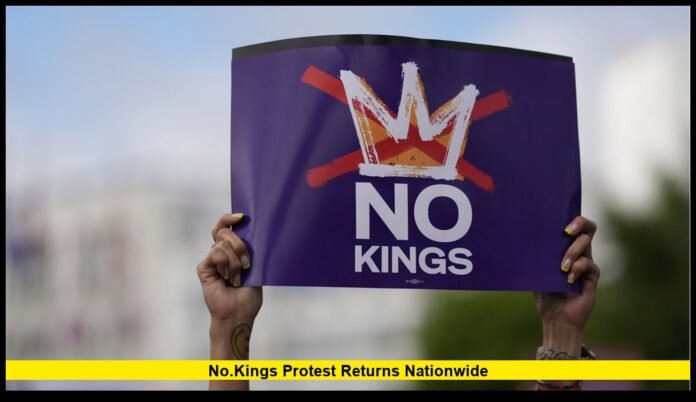

The no.kings protest is preparing to make its presence felt across the United States once again. Organizers are planning thousands of demonstrations on October 18, 2025, in what is expected to be one of the largest coordinated civic actions of the year. From bustling cities to quiet rural towns, Americans are mobilizing to deliver a unified message against the concentration of political power.
With the federal government shut down for over two weeks and political divisions deepening, the timing of this mass protest has intensified public attention. The movement’s slogan — “No Thrones. No Crowns. No Kings.” — has become a rallying cry for many who believe the balance of power in the country is under threat.
A Movement With a Simple but Powerful Message
At its core, the no.kings protest is a symbolic stand against authoritarianism and the unchecked expansion of executive power. Participants are not rallying for a specific bill or party platform; instead, they are coming together to affirm a core democratic principle — that power in the United States belongs to the people, not to a single leader.
The protest’s language intentionally evokes images of monarchy to highlight what organizers view as a growing disregard for institutional checks and balances. The phrase “no kings” underscores their belief that the nation should resist any shift away from representative governance toward concentrated personal power.
The movement has attracted people from a wide range of political backgrounds. Some are longtime activists, while others are first-time participants drawn in by the clarity of the message. By focusing on shared civic values rather than partisan divides, the no.kings protest has been able to grow rapidly since its first major wave earlier this year.
Why October 18 Matters
The upcoming demonstrations are taking place at a crucial moment. The federal government has been in shutdown since October 1, disrupting services and causing uncertainty nationwide. Tensions are high as political leaders clash over budget negotiations and executive actions. For organizers, this moment represents both a challenge and an opportunity.
By staging the no.kings protest now, they aim to remind Americans that civic engagement is essential during political crises. Their message is clear: the country’s future cannot be left solely in the hands of political elites.
Several factors are fueling this renewed wave of protests:
- Political Polarization: With national debates growing sharper, organizers believe public mobilization can bring focus back to shared democratic values.
- Shutdown Fatigue: The prolonged government shutdown has increased frustration across the political spectrum.
- Momentum From the Summer: Earlier no.kings protests drew millions, and this new wave aims to sustain that energy.
- Symbolic Timing: Mid-October is strategically chosen to keep pressure on lawmakers before key fiscal deadlines.
This combination of urgency and symbolism has set the stage for what could be one of the defining protest events of the year.
Nationwide Scope: Big Cities and Small Towns Unite
On October 18, the no.kings protest will span all 50 states. Organizers expect more than 2,500 separate events, making it a truly nationwide movement.
Large cities like New York, Washington, Los Angeles, Chicago, Atlanta, and Dallas are preparing for major marches and rallies. Crowds in these urban centers are expected to number in the tens of thousands. Meanwhile, smaller towns and communities across the Midwest, Great Plains, and rural South are crafting their own unique approaches.
In many of these towns, events will emphasize local identity — from courthouse square gatherings to community picnics that blend protest with civic education. Organizers believe this local focus is key to making the movement sustainable beyond a single day.
This dual structure — mass urban demonstrations paired with intimate local events — gives the no.kings protest both scale and depth.
Creative Tactics and Symbolism
One of the distinctive features of the no.kings protest is its emphasis on visual impact and creativity. Organizers are encouraging participants to use clear, memorable symbols to express their message.
Some of the most common tactics planned for this wave include:
- White Flags: Used to symbolize peace and unity, not surrender.
- Choreographed Formations: Groups arranging themselves to spell “NO KINGS” for aerial photos.
- Drone Light Displays: Coordinated sky shows in major cities to create striking nighttime visuals.
- Candlelight Vigils: Held in several state capitals as a quieter, reflective form of participation.
- Art Installations: Temporary “throne” sculptures set up in public squares, which protesters will symbolically dismantle during the rallies.
The emphasis on imagery reflects the movement’s understanding of modern communication. In an age where social media amplifies visuals faster than words, organizers aim to make the no.kings protest impossible to ignore.
Political Response and National Debate
The resurgence of the no.kings protest has drawn sharp political reactions. Supporters describe it as a patriotic defense of democratic norms. Critics — particularly from conservative political circles — have accused the movement of being politically motivated, disruptive, and even dangerous.
Some political leaders have sought to frame the protests as anti-government rather than pro-democracy, while organizers maintain that their message is about accountability, not partisanship. The divide in interpretation has only increased public interest in how these events will unfold.
This debate reflects larger tensions in American politics: the struggle to distinguish between dissent and division, and the role of protest in shaping national conversations.
Public Sentiment and Expectations
Public attitudes toward the no.kings protest are divided but deeply engaged. Many Americans, even those who may not join the demonstrations, view the movement as a reminder of civic responsibility. Others question whether protests can bring tangible change in an era of entrenched political polarization.
Nevertheless, turnout is expected to be significant. The summer wave of no.kings demonstrations saw millions of participants across thousands of locations. Early registration numbers and social media activity suggest that October’s events may match or surpass those figures in key regions.
Observers are particularly watching how the movement performs in suburban and rural areas. Strong participation beyond the traditional protest hubs could signal a broader cultural resonance.
Evolving Strategy: From Launch to Sustained Pressure
The no.kings protest began earlier this year with a wave of symbolic, inspirational events aimed at building awareness. The October 18 protests, however, represent a shift toward sustained pressure and longer-term mobilization.
Here’s how the two waves compare:
| Aspect | Summer Wave | October Wave |
|---|---|---|
| Goal | Launch and visibility | Sustained engagement and pressure |
| Tone | Inspirational, broad civic unity | Sharper political edge due to shutdown |
| Geography | Heavily urban | More balanced urban and rural |
| Duration | One major day of action | Potential follow-up cycles planned |
Organizers have hinted that the October protests may lead to ongoing civic action, including monthly rallies, community councils, and partnerships with voting rights groups.
Potential Impact
The direct political outcomes of the no.kings protest remain uncertain, but several potential effects are already emerging:
- Shaping Public Discourse: By focusing attention on the idea of power concentration, the movement is influencing how political debates are framed.
- Energizing Civic Groups: Local organizations are using the protest as a springboard for long-term engagement.
- Pressure on Lawmakers: Large, visible demonstrations during a shutdown can influence legislative dynamics, even indirectly.
- Cultural Influence: Iconic images from the protests could become lasting symbols of this political era.
The movement’s decentralized structure gives it flexibility. It can adapt to changing political contexts without depending on a single leader or narrow agenda.
Why the No.Kings Protest Resonates
The no.kings protest taps into a deep cultural undercurrent in American life: a wariness of concentrated power. This sentiment crosses party lines and speaks to the nation’s founding ideals. By emphasizing a message that feels both urgent and timeless, the protest has carved out a unique space in the national conversation.
Its mix of symbolism, strategy, and timing has allowed it to grow quickly, capturing both media attention and public imagination.
Closing Thoughts
As October 18 approaches, the no.kings protest stands poised to become one of the defining civic moments of 2025. Whether it will lead to immediate political changes or evolve into a longer movement remains to be seen. What’s clear is that it has struck a chord with people across the country, uniting diverse voices under a shared banner of democratic vigilance.
The streets, parks, and town squares of America will soon fill with chants, art, and collective expression. How the nation responds to this movement may shape the political narrative for months to come.
What are your thoughts on the no.kings protest and its message? Share your perspective below and join the discussion.