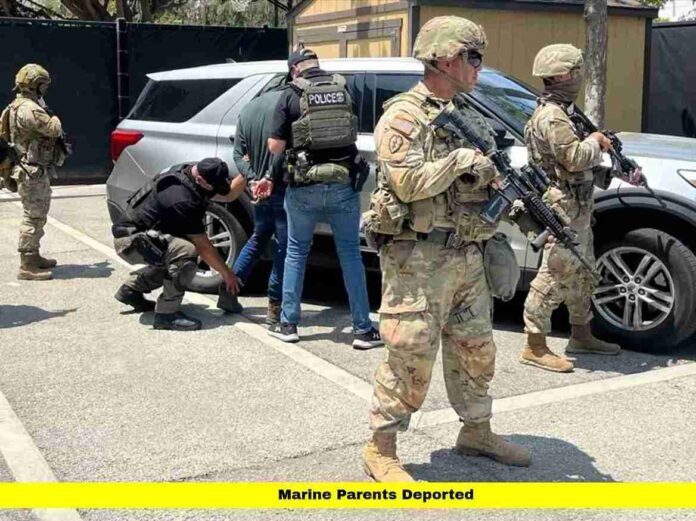

The shocking news of marine parents deported has sent ripples through the military community. Esteban Rios and Luisa Rodriguez, long-time residents of the United States, were detained by immigration authorities during a visit to Camp Pendleton to see their daughter and her Marine husband. Esteban was deported to Mexico, while Luisa’s current whereabouts remain uncertain. This incident has raised questions about immigration policies affecting military families and sparked widespread public concern.
Background of the Family
Esteban and Luisa immigrated from Mexico in the early 1990s. They settled in Oceanside, California, and have lived in the country for over three decades. Both have contributed to their local community through various jobs, including cleaning services and other employment, while raising their two children: Steve, an active U.S. Marine, and Ashley, who is married to another Marine stationed at Camp Pendleton.
The family has no criminal history and was in the process of obtaining green cards through their son Steve. Their case highlights the challenges faced by immigrant families who have deep roots in the United States yet remain vulnerable to immigration enforcement actions.
The Detention Incident at Camp Pendleton
On September 28, 2025, Esteban and Luisa arrived at Camp Pendleton to visit their daughter and her husband. Upon reaching the base, they were stopped by immigration authorities. Despite Esteban wearing a shirt that proudly identified him as the father of a Marine, the couple was taken into custody and transported to a detention center.
Initially, both were released with ankle monitors and required to check in with immigration authorities. However, they were re-detained upon returning for a check-in. On October 10, 2025, Esteban was deported to Mexico. Luisa’s status has not yet been clarified, leaving the family in distress and uncertainty.
Community and Public Reactions
The news of Esteban’s deportation prompted widespread outrage. Local residents and military supporters expressed shock at the treatment of a family so closely connected to the U.S. Armed Forces. Many pointed out the irony of deporting the parents of a Marine, who risk life and serve the nation while their own family faces removal.
Social media quickly became a hub for public support, with calls for a review of immigration enforcement practices and better consideration for families of service members. The case has also sparked debates about the balance between strict immigration enforcement and compassion for families contributing positively to society.
Impact on the Family
Steve Rios, the Marine son of the detained couple, described the situation as heartbreaking. He stated, “I just kept looking at my parents. I didn’t know if it would be the last time I’d see them.” The deportation has created emotional turmoil, separating a family that has long been a part of the U.S. community.
Ashley, the daughter, was also deeply affected. Expecting a child and facing the absence of her parents during a critical period, she represents the immediate human cost of this policy. The emotional strain extends beyond the deported father, affecting multiple generations of the family.
Legal and Policy Considerations
The deportation of Esteban Rios underscores the complexities of the U.S. immigration system. Even long-term residents with no criminal records and pending legal status can face sudden removal. Legal experts argue that current enforcement practices may fail to adequately consider family ties to U.S. citizens and military personnel.
This incident has raised broader questions about the criteria used by immigration authorities for detention and deportation. Advocates emphasize that military families, who already make significant sacrifices for the country, should be afforded special consideration under immigration law.
Broader Implications for Military Families
The case of marine parents deported serves as a reminder of the vulnerabilities faced by military families with immigrant roots. It highlights the potential disconnect between national security policies and the acknowledgment of families contributing to the nation through military service.
Key takeaways for policymakers include:
- The need to review enforcement policies affecting military families
- Consideration of humanitarian factors in deportation decisions
- Greater clarity and transparency in legal proceedings for long-term residents with family in the Armed Forces
Experts suggest that the military and immigration authorities collaborate to prevent similar incidents in the future.
Ongoing Developments
As of October 14, 2025, the status of Luisa Rodriguez is still unresolved. Efforts by the family and advocacy groups aim to locate her and ensure her rights are protected. The case continues to attract national attention, putting pressure on authorities to consider alternatives and review enforcement practices.
The situation also emphasizes the importance of legal support and public advocacy in immigration cases. Many families in similar circumstances face uncertainty, and public awareness can influence policy decisions and procedural reforms.
Conclusion
The deportation of Esteban Rios, along with the uncertain situation of Luisa Rodriguez, has highlighted critical issues at the intersection of immigration enforcement and military service. The case of marine parents deported brings attention to the human impact of policies, showing the profound consequences on families who have long contributed to their communities and the nation.
This ongoing story is a call to reflect on immigration practices, compassion for military families, and the broader societal implications of enforcement policies. Staying informed and engaged with such developments can help advocate for fairer treatment for all families affected by immigration decisions.