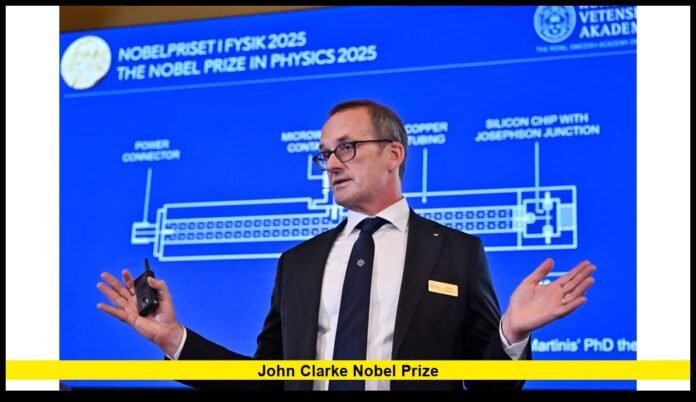

John Clarke Nobel Prize recognition in 2025 has marked one of the most celebrated scientific milestones of the year. The University of California, Berkeley physicist has officially been awarded the Nobel Prize in Physics for pioneering work that transformed our understanding of quantum mechanics on a macroscopic scale. Alongside fellow laureates Michel H. Devoret and John M. Martinis, Clarke’s research decades ago laid the groundwork for today’s rapidly advancing quantum technologies.
This historic moment has resonated strongly in the United States, underscoring the nation’s leadership in fundamental physics and innovation. From academic circles to quantum industry leaders, Clarke’s Nobel win is seen as a recognition not only of past discoveries but also of their immense impact on the technological future.
A Defining Moment in Modern Physics
The Royal Swedish Academy of Sciences awarded the 2025 Nobel Prize in Physics “for the discovery of macroscopic quantum mechanical tunneling and energy quantization in an electric circuit.” For decades, scientists believed that quantum phenomena like tunneling and quantized energy states could only be observed in atoms or particles at the tiniest scales. Clarke and his collaborators shattered this assumption.
Their experiments in the 1980s used superconducting circuits with Josephson junctions—tiny barriers where electrons behave in quantum ways. Through meticulous work at ultralow temperatures, they proved that these circuits:
- Could “tunnel” through energy barriers, just as subatomic particles do in quantum mechanics.
- Exhibited discrete energy levels, meaning their behavior followed the same quantum rules as electrons in atoms.
This was a scientific revelation. It bridged the gap between classical physics, which governs our everyday experiences, and quantum physics, which operates in the strange world of the very small. By showing that quantum effects could exist in circuits visible to the naked eye, Clarke and his colleagues opened a new era of research.
Today, their discoveries form the theoretical and practical foundation of quantum computing, quantum sensing, and other advanced technologies. What was once an abstract scientific curiosity is now an essential pillar of the emerging quantum industry.
John Clarke’s Journey: From Cambridge to California
John Clarke’s scientific journey is a story of intellectual curiosity, persistence, and global impact. Born in Cambridge, England, Clarke completed his doctorate in physics at the University of Cambridge in 1968. A year later, he crossed the Atlantic to join the University of California, Berkeley—a move that would define his career.
At Berkeley, Clarke focused on low-temperature physics and superconductivity, two areas critical to understanding quantum behavior in large systems. Over time, his laboratory became a world leader in quantum measurements and superconducting technologies.
Clarke’s work on Superconducting Quantum Interference Devices (SQUIDs) was particularly influential. SQUIDs are instruments capable of detecting magnetic fields with extraordinary sensitivity, finding applications in physics, medical imaging, and geology. This expertise naturally positioned Clarke to explore how quantum effects could be harnessed in large, superconducting circuits.
By the mid-1980s, Clarke and his collaborators had produced results that astonished the physics community. They didn’t just theorize quantum tunneling in macroscopic systems—they demonstrated it experimentally with rigorous precision.
When the Nobel Prize committee called in 2025, Clarke—now a professor emeritus—expressed genuine surprise. After decades of teaching and research, he had become accustomed to quietly advancing his field. The Nobel Prize elevated his lifelong contributions to global recognition.
Why This Nobel Prize Matters for the United States
The John Clarke Nobel Prize win carries special weight in the United States. All three laureates are closely tied to American institutions:
- Clarke has spent his entire academic career at UC Berkeley.
- Michel Devoret holds positions at Yale University and UC Santa Barbara.
- John Martinis is a prominent figure at UC Santa Barbara and played a key role in Google’s quantum computing efforts.
This alignment with top U.S. research universities underscores America’s leadership in quantum science. It also sends a powerful signal at a time when nations are racing to build quantum technologies that could revolutionize computing, communication, and sensing.
The Nobel Prize also reinforces the value of long-term fundamental research. Clarke’s experiments took place decades before quantum computing became a global priority. His recognition today shows that visionary basic science can shape entire industries in the future.
The Core of Clarke’s Breakthrough: Making Quantum Effects Big
To appreciate why this Nobel Prize is so significant, it helps to understand what Clarke and his colleagues actually achieved.
In quantum mechanics, particles like electrons can “tunnel” through barriers that classical physics says are impenetrable. This behavior is central to many technologies, including semiconductors. However, seeing this effect in something as large as an electrical circuit was almost unimaginable in the 1970s and early 1980s.
Clarke’s team cooled superconducting circuits to near absolute zero, where thermal noise disappears and quantum effects can emerge clearly. They then observed unmistakable signs of tunneling and energy quantization.
This discovery showed that macroscopic objects can behave like quantum systems under the right conditions. It provided the conceptual and experimental blueprint for devices like superconducting qubits—the building blocks of many modern quantum computers.
Quantum Technology: How Clarke’s Work Shaped the Future
The impact of Clarke’s research is visible in several technological domains:
| Field | Impact of Clarke’s Discoveries |
|---|---|
| Quantum Computing | Clarke’s macroscopic quantum effects paved the way for superconducting qubits, used in most quantum processors today. |
| Quantum Sensing | His techniques led to ultra-sensitive detection tools, improving precision in medical imaging, geology, and fundamental science. |
| Cryptography & Communications | Quantum properties discovered in circuits help enable more secure communication methods resistant to hacking. |
| Fundamental Physics | His work pushed the boundaries of where the “classical world” ends and the quantum world begins. |
What makes Clarke’s Nobel Prize especially relevant now is that quantum technology is no longer theoretical. Quantum computers are being developed by major companies. Quantum sensors are entering commercial and scientific use. Clarke’s research is embedded in the technologies that will define the coming decades.
A Historic Addition to Berkeley’s Nobel Legacy
Clarke’s award marks the 27th Nobel Prize connected to UC Berkeley faculty—a staggering record that highlights the university’s influence on global science.
Berkeley has long been a powerhouse in physics. From Ernest Lawrence’s invention of the cyclotron to discoveries in atomic energy and cosmology, the institution has shaped the 20th and 21st centuries of science. Clarke’s Nobel adds a chapter focused on the quantum frontier—an area where American universities continue to excel.
His career also exemplifies the power of academic institutions to support long-term, curiosity-driven research. Clarke’s discoveries emerged from decades of focused investigation, not short-term industrial projects. This model remains essential for nurturing future breakthroughs.
Boosting U.S. Quantum Research and Industry
The Nobel Prize announcement has already sparked discussions across U.S. research and policy communities. Clarke’s win is expected to:
- Encourage further investment in basic quantum research by government agencies and private institutions.
- Inspire students to pursue careers in physics, quantum engineering, and advanced technology.
- Strengthen partnerships between universities and emerging quantum technology companies.
- Elevate public awareness of the role fundamental science plays in shaping everyday technology.
Quantum technology is a strategic priority for the United States, with billions of dollars allocated through the National Quantum Initiative. Clarke’s Nobel Prize gives momentum to these efforts, highlighting the deep roots of U.S. leadership in the field.
A Legacy That Extends Beyond the Lab
John Clarke’s legacy is not only about circuits and qubits—it’s about redefining what’s possible. His work demonstrated that the quantum world is not confined to the invisible realm of particles but can shape the behavior of larger, human-made systems.
This vision opened doors for new technologies and expanded our understanding of reality itself. It also set a standard for rigorous, creative science that inspires new generations of researchers.
Final Thoughts
The John Clarke Nobel Prize of 2025 is more than an individual honor—it’s a celebration of American scientific excellence, long-term research vision, and transformative discovery. Clarke’s contributions remind us that the greatest technological revolutions often start as bold scientific questions pursued patiently over decades.
What are your thoughts on John Clarke’s Nobel Prize and its impact on America’s role in the quantum future? Share your views below and stay tuned for more in-depth scientific coverage.