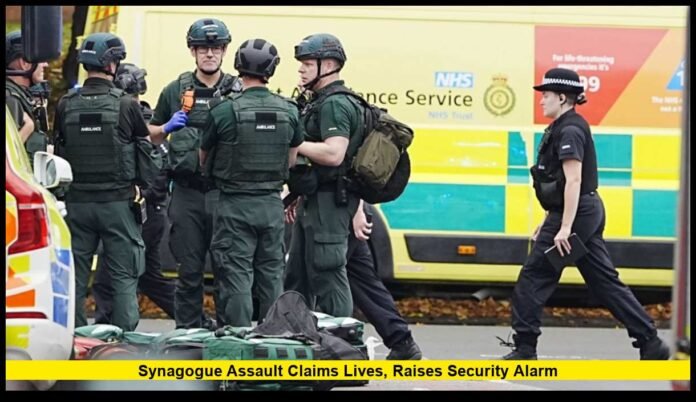

The Manchester England attack has sent shockwaves through the United Kingdom and beyond. On October 2, 2025, during Yom Kippur services, a violent assault on a synagogue in the Crumpsall district of Manchester left two worshippers dead, several others injured, and an entire community shaken. Investigators are treating the incident as a terrorist attack with suspected antisemitic motives, while authorities, religious leaders, and citizens grapple with urgent questions about security, hate, and resilience.
This attack — occurring on one of the holiest days in Judaism — is more than an isolated act of violence. It represents a convergence of religious vulnerability, rising extremism, and evolving security threats. As Manchester mourns, the United Kingdom is forced to examine how it protects communities in an era of complex and fast-moving risks.
How the Manchester England Attack Unfolded
The attack took place just before midday on Yom Kippur, as worshippers gathered at the Heaton Park Hebrew Congregation synagogue. Witnesses described a peaceful scene that was suddenly shattered when a man drove a vehicle into pedestrians near the synagogue entrance. He rammed through a security barrier, exited the vehicle, and began stabbing congregants who were attempting to enter or leave the service.
Police officers were already patrolling the area due to the religious holiday and responded within minutes. A brief exchange of gunfire followed. The attacker was fatally shot on site. Congregants barricaded doors while others attempted to provide first aid to victims until emergency responders arrived.
Two people were killed in the assault. Three more sustained serious injuries, while others were treated for shock and minor wounds after trying to escape through narrow exits during the chaos. Police later confirmed that the attacker was wearing a fake explosive vest — a deliberate ploy to increase panic and slow down initial response.
The Victims and Community Impact
The two victims were long-standing members of Manchester’s Jewish community. One was struck during the vehicle assault at the synagogue entrance. The other died while helping to block the attacker’s entry inside, an act many have described as heroic.
Their deaths have left a profound mark on a community already familiar with rising antisemitic threats. Vigils were held throughout Manchester, including at public squares and other synagogues. Attendees lit candles, recited prayers, and observed moments of silence. Messages of support poured in from across the U.K. and internationally.
For many congregants, this was not only an act of violence but a violation of sacred space. Synagogues are places of reflection and worship; to experience an attack there, during Yom Kippur, has shaken feelings of safety to their core.
Investigation and Arrests
The Manchester England attack triggered one of the largest counterterrorism investigations in the region since the Manchester Arena bombing in 2017. Within hours, police and national counterterror units had launched coordinated raids in multiple locations. Several people were arrested on suspicion of providing support or resources to the attacker.
While some detainees were released after questioning, several remain in custody for extended interrogation. Investigators are focusing on four major lines of inquiry:
- Motive: Early evidence points toward antisemitic and extremist ideology as key motivations behind the attack.
- Networks: Authorities are working to determine if the attacker had accomplices, logistical support, or connections to extremist organizations.
- Digital activity: Investigators are combing through the suspect’s online communications, forums, and travel records to trace radicalization patterns.
- Security breach analysis: Specialists are reviewing how the attacker bypassed existing barriers and whether warning signs were missed.
Police have also deployed additional counterterrorism officers to Manchester to support the investigation and reassure communities.
National Political and Law Enforcement Response
The attack has become a defining security moment for the U.K. government. Within hours, national leaders condemned the assault and pledged to strengthen protections for religious institutions. The Prime Minister described the attack as “an assault on every community that values freedom, safety, and worship.”
Police forces across the country raised their alert levels. Synagogues, mosques, and churches in major cities saw increased patrols. Special attention was given to Jewish institutions, with rapid security assessments underway.
Local Manchester officials called emergency meetings with community representatives. They outlined plans for immediate reinforcement of synagogue security, increased neighborhood policing, and improved communication channels between religious communities and law enforcement.
This response reflects the government’s recognition that attacks on places of worship are not only targeted acts of violence — they are designed to instill fear and divide communities.
The Significance of Yom Kippur Timing
The choice to strike on Yom Kippur adds a chilling dimension to the Manchester England attack. Yom Kippur, the Day of Atonement, is the holiest day in Judaism. Synagogues typically host their largest gatherings of the year, with extended services, communal fasting, and periods of prayer and reflection. Targeting a synagogue on this day maximized the number of potential victims and aimed to strike at the spiritual heart of the community.
Jewish leaders have warned for years that religious holidays can be vulnerable periods, especially in communities already facing antisemitic threats. This attack has intensified calls for enhanced holiday security planning, similar to measures adopted in the United States during major religious observances.
Antisemitism and Rising Security Threats
The attack occurs amid a documented rise in antisemitic incidents across Europe and the U.K. Over the past several years, synagogues, schools, and Jewish community centers have faced graffiti, harassment, vandalism, and occasional assaults. This environment has led many Jewish communities to invest heavily in security, often with support from government grants.
For community leaders, the Manchester England attack is both a tragedy and a warning sign. Many are calling for expanded funding for security infrastructure, better intelligence sharing, and stronger political leadership in addressing antisemitism.
Security Failures Under Scrutiny
While police responded quickly, experts are questioning whether existing security measures were adequate. Key issues under review include:
- Perimeter defenses: The attacker was able to crash through existing barriers with a vehicle, raising questions about their effectiveness.
- Multi-stage threat planning: The combination of a vehicle attack followed by a knife assault shows tactical planning that existing protocols may not have fully anticipated.
- Early warning systems: Whether there were missed indicators that could have prevented the attack remains under investigation.
- Coordination: How effectively law enforcement, synagogue security, and community volunteers communicated during the incident is also being examined.
Security analysts argue that religious sites must adapt to evolving threat models. Vehicle attacks, multi-method assaults, and fake explosive vests are increasingly common tactics designed to overwhelm initial response efforts.
Manchester’s History With Terrorism
Manchester has endured tragic attacks before, most notably the 2017 bombing at the Manchester Arena that killed 22 people. That event reshaped local and national security policy. Public spaces were redesigned, surveillance increased, and emergency response procedures improved.
The Manchester England attack on the synagogue has revived painful memories for many residents. Yet, it has also prompted a familiar response: solidarity. Manchester’s civic identity is deeply tied to resilience. Following the attack, interfaith groups, political leaders, and residents emphasized unity over division, vowing not to allow hate to dictate the city’s future.
A Turning Point for U.K. Security Policy
The synagogue attack may become a catalyst for a broader shift in how the U.K. approaches the protection of religious and community institutions. Policy discussions are already underway about increasing funding for physical security upgrades, expanding counterterrorism resources, and enhancing legal tools to disrupt extremist networks earlier.
Potential measures being considered include:
- Expanded security grants for places of worship
- Improved intelligence sharing between local communities and national agencies
- Tighter regulations around surveillance of high-risk individuals
- Specialized training for community security teams and volunteers
These discussions reflect growing recognition that threats to religious communities are persistent and evolving.
International Reaction
The attack has drawn global attention. Leaders from across Europe, North America, and Israel expressed condolences and solidarity. In several U.S. cities, Jewish institutions increased their own security measures in response to the news, reflecting the global interconnectedness of these threats.
For many abroad, the Manchester England attack is seen not only as a U.K. tragedy but as part of a broader pattern of targeted violence against religious communities in democratic societies.
Final Thoughts
The Manchester England attack is a devastating reminder of how extremism can strike at the heart of religious communities, turning sacred spaces into sites of fear and mourning. It was a calculated assault on a synagogue during its most solemn day, designed to wound a community both physically and spiritually.
As investigations continue, the focus turns to accountability, security reform, and unity. Manchester’s history shows that it will respond with resilience. The challenge now is ensuring that such attacks become less likely — through stronger protections, smarter intelligence, and unwavering solidarity.
What steps do you believe should be prioritized to prevent future attacks on places of worship? Share your perspective below.