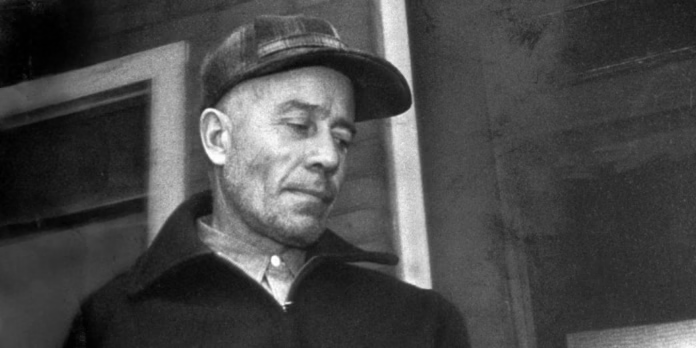

The chilling question “did Ed Gein kill his brother” continues to fascinate true crime enthusiasts and historians alike. While Ed Gein is best known for the gruesome crimes discovered in 1957 that inspired some of the most iconic horror villains in American culture, his brother Henry’s mysterious death years earlier remains one of the most intriguing and unsettled chapters in his story.
To understand why this question persists nearly eight decades later, we must revisit the Gein family’s troubled history, the strange events of 1944, and the many details that point to the possibility that Henry’s death may not have been an accident after all.
The Gein Family: Isolation, Control, and Obsession
The Gein family lived on a remote 160-acre farm just outside Plainfield, Wisconsin. Life inside the Gein household was dominated by Augusta Gein, the strict, religious, and controlling matriarch who shaped her sons’ worldviews with fire-and-brimstone sermons about sin and moral decay.
Ed Gein, born in 1906, was the younger of two brothers. His older brother, Henry, was born in 1901. The two grew up under the same roof, but their paths began to diverge as adults. Ed remained devoted to their mother to a degree that bordered on obsession. Henry, on the other hand, began to question Augusta’s control and expressed concern about Ed’s dependence on her.
Their father, George Gein, was an abusive alcoholic who contributed little stability to the household. His death in 1940 left Augusta, Ed, and Henry alone on the farm. By the early 1940s, the Geins were a small, insular family living in a world of their own making — one shaped almost entirely by Augusta’s rigid rules and Ed’s growing isolation.
The Fire of 1944
The turning point came on May 16, 1944. Ed and Henry were burning brush on their farm — a common practice at the time. The fire got out of control, spreading rapidly. Local volunteer firefighters eventually arrived to contain the flames.
As the fire died down, Ed reported to authorities that his brother was missing. A search party was organized to find Henry. According to Ed’s account, he didn’t know where Henry had gone. But in a strange twist, he led the search party directly to Henry’s body in a marshy area not far from the burned brush.
This odd behavior immediately raised eyebrows. If Ed truly didn’t know where Henry was, how could he have walked the search party straight to him in the dark?
Discovery of Henry Gein’s Body
Henry’s body was found face down, lying on the ground in an area untouched by the fire. His clothing was unburned. Most strikingly, his head bore bruises, as if he had suffered some kind of blunt trauma before he died.
Despite these suspicious details, local authorities ruled the death accidental. The official cause listed was asphyxiation from smoke inhalation. No autopsy was performed. There was no formal investigation into the bruises on Henry’s head. The case was closed quickly.
In 1944, Ed Gein was regarded by neighbors as a shy, quiet, somewhat strange but harmless man. He was helpful around the community, often doing odd jobs for neighbors. Nobody suspected he was capable of violence. As a result, Henry’s death did not receive deeper scrutiny.
Why Henry’s Death Stands Out Today
The question “did Ed Gein kill his brother” gained traction only years later, after Ed’s arrest in 1957 revealed the full extent of his crimes. Investigators, journalists, and criminologists began revisiting Henry’s death and noticed several details that seemed far too coincidental:
- The location of the body: Ed claimed not to know where Henry was, yet found him effortlessly.
- Head injuries: The bruises on Henry’s head were never fully explained.
- Unburned body: His body was found far from the fire, suggesting he didn’t die while trying to escape the flames.
- Relationship tensions: Henry had been increasingly critical of Augusta’s dominance and Ed’s devotion to her, creating possible conflict between the brothers.
- Early signs of violent capacity: Ed’s later crimes showed a chilling ability to kill and conceal his actions.
Together, these factors paint a picture that raises legitimate suspicion — even if hard proof no longer exists.
Psychological Dynamics Between the Brothers
Understanding the dynamic between Henry and Ed sheds light on why some believe Henry’s death may not have been accidental.
Henry was the more independent of the two. As an adult, he began dating a woman and spoke openly about wanting to leave the farm. He criticized their mother’s religious extremism and worried about Ed’s almost childlike dependence on Augusta. Ed, meanwhile, worshiped their mother and shared her puritanical worldview.
This created an emotional divide between the brothers. Some criminologists speculate that Henry’s criticism may have triggered Ed’s anger, especially given his fragile mental state. A heated argument during the fire could have escalated, leading to Henry’s death.
The Missed Opportunity for Investigation
One of the most striking aspects of Henry’s case is how quickly it was dismissed. In modern times, unexplained bruises, suspicious circumstances, and contradictory statements would likely prompt a full homicide investigation, autopsy, and possibly forensic evidence collection.
In rural Wisconsin in 1944, however, such resources and protocols were limited. The local sheriff and coroner simply accepted the explanation of an accident. Without an autopsy, no evidence was preserved. This oversight made it impossible to revisit the case later with forensic accuracy.
Ed Gein’s Later Crimes: A Shadow Over the Past
More than a decade later, Ed Gein’s secret life came to light. In 1957, the disappearance of a local woman led police to search Gein’s farmhouse. What they found shocked the world:
- Human remains turned into household items
- Skulls used as bowls
- Furniture upholstered with human skin
- Evidence of grave robbing and two confirmed murders
These discoveries revealed that Ed Gein had been living a double life. His outward persona of a quiet, eccentric neighbor masked a disturbed individual capable of extreme violence.
Once his crimes were exposed, the 1944 death of Henry Gein took on new significance. What once seemed like a tragic accident began to look like a potential early act of violence.
Modern Theories: What Might Have Happened
While no one can know for certain, several theories have emerged over the years:
1. Accidental Death During the Fire
One theory suggests that Henry genuinely got lost or collapsed during the fire, inhaled smoke, and died accidentally. Ed’s later discovery of the body could have been coincidence. This aligns with the official ruling but fails to explain the bruises.
2. An Argument Turned Fatal
Another theory posits that Henry and Ed argued near the fire, perhaps about Augusta or farm matters. In the heat of the moment, Ed may have struck Henry, causing fatal injuries, and later reported it as an accident.
3. A Premeditated Act
A more extreme theory suggests Ed killed Henry intentionally, possibly to eliminate a figure who opposed his devotion to their mother. Under this theory, the fire may have been a cover-up attempt that went wrong.
While each theory has its proponents, the lack of physical evidence means none can be proven conclusively.
Why the Case Was Never Reopened
After Ed Gein was declared legally insane and confined to a mental institution, authorities focused on the murders and grave robberies he confessed to. Henry’s death, by then more than a decade old, lacked evidence that could support prosecution or even a reopened investigation.
Forensic technology in the 1950s wasn’t advanced enough to revisit old cases effectively. Henry’s remains had been buried for years, and any evidence of foul play would have been degraded.
Cultural and Historical Significance
The story of Ed Gein has had a massive impact on American culture. His crimes inspired characters like Norman Bates (Psycho), Leatherface (The Texas Chainsaw Massacre), and Buffalo Bill (The Silence of the Lambs).
Within this larger narrative, Henry’s death represents the earliest known suspicious event connected to Ed. If he did kill his brother, it would mark his first act of violence—years before his later crimes came to light.
This case also highlights how rural law enforcement practices in the mid-20th century sometimes overlooked signs that, today, would raise immediate red flags.
Final Thoughts
So, did Ed Gein kill his brother? The evidence is circumstantial, but the suspicions are well-founded. The strange details surrounding Henry’s death—the bruises, the location of the body, the relationship tensions—make it hard to dismiss the possibility that Ed may have been involved.
Without an autopsy or preserved evidence, the truth may never be known. Yet the mystery endures, adding another unsettling layer to the story of one of America’s most infamous criminals.
What’s your theory about Henry’s death? Share your thoughts and perspectives below.