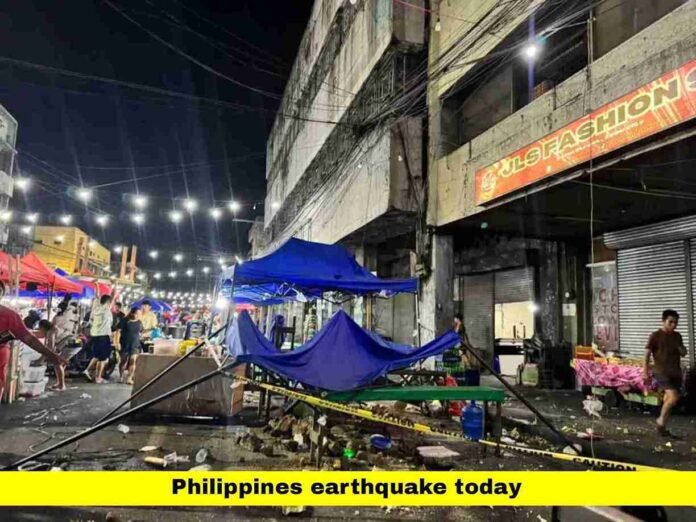

A powerful Philippines earthquake today has left at least 31 people dead and dozens injured after a magnitude 6.9 tremor struck off the coast of Cebu. The quake hit late Tuesday evening, bringing destruction to multiple towns and disrupting power and infrastructure across the region.
Epicenter, Magnitude & Initial Impact
The earthquake struck at 9:59 PM Philippine Standard Time, with its epicenter located 19 km northeast of Bogo City in northern Cebu. Due to its shallow depth, the shaking was strongly felt across the province.
Initial reports confirm significant damage in Bogo, San Remigio, Medellin, and nearby towns. Buildings collapsed, roads split, and landslides buried several communities.
Casualties, Injuries & Ongoing Rescue Efforts
- At least 31 fatalities have been confirmed.
- Dozens more were injured, with hospitals in Cebu struggling to accommodate patients.
- In San Remigio, several children and emergency responders were among the victims.
- Search and rescue teams are working through rubble in remote barangays.
- Survivors have been advised to stay in open areas to avoid aftershock-related collapses.
Authorities warn that the death toll could climb as more areas become accessible.
Widespread Damage to Infrastructure
The quake caused severe destruction to public facilities and utilities across Cebu:
| Type of Damage | Reported Incidents |
|---|---|
| Collapsed homes & buildings | Entire blocks in Bogo and San Remigio |
| Government facilities | A fire station collapsed, injuring firefighters |
| Roads & bridges | Landslides and cracks cut off rural towns |
| Power supply | Large areas in northern Cebu remain without electricity |
| Water systems | Pipe bursts have disrupted local supply |
Classes and government work in the hardest-hit regions have been suspended until further notice.
Tsunami Alert & Aftershock Warnings
A tsunami warning was briefly issued, forcing coastal residents to evacuate. Fortunately, it was lifted after no abnormal sea activity was recorded.
Seismologists caution that aftershocks are expected to continue, some strong enough to worsen structural damage. Residents have been told to remain alert and avoid unsafe buildings.
Storm Aftermath Intensifies the Crisis
The earthquake struck only days after Storm Bualoi (locally “Opong”) battered the Philippines, killing at least 10 and leaving thousands displaced.
This overlap of disasters has worsened the humanitarian crisis:
- Roads weakened by flooding gave way during the quake.
- Relief centers already at capacity are now overwhelmed.
- Emergency responders are stretched thin across storm-hit and quake-hit areas.
Government Response & Relief Operations
The National Disaster Risk Reduction and Management Council (NDRRMC) has deployed emergency units to Cebu. Local governments are working with national agencies to:
- Provide food, clean water, and medical aid to evacuees.
- Set up temporary shelters in schools and gymnasiums.
- Clear blocked roads for supply trucks and rescue teams.
- Restore electricity and water to affected towns.
The President has expressed condolences and ordered rapid mobilization of funds for recovery.
Stories from Survivors
Residents shared terrifying accounts of the moment the quake struck:
- Families ran into the streets barefoot as homes crumbled.
- Parents shielded children from falling debris.
- Survivors camped outdoors through the night, fearful of aftershocks.
Social media has been flooded with images of collapsed buildings, crowded hospitals, and volunteers digging through debris to help trapped neighbors.
Why Cebu and the Philippines Remain Vulnerable
The Philippines lies within the Pacific Ring of Fire, a highly active seismic zone. Earthquakes of magnitude 6 or higher are not uncommon, though Cebu rarely experiences quakes of this intensity.
Experts note that the shallow depth of this event amplified its destructive power, highlighting the urgent need for more earthquake-resistant structures in the country.
Challenges for the Days Ahead
The focus in the coming days will be on:
- Rescuing survivors in hard-to-reach areas.
- Providing medical care to the injured and trauma support to affected families.
- Supplying food and shelter for thousands displaced.
- Repairing infrastructure including power lines, roads, and public buildings.
- Managing aftershocks to prevent further casualties.
Long-term recovery will involve rebuilding homes, schools, and hospitals using more resilient construction methods.
Community Strength in Crisis
Despite the devastation, stories of solidarity continue to emerge. Neighbors are sharing food, volunteers are organizing relief drives, and local groups are mobilizing resources.
The resilience of Filipinos shines through in moments of tragedy. Communities across the nation are offering help, from donations to blood drives, proving once again that collective strength is the country’s greatest resource.
The Philippines earthquake today is a stark reminder of the country’s seismic vulnerability. While the losses are tragic, the courage of survivors and the swift action of responders provide hope. As Cebu begins the difficult road to recovery, Filipinos remain united in the face of disaster.