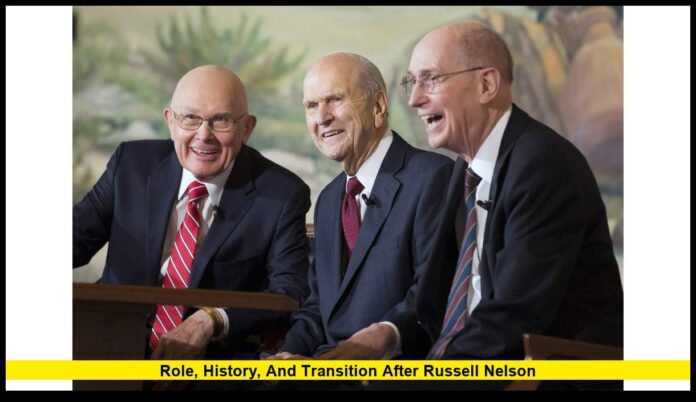

The passing of President Russell M. Nelson at the age of 101 has drawn global attention to The Church of Jesus Christ of Latter-day Saints. While much of the focus is on who will serve as the next prophet, another equally significant question has emerged: who will hold the role of president of the quorum of the twelve apostles? This position is central to LDS leadership and succession, carrying responsibilities that shape both the present and future of the faith.
The Role of the Quorum of the Twelve Apostles
The Quorum of the Twelve Apostles is one of the most important governing bodies in the LDS Church. Modeled after the ancient apostles of Jesus Christ, it is tasked with spreading the gospel, guiding members, and overseeing global administration.
Each apostle is sustained as a prophet, seer, and revelator, giving their collective voice spiritual weight. Together, they:
- Direct worldwide missionary work.
- Oversee temple construction and worship policies.
- Provide guidance to church leaders in over 180 countries.
- Act as the presiding authority during leadership transitions.
The president of the quorum of the twelve apostles serves as the leader among equals, providing direction to his fellow apostles and standing next in line to succeed the prophet.
How the President of the Quorum Is Chosen
One of the hallmarks of LDS leadership is its clarity. When the position becomes vacant, there is no campaigning, debate, or voting among members. Instead, the process is determined entirely by seniority of service.
- The apostle with the longest continuous tenure in the quorum automatically becomes president.
- He presides over quorum meetings and serves as a key advisor to the prophet.
- If the prophet passes away, the quorum president becomes the senior apostle and is prepared to lead until a new president is ordained.
This tradition, established in the 19th century, ensures smooth transitions during times of loss or uncertainty.
Current Transition After Nelson’s Passing
With Russell M. Nelson’s passing, Dallin H. Oaks, who served as First Counselor in the First Presidency, is expected to be ordained as the next prophet. That transition raises the next question: who will serve as president of the quorum of the twelve apostles?
By seniority, the answer is Henry B. Eyring.
- Age: 92 years old.
- Background: Former president of Ricks College (now BYU–Idaho), commissioner of Church Education, and noted scholar.
- Church Leadership: He has served as both Second and First Counselor in the First Presidency under Presidents Gordon B. Hinckley, Thomas S. Monson, and Russell M. Nelson.
- Reputation: Known for his warmth, humility, and emphasis on faith, Eyring has been a beloved voice in general conference for decades.
His assumption of the quorum presidency places him in a vital role during this historic transition.
Why the Position Matters
The title of president of the quorum of the twelve apostles is far more than symbolic. It is a position of both spiritual and administrative responsibility.
Support to the Prophet
The quorum president provides counsel to the prophet, helping shape decisions on doctrine, policy, and global initiatives.
Spiritual Leadership
As a prominent voice in general conference, the quorum president’s sermons often provide clarity on gospel principles and direction for the membership.
Administrative Oversight
The quorum oversees missionary programs, humanitarian efforts, and the expansion of temples worldwide.
Succession Preparation
The quorum president is always the next in seniority after the prophet. If the prophet dies, the quorum president becomes the most senior apostle until the new prophet is formally set apart.
This dual role of present service and future readiness makes the position one of the most watched in LDS leadership.
A Look Back: Historical Importance
Throughout history, the president of the quorum of the twelve apostles has often gone on to become prophet. Some notable examples include:
- Brigham Young: Served as quorum president before guiding the Church westward to Utah.
- Joseph Fielding Smith: Became Church president after decades as quorum leader.
- Gordon B. Hinckley: Rose from quorum presidency to become one of the most recognized LDS leaders in modern times.
- Thomas S. Monson: Likewise served as quorum president before leading the Church as prophet.
This pattern illustrates why the role is not only critical in the present but also signals the future direction of the Church.
Challenges Facing the New Quorum President
With Henry B. Eyring stepping into the role, he inherits a range of pressing issues:
- Global Expansion: Membership is growing most rapidly in Africa, Latin America, and Asia. The quorum must ensure local leadership and resources are in place to support this growth.
- Generational Needs: Younger members seek openness, digital engagement, and inclusivity in Church culture.
- Doctrinal Consistency: Leaders must balance timeless teachings with responses to evolving social questions.
- Public Engagement: The quorum president helps shape the Church’s image on the world stage, particularly on sensitive issues such as gender, history, and humanitarian outreach.
These challenges require wisdom, patience, and vision—qualities Eyring is widely recognized for.
What Members Can Expect
The coming weeks will include several key steps:
- Dallin H. Oaks ordained as the new prophet and president of the Church.
- Henry B. Eyring assuming the role of president of the quorum of the twelve apostles.
- Formation of a new First Presidency, as Oaks selects his counselors.
- Solemn Assembly at General Conference, where members worldwide will sustain the new leadership.
This structured process ensures continuity even in times of loss, reminding members of the stability built into the Church’s succession system.
The Global Impact of Quorum Leadership
The quorum presidency has far-reaching influence, especially as the Church continues its transformation into a worldwide faith. Under Nelson’s leadership, hundreds of new temples were announced, including in regions where membership has only recently grown. The quorum president will play a key role in overseeing the continuation of these projects.
For members in Africa, South America, and Asia, this leadership provides reassurance that their voices and needs are being recognized at the highest levels of the Church.
Stability in Times of Transition
The beauty of the LDS succession process lies in its predictability. Members do not worry about contested elections or political struggles. Instead, they trust that leadership passes smoothly through seniority and divine guidance.
The position of president of the quorum of the twelve apostles embodies this stability, offering confidence that the Church will continue on its path even during leadership changes.
Final Thoughts
The role of president of the quorum of the twelve apostles is one of the most influential in the LDS Church. As Henry B. Eyring steps into this position following Russell M. Nelson’s passing, he brings decades of experience, spiritual depth, and humility.
For members, this moment is both one of reflection and reassurance. While they grieve the loss of a beloved prophet, they also look forward with faith, knowing that the Church’s leadership is steady, inspired, and rooted in a tradition of continuity.
What do you value most in this new phase of leadership? Share your reflections below and join the conversation on this historic transition.