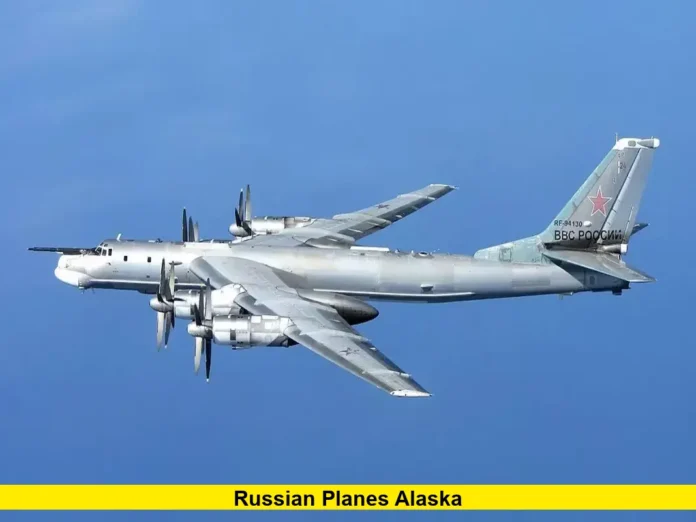

Russian planes Alaska incidents continue to capture American attention as NORAD intercepted four Russian military aircraft near the Alaskan Air Defense Identification Zone (ADIZ) this week. The formation, consisting of two Tu-95 “Bear” bombers and two Su-35 fighter jets, was tracked and escorted by U.S. fighter jets until it departed the area.
While the Russian planes never violated U.S. or Canadian sovereign airspace, the encounter highlights ongoing tension in the Arctic region and underscores how regularly Russia tests the readiness of North American defenses.
NORAD Responds Swiftly to Russian Aircraft
The North American Aerospace Defense Command scrambled an E-3 Sentry surveillance aircraft, four F-16 fighters, and KC-135 refueling tankers to respond to the Russian formation. These intercepts follow a precise, rehearsed protocol:
- Detection – Radar and satellite systems pick up the incoming aircraft.
- Scramble – Fighter jets are launched to visually identify and shadow the aircraft.
- Assessment – Pilots confirm aircraft type, tail numbers, and track their flight paths.
- Escort – U.S. fighters remain with the Russian planes until they leave the ADIZ.
Officials emphasized that while these missions remain within international airspace, every approach requires careful monitoring to prevent miscalculations.
Recurring Russian Flights Near Alaska
This week’s interception is not an isolated event. Russian military aircraft have approached the Alaskan ADIZ nine times already in 2025, making it one of the busiest years in recent memory. The September intercept was the third just this month.
Flights like these have become a hallmark of Russia’s military activity in the region. They often include:
- Long-range bombers such as the Tu-95, capable of carrying nuclear weapons.
- Escort fighters like the Su-35, designed to counter U.S. interceptors.
- Reconnaissance aircraft deployed in other incidents earlier this year.
This consistent pattern shows that Russia uses the Arctic corridor not only for training but also as a stage for demonstrating power projection.
Understanding the Alaska ADIZ
The Alaskan Air Defense Identification Zone is a critical buffer zone extending hundreds of miles off the U.S. coast. It is not sovereign airspace, but all foreign aircraft entering it are required to identify themselves for security reasons.
The ADIZ is strategically important because:
- It serves as the first line of defense against potential threats.
- It lies directly in the path of routes connecting Russia’s eastern bases with the Pacific.
- It allows NORAD to detect hostile or unidentified aircraft well before they reach U.S. borders.
For Russia, flying near the ADIZ sends a message without triggering a violation of international law.
Why Russia Flies Near Alaska
The presence of russian planes alaska is not random. These flights serve multiple purposes:
- Training and Readiness – Long-range aviation units gain valuable practice in extended missions over harsh Arctic conditions.
- Strategic Messaging – Russia signals its ability to project power close to U.S. territory.
- Testing Defenses – Each approach forces NORAD to activate its network of interceptors, radar, and surveillance.
- Geopolitical Pressure – Amid global tensions, including conflicts in Europe, these flights remind Washington of Russia’s global reach.
The Aircraft Involved
- Tu-95 “Bear” Bomber
A Cold War-era design, still modernized and active, the Tu-95 is a strategic bomber capable of carrying nuclear and conventional weapons. Its ability to fly long distances makes it a frequent presence near Alaska. - Su-35 Fighter Jet
One of Russia’s most advanced fighters, the Su-35 provides escort protection. It can conduct air superiority missions, electronic warfare, and close-range intimidation. - U.S. Response Aircraft
NORAD typically deploys F-16 or F-22 fighters, supported by E-3 Sentry radar aircraft and KC-135 refuelers. This ensures extended coverage even over remote Arctic zones.
Timeline of 2025 Russian Flights Near Alaska
| Month | Incident Summary | Aircraft Involved | Notes |
|---|---|---|---|
| February | First intercept of the year | Tu-95, Su-35 | Routine patrol |
| April | Bombers approached ADIZ | Tu-95 | Escorted out |
| July | Large formation tracked | Tu-95, Su-35 | High-profile mission |
| August 10 | Reconnaissance flight | Il-20 | Near Aleutians |
| August 26 | Another bomber escort | Tu-95, Su-35 | Same flight path |
| September 5 | First September intercept | Tu-95 | Rapid NORAD scramble |
| September 12 | Second September incident | Tu-95, Su-35 | Escorted to international waters |
| September 25 | Current incident | Tu-95, Su-35 | Ninth in 2025 |
This timeline reveals an increase in frequency during late summer and early fall, suggesting Russia has escalated its aerial activity in the region.
The Bigger Picture: Arctic Security
The Arctic has become a growing theater of competition between world powers. Melting sea ice is opening new shipping routes and increasing access to natural resources, drawing military interest.
For the U.S., Alaska provides a strategic vantage point:
- It is the closest U.S. territory to Russia.
- It hosts key air bases and radar installations.
- It is essential for defending the northern approaches to North America.
Russia, meanwhile, has invested heavily in modernizing Arctic bases, airstrips, and missile defenses. The flights of Russian planes near Alaska should be viewed within this larger military buildup.
Risks of Escalation
Though most intercepts remain professional and controlled, the risks cannot be ignored:
- Pilot Error – Misjudged maneuvers at high speeds could trigger dangerous incidents.
- Aggressive Tactics – Close flybys or electronic jamming could escalate encounters.
- Political Misuse – A single mistake could be amplified into a major diplomatic crisis.
History has shown that incidents in international airspace can spiral quickly if not handled with restraint. Both nations maintain hotlines and protocols to reduce such risks, but tensions remain.
Comparisons to Europe
Russian air activity is not limited to the Arctic. European nations, particularly NATO members, frequently report Russian military aircraft approaching or entering their airspace. Estonia, Norway, and the United Kingdom have all scrambled fighters in recent months.
The Alaska flights are part of this wider pattern: Russia pushes against NATO in Europe and probes U.S. defenses across the Pacific. Together, these actions reflect a strategy of keeping adversaries alert on multiple fronts.
What Comes Next
Looking ahead, it is highly likely that russian planes alaska will continue making appearances through the remainder of 2025. Several trends may shape the future:
- Increased Frequency – Multiple flights per month could become the norm.
- Mixed Aircraft Groups – More reconnaissance planes, drones, or advanced bombers may be added.
- Expanded Patrol Routes – Flights may extend further south into the Pacific.
- Greater U.S. Response – Expect more F-22 deployments and advanced radar coverage in Alaska.
The U.S. and Canada are also investing in modernizing NORAD’s early warning systems, ensuring they can keep pace with evolving threats.
Final Thoughts
Russian planes Alaska remain a consistent reminder that the Arctic is a contested space and a vital part of U.S. security. While most of these flights remain routine and stay in international airspace, their frequency highlights the importance of constant vigilance. For now, NORAD’s swift response shows that North America is watching closely—and prepared to act whenever Russian aircraft approach.
Do you think these repeated flights are just routine exercises, or do they represent something more concerning? Share your views below and join the conversation.