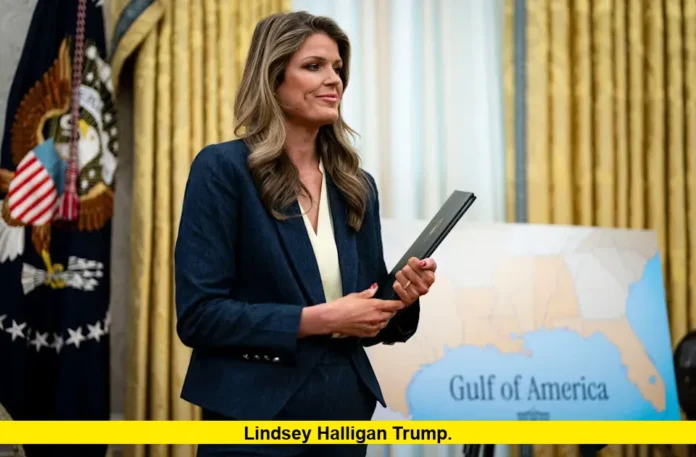

President Donald Trump’s announcement to nominate Lindsey Halligan as the next U.S. Attorney for the Eastern District of Virginia has ignited one of the most closely watched debates in Washington. The decision not only fills a key vacancy but also raises fundamental questions about loyalty, qualifications, and the future direction of federal prosecutions.
The nomination comes at a crucial time, as Trump continues reshaping the Justice Department and installing figures he trusts into positions of influence. The Lindsey Halligan Trump connection reflects both personal loyalty and political strategy, and observers across the nation are weighing what this move could mean for the independence of the federal justice system.
Who Is Lindsey Halligan?
Lindsey Halligan is not a career prosecutor, but she is no stranger to controversy. A Florida-based insurance attorney before entering politics, she rose to national attention in 2022 when she joined Trump’s legal defense team during the Mar-a-Lago classified documents case.
Her role on Trump’s team positioned her as a loyal defender at a time when few attorneys were willing to take on the politically charged case. Over the years, she transitioned into the White House, where she served as a senior aide and became one of Trump’s trusted insiders.
Unlike many nominees for U.S. Attorney roles, Halligan lacks experience as a federal prosecutor. Instead, her career has been defined by private legal practice, political assignments, and a reputation for fiercely defending Trump’s positions. This background makes her nomination unusual and controversial, particularly for a district as important as Virginia’s Eastern District.
Why the Vacancy Emerged
The Eastern District of Virginia became available after Erik Siebert resigned. His departure followed public criticism from Trump, who accused him of failing to pursue politically sensitive cases involving figures such as New York Attorney General Letitia James, former FBI Director James Comey, and other long-time critics.
Trump’s dissatisfaction stemmed from what he described as delays and unwillingness to take action. Siebert, however, reportedly believed the evidence was insufficient for prosecution in those cases. This tension between political expectations and legal discretion created an untenable situation, ultimately leading to his resignation.
In the interim, Mary “Maggie” Cleary was appointed as acting U.S. Attorney, but the administration quickly moved to nominate Halligan permanently. This speed highlights Trump’s urgency in reshaping the office to align with his priorities.
The Role of the Eastern District of Virginia
Often called the “rocket docket”, the Eastern District of Virginia is one of the most influential federal prosecutor’s offices in the United States. Known for moving cases at an unusually fast pace, the district has handled matters ranging from terrorism to high-profile corruption and espionage.
Because of its proximity to Washington, D.C., the office often becomes a central arena for politically sensitive prosecutions. Whoever leads this office wields enormous influence not just over local cases but also over matters with national security and political implications.
Placing Halligan at the helm represents a significant shift in the character of the office. While past leaders often came with decades of prosecutorial experience, this nomination suggests Trump is prioritizing loyalty and alignment over traditional qualifications.
Supporters’ View: A Fresh Perspective
Supporters of the nomination argue that Halligan’s lack of prosecutorial background could actually be an asset. They claim she will bring a fresh perspective to an office they see as stagnant and resistant to accountability.
Trump himself described Halligan as “fair, smart, and dedicated to justice for all.” For many in his base, this is exactly what they want: a figure unafraid to challenge the traditional system and willing to pursue cases that others have avoided.
From this perspective, Halligan is not an outsider but a reformer. Supporters frame her nomination as a way to clean up a justice system they believe has been weaponized against Trump and his allies for years.
Critics’ Concerns: Politicization and Experience
Critics, however, see the nomination in starkly different terms. They warn that the move represents an unprecedented politicization of a critical office. By nominating someone without prosecutorial experience, Trump risks undermining the credibility and independence of the Eastern District of Virginia.
Concerns include:
- Lack of experience: Halligan has never overseen a criminal prosecution, let alone managed a federal prosecutor’s office known for its complexity and volume.
- Political loyalty: Her career trajectory suggests loyalty to Trump is the primary qualification, raising fears that legal decisions could be driven by political agendas.
- Independence of justice: Critics worry that prosecutions may be used to target political opponents, further eroding public trust in the justice system.
These arguments resonate strongly among legal scholars and opposition politicians, many of whom see the nomination as part of a broader pattern of politicization.
The Broader Trump Strategy
The Lindsey Halligan Trump nomination fits into a larger strategy visible across Trump’s administration. Since returning to office, Trump has prioritized appointing loyalists to roles where they can directly shape outcomes.
This includes reshuffling legal leadership, revising Justice Department policies, and even assigning White House aides to tasks such as reviewing museum exhibits for ideological bias. In this context, Halligan’s rise from defense attorney to White House aide to potential U.S. Attorney appears less surprising and more consistent with Trump’s broader goals.
The move also reinforces Trump’s approach of rewarding loyalty. Few other figures in his orbit have transitioned so quickly from defending him personally to holding one of the most influential prosecutorial posts in the country.
What Confirmation Could Look Like
Halligan’s nomination must go through Senate confirmation, and this process is likely to be contentious. Republicans are expected to rally behind her, framing the nomination as a needed corrective to years of politically motivated prosecutions against Trump and his allies.
Democrats, however, will likely challenge her qualifications and raise concerns about impartiality. Questions about her prosecutorial inexperience and loyalty to Trump are expected to dominate the hearings.
Depending on the political climate in the Senate, her confirmation could either proceed quickly with Republican support or stall amid partisan gridlock.
Possible Impact on Pending Cases
If confirmed, Halligan’s leadership could have immediate consequences for ongoing investigations. Among the most closely watched are cases involving alleged financial misconduct tied to political figures, as well as potential charges Trump has openly pushed for against his critics.
How she balances political pressure with the demands of federal law will be one of the defining tests of her tenure. Decisions made in the Eastern District of Virginia often set national precedents, making her leadership role even more consequential.
The Symbolism of the Nomination
Beyond the practical effects, the nomination carries deep symbolism. It represents Trump’s determination to take control of the justice system in ways that previous presidents rarely attempted. By elevating a loyalist rather than a seasoned prosecutor, Trump is signaling that alignment with his vision matters more than conventional credentials.
For supporters, this symbolizes courage and reform. For critics, it is a troubling sign of further politicization. Either way, the nomination cements Halligan as one of the most closely watched legal figures in the country.
Looking Ahead
As the Senate prepares for confirmation hearings, the spotlight will remain fixed on Halligan. Every decision she has made in the past, every case she worked on for Trump, and every statement she delivers in public will be scrutinized.
The debate is not simply about one attorney. It is about the balance between loyalty and independence, politics and law, tradition and disruption. The Eastern District of Virginia is more than just another federal prosecutor’s office—it is a bellwether for how justice in America is carried out.
Conclusion
The nomination of Lindsey Halligan to lead the Eastern District of Virginia is more than a personnel change. It is a reflection of Trump’s broader agenda, a test of Senate dynamics, and a turning point for one of the most powerful prosecutor’s offices in the nation.
Her supporters see her as a loyal, determined figure ready to reform a system they view as broken. Her critics warn that her lack of prosecutorial experience could undermine the credibility of federal justice.
Whatever the outcome, the Lindsey Halligan Trump nomination will shape not only the immediate future of prosecutions in Virginia but also the national conversation about law, politics, and the independence of justice.
What’s your take on Lindsey Halligan’s nomination—reform or risk? Share your thoughts in the comments below.