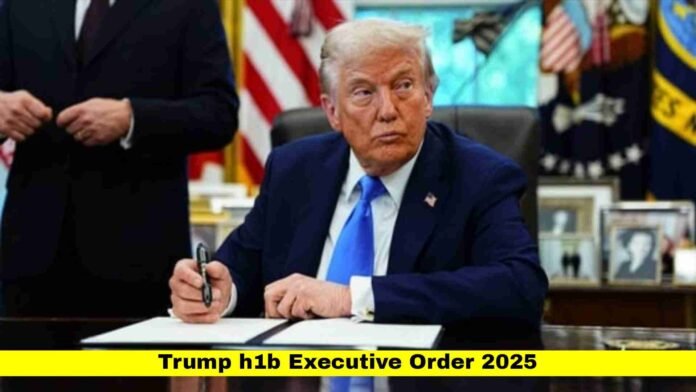

The Trump H1B executive order 2025 has sparked major debate across the U.S. and globally as it reshapes the rules for highly skilled foreign workers. With H1B visas being one of the most critical pathways for professionals in technology, healthcare, and finance, the new order is already influencing hiring strategies for American companies and the career plans of thousands of international workers.
Key Points Summary
➡️ Tightened Criteria: Higher salary thresholds and stricter eligibility rules for H1B applicants.
➡️ Domestic Priority: Companies must now prioritize hiring U.S. citizens before applying for foreign workers.
➡️ STEM Focus: Special provisions benefit advanced STEM professionals, particularly AI, cybersecurity, and biotech experts.
➡️ Industry Impact: Tech giants, startups, and universities are bracing for immediate changes in talent pipelines.
➡️ Global Ripple Effect: Skilled professionals from India, China, and other countries are reconsidering their U.S. career strategies.
📌 Background of the Trump H1B Executive Order 2025
The H1B visa program was originally designed to fill gaps in specialized fields by allowing U.S. companies to hire foreign workers with unique skills. Over the decades, it became a backbone of industries such as Silicon Valley tech, healthcare systems, and higher education research.
In 2025, former President Donald Trump’s administration issued a new executive order aimed at overhauling the system. Trump argued that the program had been exploited by corporations to cut costs by hiring cheaper foreign labor, undermining opportunities for American citizens.
Key changes in the order include:
- Raising the minimum salary requirements for H1B workers.
- Requiring companies to prove no qualified American workers were available before hiring from abroad.
- Prioritizing advanced STEM degrees from U.S. universities in the H1B lottery.
- Expanding audits to prevent abuse by outsourcing firms.
📌 Why the Trump H1B Executive Order 2025 Matters
The U.S. relies heavily on international talent, especially in industries where the domestic workforce cannot fully meet demand. For example:
- Tech sector: Over 70% of Silicon Valley engineers are foreign-born.
- Healthcare: International doctors fill critical shortages in rural areas.
- Academia: Universities depend on global researchers and PhD candidates.
The executive order reshapes how these sectors recruit and operate. Supporters believe it protects American jobs, while critics argue it risks talent shortages and innovation slowdowns.
📌 Major Provisions of the Trump H1B Executive Order 2025
1. Salary Threshold Increases
Employers must now pay foreign workers salaries at or above the 75th percentile of industry wages. This limits companies from undercutting local wages by hiring lower-cost workers.
2. Priority for U.S. Workers
Before filing an H1B petition, companies must publicly advertise the role for at least 60 days and document recruitment efforts for American citizens.
3. STEM-Focused Exemptions
Applicants with U.S.-earned master’s or PhD degrees in artificial intelligence, quantum computing, or biotech get priority in the visa lottery.
4. Stricter Oversight
Random audits and compliance checks are mandatory for firms with high concentrations of H1B employees, especially IT outsourcing firms.
5. Shortened Visa Renewals
Instead of three years, initial H1B approvals are now capped at two years, requiring more frequent renewals.
📌 Impact on the U.S. Tech Industry
The American tech industry has been the loudest voice against the changes. Giants like Google, Microsoft, and Meta rely on H1B workers to stay competitive globally.
- Recruitment challenges: Companies fear delays in hiring top-tier talent.
- Outsourcing rise: Firms may move projects overseas if they cannot bring talent to the U.S.
- Innovation risks: AI and cybersecurity advancements depend heavily on international researchers.
A recent industry poll revealed that 68% of U.S. tech leaders believe the executive order will slow innovation within five years.
📌 Global Reactions to the H1B Executive Order
Countries like India and China, which supply the majority of H1B professionals, are monitoring the situation closely. Indian IT firms such as Infosys and TCS could see reduced placements in U.S. offices, while American graduates may face less competition domestically.
Meanwhile, Canada, the UK, and Australia are seizing the opportunity by rolling out fast-track visa programs to attract skilled professionals discouraged by the U.S. system.
📌 Who Benefits from the New Rules?
While the reforms make it tougher for many, some groups stand to benefit:
- U.S. graduates: More job opportunities due to reduced foreign competition.
- STEM experts: Those with advanced U.S. degrees now have a better chance at securing visas.
- Small American businesses: Higher barriers for outsourcing firms mean local businesses face less wage pressure.
📌 Criticism of the Executive Order
Critics argue the order may backfire by reducing the U.S.’s global competitiveness. Concerns include:
- Brain drain: Skilled professionals may choose Europe or Canada over the U.S.
- Higher costs: Employers may struggle to afford new wage requirements.
- Research setbacks: Universities fear losing top international talent critical for labs and innovation.
📌 Comparisons with Previous H1B Reforms
The Trump administration had previously attempted to restrict H1B visas during 2017–2020, but many measures faced legal challenges. The 2025 executive order, however, comes with more detailed frameworks, making it harder to overturn.
Compared to earlier reforms:
| Year | Reform Type | Focus | Outcome |
|---|---|---|---|
| 2017 | Travel Ban Impact | Country-based restrictions | Legal challenges & protests |
| 2020 | Wage Rule Changes | Higher salary thresholds | Blocked in court |
| 2025 | Executive Order | Comprehensive overhaul | In effect now |
📌 What Workers Should Do Next
For professionals hoping to work in the U.S., adapting to the new rules is crucial. Key steps include:
- Pursue advanced U.S. degrees in STEM fields.
- Stay updated on wage levels in your sector.
- Work with compliant employers that meet new advertising and reporting requirements.
- Consider alternative visa pathways like O-1 for extraordinary ability or EB-2 National Interest Waiver.
📌 Future of the H1B Program Under Trump’s Order
Experts predict a sharp decline in new H1B filings in 2025 compared to previous years. However, the long-term future will depend on court challenges, congressional action, and business lobbying. Some believe the order may eventually push for a merit-based immigration system, emphasizing skills rather than lottery-based selection.
📌 Conclusion
The Trump H1B executive order 2025 is one of the most consequential shifts in U.S. immigration policy in recent years. While it seeks to protect American jobs, it also risks slowing innovation and driving talent elsewhere. Workers, businesses, and global governments are now watching closely to see how the order plays out in practice.
For many, the coming months will be about adapting strategies, weighing opportunities, and deciding whether the U.S. remains the best destination for global talent.
❓ FAQ Section
Q1: Who will be most affected by the Trump H1B executive order 2025?
Primarily foreign tech professionals, outsourcing firms, and U.S. companies dependent on skilled international workers.
Q2: Can existing H1B holders lose their status under the new rules?
No, but they will face stricter renewal processes with shorter approval periods.
Q3: What alternatives exist for foreign professionals if H1B becomes harder to secure?
Options include Canada’s Global Talent Stream, the UK’s Skilled Worker visa, or U.S. alternatives like O-1 and EB-2 NIW.
⚠️ Disclaimer: This article is for informational purposes only and does not constitute legal or financial advice. Readers should consult official government updates or professional immigration attorneys for guidance on specific cases.