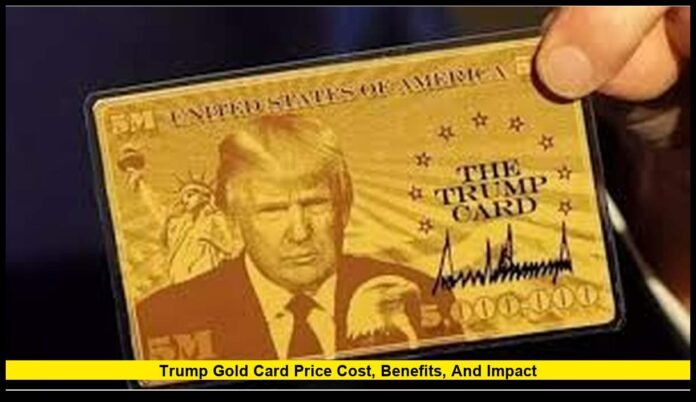

The Trump Gold Card price has officially been set at $1 million for individuals seeking residency in the United States. Launched in September 2025, the program represents one of the most dramatic shifts in U.S. immigration law in decades. Unlike traditional green cards or employment-based visas, the Gold Card offers a direct path for wealthy contributors and corporations ready to invest significant funds.
This move has sparked national debate. Supporters see it as an innovative way to bring in billions of dollars to the U.S. economy, while critics argue it favors only the ultra-rich and raises questions about fairness and legality.
In this detailed breakdown, we’ll cover everything you need to know about the Trump Gold Card price, its requirements, how it compares to existing visa programs, and what it could mean for the future of immigration in America.
What Is the Trump Gold Card?
The Trump Gold Card is a residency program that allows individuals and corporations to secure U.S. residency by making a large financial contribution. Unlike the EB-5 investor visa, which requires investments into projects that create jobs, the Gold Card centers solely on a monetary “gift” to the U.S.
The program was introduced through executive action in September 2025. Its launch marked a new era in immigration policy by prioritizing financial contribution over skills, family ties, or traditional investment projects.
Trump Gold Card Price and Payment Structure
The headline figure—the Trump Gold Card price of $1,000,000 per individual applicant—has attracted global attention, but the program’s payment system is more layered than a single number. The Trump administration has introduced multiple tiers to accommodate both individuals and corporations, while also unveiling a premium option for the ultra-wealthy.
1. Individual Applicants
For individuals, the requirement is straightforward: a direct contribution of $1 million to the U.S. Treasury. This payment is not considered an investment but a gift, meaning applicants do not need to tie their funds to a business venture, real estate project, or job-creation plan. In addition to the contribution, applicants must also pay a nonrefundable processing fee that covers administrative costs and federal review. Every individual undergoes full background and security vetting by the Department of Homeland Security and related agencies to ensure compliance with national security and financial integrity standards.
2. Corporate Sponsorship
A second pathway allows multinational corporations to sponsor foreign employees through the Gold Card program. Under this structure, companies must make a $2,000,000 contribution per sponsored worker. This option is designed to help global enterprises relocate executives, senior management, or specialized talent into the U.S. quickly, without being restricted by traditional visa quotas or lengthy labor certification processes. For corporations, this pathway offers a strategic tool to attract and retain top-tier talent in a competitive global market.
3. Platinum Card Option
At the top end of the program sits the Trump Platinum Card, a higher-tier residency pathway priced at $5,000,000 per applicant. Still in its rollout stage, the Platinum Card promises exclusive perks, such as longer allowable stays in the United States without triggering full tax residency on global income. Additional benefits under discussion include priority processing, reduced renewal requirements, and enhanced financial flexibility. Immigration experts suggest the Platinum Card could become the most prestigious residency option in the U.S., targeting billionaires and global families with diversified assets across multiple countries.
By creating this tiered payment structure, the Trump administration has positioned the Gold and Platinum Cards as more than just immigration tools—they are elite residency products, marketed to the world’s wealthiest individuals and corporations. The system is designed to generate substantial federal revenue while also providing a streamlined and predictable pathway to U.S. residency for those who can afford it.
How Does It Compare to Green Cards?
To understand the significance of the Trump Gold Card price, it helps to compare it with existing pathways:
| Program | Cost | Requirements | Path to Residency |
|---|---|---|---|
| EB-5 Visa | $800,000–$1,050,000 | Invest in U.S. project that creates 10+ jobs | Green Card after years of processing |
| Employment-Based Green Card | Filing fees + employer sponsorship | Based on skills, education, or demand | Green Card through quota system |
| Trump Gold Card | $1,000,000 contribution | Direct “gift,” background check, no job creation requirement | Residency fast-tracked |
The Gold Card is essentially a shortcut for the wealthy, bypassing many of the barriers that slow down other visa categories.
Why Was the Trump Gold Card Introduced?
The Trump administration has positioned the Trump Gold Card as a bold reform of the U.S. immigration system, designed to address long-standing challenges while unlocking new opportunities for economic growth. Unlike traditional pathways that often get bogged down by bureaucracy, the Gold Card introduces a direct, contribution-based model that aligns with the administration’s broader goals of efficiency, revenue generation, and global competitiveness.
1. Generating New Federal Revenue
At its core, the Gold Card is intended to serve as a significant revenue stream for the U.S. government. With contributions starting at $1 million per individual and scaling up to $5 million for the Platinum Card, the program has the potential to funnel tens of billions of dollars directly into the U.S. Treasury. These funds can be redirected into infrastructure, defense, healthcare, and other national priorities without raising taxes on American citizens.
2. Attracting Global Investors
The administration has also emphasized the importance of positioning the United States as a top destination for global investors and entrepreneurs. In an era where countries like Portugal, the UAE, and Singapore have gained traction with residency-by-investment programs, the Trump Gold Card ensures the U.S. remains competitive in attracting high-net-worth individuals and multinational corporations. By offering clear rules and faster processing, the U.S. is signaling that it welcomes global wealth and talent.
3. Simplifying Immigration
One of the strongest selling points of the Gold Card is its simplicity compared to traditional immigration routes. Employment-based green cards, the H-1B visa, and the now-defunct EB-5 investor program have long been criticized for slow timelines, complex requirements, and heavy backlogs. The Gold Card eliminates these barriers by focusing purely on contributions and background checks, creating a faster, more transparent pathway for those who qualify.
4. Supporting Corporate Needs
The Gold Card also offers direct advantages to corporations seeking to bring in specialized foreign talent. Instead of being constrained by H-1B quotas, labor certifications, or years of waiting, multinational companies can sponsor executives and skilled employees through straightforward contributions. This approach gives businesses greater flexibility and agility in relocating their top talent to the United States.
5. A Strategic Policy Shift
Beyond economics and efficiency, the Gold Card reflects a broader policy shift. By replacing the EB-5 program and prioritizing immediate financial contributions, the Trump administration is moving away from performance-based immigration models that relied on project success and job creation. In their place, the U.S. is adopting a contribution-first approach that provides certainty for applicants and guaranteed revenue for the government.
According to early projections, if uptake is strong, the Trump Gold Card could generate tens of billions of dollars in new revenue, reshaping both the immigration landscape and America’s role in the global competition for wealth and talent.
Benefits for Applicants
For those who can afford the Trump Gold Card price, the advantages are designed to be both practical and prestigious. By removing the complexities of older immigration pathways, the program delivers a clear set of benefits that appeal directly to the world’s wealthiest individuals and corporations.
1. Speed
One of the most attractive features of the Gold Card is its rapid processing timeline. Unlike the EB-5 visa or traditional employment-based green cards—which often involve years of backlogs, project reviews, and compliance checks—the Gold Card is structured to deliver approvals within months, not years. For global entrepreneurs and families who value certainty and time, this accelerated process is a game-changer.
2. Certainty
With the Gold Card, there is no obligation to invest in a specific business venture or create American jobs. Instead, the residency rights are tied solely to the applicant’s financial contribution and successful security clearance. This eliminates the risk of losing residency due to a failing project or unmet job-creation quotas, offering a level of predictability and stability that is rare in immigration programs worldwide.
3. Status Symbol
Beyond residency, the Trump Gold Card is marketed as a prestigious symbol of wealth and influence. Much like luxury real estate or exclusive club memberships, it signals elite status on the global stage. For high-net-worth individuals, the card represents more than just legal rights in the United States—it embodies access, exclusivity, and recognition as part of a select group with the means to secure one of the most premium residency options in the world.
4. Corporate Flexibility
Businesses also benefit under the corporate sponsorship pathway. Multinational companies can secure residency rights for key executives and specialized talent without navigating traditional visa quotas, labor certifications, or H-1B lottery caps. This flexibility allows corporations to relocate global teams more efficiently, giving them a competitive edge in a fast-moving global economy.
5. Lifestyle Advantages
For families, the Gold Card opens doors to world-class U.S. healthcare, education, and financial systems. It provides long-term security in one of the most stable economies in the world, while also allowing children access to leading universities and a strong foundation for future opportunities.
Concerns and Criticism
Despite its appeal to the wealthy, the Gold Card has raised major concerns:
- Equity Issues: Critics argue it creates a two-tiered immigration system where only the rich can bypass red tape.
- Legal Questions: Immigration law is typically set by Congress, leading some to question the executive authority behind the program.
- Transparency: Details about annual limits, application approval rates, and oversight remain unclear.
- Ethical Debate: Some worry this sends the wrong message—that American residency is for sale to the highest bidder.
Financial Impact of the Program
From a financial standpoint, the program could be transformative.
- Each individual Gold Card contributes $1 million to federal funds.
- Corporate-sponsored workers bring in $2 million each.
- The Platinum Card, at $5 million, adds even greater revenue potential.
If even 50,000 individuals applied, that alone could generate $50 billion in contributions. While those figures are projections, they illustrate the scale of potential income.
Who Is Likely to Apply?
The Trump Gold Card is not designed for everyday immigrants or middle-income applicants—it is deliberately targeted toward the global elite. By setting the financial bar at $1 million for individuals and $5 million for the Platinum option, the program positions itself as one of the most exclusive residency opportunities in the world. Likely applicants include:
1. High-Net-Worth Individuals from Key Regions
Wealthy individuals from Asia, the Middle East, and Europe are expected to make up the bulk of applicants. Many of these regions have a growing number of billionaires and ultra-high-net-worth families who see U.S. residency as both a security investment and a lifestyle upgrade. For these applicants, the Gold Card offers access to America’s financial markets, healthcare system, and global influence without the uncertainties tied to traditional immigration programs.
2. International Entrepreneurs and Investors
The program is also appealing to entrepreneurs and global investors who require maximum flexibility in where they live and conduct business. By removing the need to tie funds to a specific project, the Gold Card allows business leaders to continue their international ventures while maintaining secure residency in the U.S. For many, it represents a backup plan or “Plan B” residency, ensuring a stable foothold in America amid geopolitical or economic uncertainties in their home countries.
3. Wealthy Families Seeking Education and Lifestyle Opportunities
Elite families are another likely demographic. Parents may pursue the Gold Card to secure top-tier education opportunities for their children at American universities, while also enjoying access to U.S. healthcare, real estate markets, and lifestyle benefits. The program provides long-term stability, making it attractive to families who view the United States as the safest and most strategic location to anchor their future.
4. Corporations Relocating Executives or Specialists
Through the corporate sponsorship pathway, multinational companies can secure Gold Cards for their senior executives, managers, or specialized employees. This approach allows businesses to bypass strict visa quotas, labor certifications, and long processing times. For corporations expanding operations in the U.S., the program provides a faster, more predictable route to bring in global talent, giving them a competitive edge in an increasingly interconnected economy.
In short, the Gold Card is tailored for those with both the means and the motivation to secure residency in one of the world’s most influential countries. It is less about mass immigration and more about creating a premium gateway for global wealth and talent.
The Platinum Card: An Ultra-Elite Option
While the Trump Gold Card sets a high bar at $1 million, the Trump Platinum Card introduces an even more exclusive tier of residency. Designed specifically for the world’s ultra-wealthy elite, the Platinum Card is positioned as a premium offering that blends financial efficiency with unmatched lifestyle advantages.
Price:
The entry threshold for the Platinum Card is $5 million, making it one of the most expensive residency options ever introduced in the United States. This steep price point ensures that the program remains highly selective, appealing only to those with significant global wealth and influence.
Potential Benefits:
The Platinum Card is being promoted as offering unique financial and residency advantages beyond the Gold Card. Among the most notable is the ability to spend up to 270 days in the United States without triggering U.S. tax residency rules. For global billionaires, entrepreneurs, and investors with diversified international holdings, this feature provides significant tax efficiency. Early reports also suggest additional perks are under discussion, which may include priority processing, expedited renewals, concierge-level government services, and enhanced travel freedoms.
Target Audience:
The Platinum Card is tailored for ultra-high-net-worth individuals who demand more than just U.S. residency. These are applicants who seek greater freedom in structuring their finances, minimizing tax burdens, and ensuring long-term access to America’s stability and prestige. Families with global business empires and billionaires looking for a strategic U.S. base are expected to be the primary applicants.
Growing Buzz:
Though still in its rollout phase, the Platinum Card has already sparked significant interest among global billionaires and wealth managers. Immigration attorneys and financial advisors report that many clients are closely tracking updates, with early demand signaling that the Platinum tier could become one of the most coveted residency programs worldwide.
The Trump Platinum Card, in essence, goes beyond residency—it is a status symbol of global wealth, power, and exclusivity, positioning the U.S. as a premier destination for the world’s most financially influential individuals.
Political and Public Reactions
Reactions to the Trump Gold Card have been divided:
- Supporters:
- Praise it as bold and innovative.
- Emphasize the billions it could generate for U.S. infrastructure and programs.
- See it as a way to streamline a broken immigration system.
- Opponents:
- Call it unfair to ordinary immigrants.
- Argue it places money above merit, skills, or family unity.
- Warn of legal challenges in the courts.
The debate over the Trump Gold Card price is likely to remain a flashpoint in upcoming political battles.
Read Also-Trump Gold Card: A New Pathway to U.S. Residency Under President Trump
What the Trump Gold Card Price Means for the Future
By setting the Trump Gold Card price at $1 million, the administration has made a bold statement: access to U.S. residency is now being explicitly tied to wealth on an unprecedented scale. This move creates a premium tier of immigration, one that reframes the United States as not only a land of opportunity for workers and families but also as an exclusive destination for the world’s financial elite.
On one hand, supporters argue that this represents a welcome modernization. They view the Gold Card as a pragmatic solution that generates billions in new revenue without raising taxes on American citizens. By cutting through bureaucratic red tape and offering a direct pathway for wealthy individuals and corporations, the program is seen as a way to boost the U.S. economy, attract foreign capital, and strengthen America’s position in the global competition for talent and investment. For advocates, the Gold Card is less about inequality and more about ensuring that the nation benefits directly from those who have the means to contribute at the highest level.
On the other hand, critics warn that this model could deepen inequality within the immigration system. By making wealth the central requirement, the Gold Card risks sidelining hardworking professionals, students, and families who lack millions of dollars but who still contribute significantly to the U.S. economy and society. Some immigration experts argue that the program sets a precedent where residency becomes a commodity—reserved only for those who can pay, while leaving others stuck in backlogs or locked out entirely.
The broader implications are profound. The Gold Card may reshape how the world views access to America, positioning the U.S. alongside countries like the UAE, Monaco, and Singapore, which already offer residency-by-investment programs targeting global elites. At the same time, it challenges America’s traditional narrative as a nation built on opportunity for all, regardless of wealth or background.
In essence, the Trump Gold Card price signals a new era in U.S. immigration policy—one that prioritizes fiscal contributions over family ties, skills, or job creation. Whether this shift will be celebrated as forward-looking or criticized as exclusionary will depend on how the program unfolds and how widely it is adopted by the global elite.
Final Thoughts
The Trump Gold Card price has redefined the economics of immigration. At $1 million per individual and $2 million per corporate-sponsored worker, the program offers unprecedented opportunities for the wealthy while sparking intense debates about fairness and legality.
Whether the Gold Card becomes a permanent fixture of U.S. immigration or faces legal and political pushback remains to be seen. What’s certain is that it has already left a lasting mark on the conversation about who gets to call America home.
What’s your take? Do you think tying residency to wealth is a smart move or a step too far? Share your thoughts and let your voice be heard.