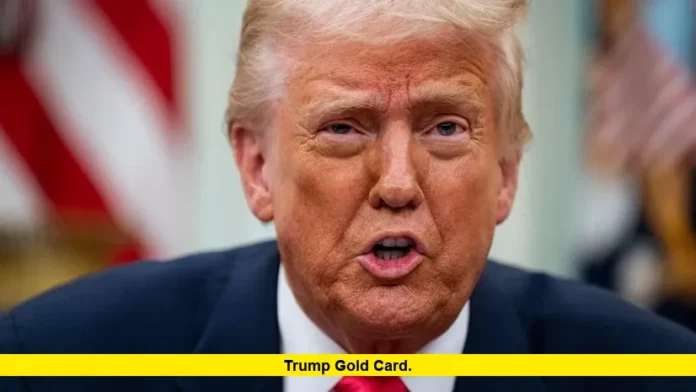

The Trump Gold Card has quickly become one of the most talked-about policy announcements in the United States. Introduced through an executive order signed by President Trump on September 19, 2025, the program is designed to offer a fast-track route to U.S. permanent residency in exchange for significant financial contributions. It represents one of the most sweeping changes in immigration policy in recent years and is already generating widespread attention, debate, and applications from around the world.
What Is the Trump Gold Card?
The Trump Gold Card is an immigration initiative that allows individuals to secure lawful permanent residency in the U.S. through a direct financial gift. Applicants can qualify by making a $1 million personal contribution. If the contribution is made by a corporation, business, or similar entity on behalf of an applicant, the required amount is $2 million.
Unlike older investment visa programs, the Gold Card does not rely on creating jobs or investing in specific projects. Instead, it treats the financial gift as evidence of “exceptional business ability” or proof that the applicant provides a benefit of national interest. This allows applicants to use existing visa pathways such as EB-1 and EB-2 while significantly speeding up the process.
How the Trump Gold Card Works
The Trump Gold Card is designed to balance simplicity with security, offering a streamlined pathway to U.S. residency while maintaining strict federal oversight. Unlike traditional visa categories, which often require years of waiting, extensive paperwork, and complicated eligibility requirements, the Gold Card focuses on a clear, contribution-based model. Here’s how the process works:
1. Application Portal
The federal government has launched a dedicated online portal where applicants can begin the filing process. This system centralizes all documentation and payments, reducing the need for in-person appointments and lengthy paper submissions. By moving the process online, the administration has sought to eliminate one of the most common frustrations in U.S. immigration—bureaucratic delays.
2. Processing Fee
In addition to the $1 million contribution (or higher for Platinum applicants), individuals must pay a nonrefundable processing fee. This fee covers administrative expenses tied to reviewing applications, handling background checks, and maintaining the online system. It also ensures that only serious applicants move forward, reducing bottlenecks in the pipeline.
3. Security Vetting
Every applicant undergoes comprehensive background and security checks led by the Department of Homeland Security (DHS), in coordination with other federal agencies. These checks include criminal record reviews, financial integrity assessments, and national security screenings. This step is designed to safeguard the program from abuse and ensure that only qualified, trustworthy applicants are granted entry.
4. Approval and Residency Status
Once the vetting process is complete, applicants receive either approval or denial based on eligibility and compliance. Approved applicants are granted permanent residency documentation, which provides the right to live, work, and study in the United States indefinitely. This residency carries many of the same rights as a traditional green card, but without the lengthy wait times or restrictive conditions.
5. A Streamlined Alternative
The biggest advantage of the Trump Gold Card lies in its efficiency. While employment-based green cards, family reunification visas, and the now-defunct EB-5 investor program often required years—sometimes even decades—of waiting, the Gold Card aims to process applications within months, not years. For high-net-worth individuals, this speed and certainty make it a uniquely attractive option.
By combining modern technology, strict vetting, and simplified requirements, the Trump Gold Card represents a fundamental shift in U.S. immigration policy. It provides a premium, fast-track pathway for the global elite to establish legal ties in America while ensuring the U.S. government receives direct and immediate financial contributions.
The Platinum Card Option
Alongside the Trump Gold Card, the administration has introduced an even more exclusive residency pathway—the Trump Platinum Card. This premium tier is targeted at the ultra-wealthy and is positioned as one of the most elite immigration offerings in the world.
Contribution Requirement
The entry price for the Platinum Card is set at a $5 million direct contribution to the U.S. Treasury. Unlike the Gold Card’s $1 million threshold, this higher price point ensures that only the global elite—billionaires, major investors, and prominent business families—are able to qualify.
Permanent Residency and Beyond
While Platinum Card holders enjoy the same core benefit of permanent U.S. residency, the program is designed to go further by offering exclusive incentives and financial advantages. It is marketed as not just a pathway to live and work in the United States, but a premium lifestyle product tied to wealth, influence, and international prestige.
Key Advantages
One of the most significant features is favorable tax treatment. Platinum Card holders can spend up to 270 days per year in the United States without being taxed on non-U.S. income. This is particularly appealing to global entrepreneurs, hedge fund managers, and investors with international assets, as it allows them to enjoy the benefits of living in America without triggering worldwide tax liabilities. Additional perks, still being finalized, may include priority application processing, expedited renewals, and enhanced mobility privileges.
Immediate Global Interest
Even though the program is still in its rollout stage, the Platinum Card has already generated strong interest among global billionaires and wealth managers. Immigration attorneys report that many of their high-net-worth clients are actively monitoring updates, viewing the Platinum Card as a strategic residency option that combines financial efficiency with long-term security in the United States.
In essence, the Trump Platinum Card elevates the residency-by-contribution model to a new level of exclusivity, positioning the U.S. as a premier hub for the world’s wealthiest individuals who seek both stability and tax-smart flexibility.
The End of the EB-5 Program
The introduction of the Trump Gold Card marks a decisive shift in U.S. immigration policy, coinciding with the phase-out of the long-standing EB-5 Immigrant Investor Program. For more than three decades, EB-5 served as the primary option for wealthy foreigners seeking U.S. residency through investment. Under its terms, applicants were required to invest a minimum of $800,000 into government-approved projects, typically large-scale real estate developments or regional economic initiatives. Beyond the financial threshold, applicants also had to prove that their investment directly created or preserved at least 10 full-time American jobs.
While the EB-5 program successfully attracted billions in foreign capital over the years, it also became notorious for delays, inefficiency, and fraud risks. Investors often faced years of waiting due to backlogs, while others lost money when projects failed to deliver on promises. Critics argued that the program lacked transparency and placed too much responsibility on applicants to ensure the success of private-sector projects they had little control over.
By replacing EB-5 with the Trump Gold Card, the administration is making the case for a simpler, faster, and more transparent system. Instead of tying contributions to specific developments or job-creation outcomes, the Gold Card requires a direct payment to the U.S. Treasury, ensuring that funds immediately benefit the federal government. This approach eliminates the uncertainty of project performance and removes the lengthy compliance process tied to job verification.
For applicants, the change represents a streamlined pathway to permanent residency, with approvals expected to take months rather than years. For the government, it guarantees immediate revenue without relying on the private sector to deliver jobs or economic outcomes. Supporters view the Gold Card as a bold modernization of investor immigration, while critics argue that it shifts the system too far toward exclusivity, making U.S. residency available only to the ultra-wealthy.
In essence, the end of EB-5 and the rise of the Gold Card highlight a paradigm shift: moving from a performance-based immigration model centered on investment and job creation to a contribution-based model centered on direct financial support for the United States.
Financial Impact on the United States
The Trump administration has positioned the Gold Card as not just an immigration reform, but also a revenue generator. By setting a clear contribution threshold, the program is expected to bring billions of dollars into federal coffers. Supporters argue that the policy is a win-win: the U.S. gains direct financial support while attracting successful business leaders, innovators, and investors.
Projected benefits include:
- Immediate financial inflows to the U.S. Treasury.
- Increased spending in real estate, technology, and consumer markets from new residents.
- Strengthened global perception of the U.S. as an attractive place to live and invest.
Read Also-Trump Gold Card Price: Cost, Benefits, and Impact on U.S. Immigration Policy
Criticism and Controversy
While the Trump Gold Card has strong support from business groups and financial leaders, it has also sparked debate. Critics argue that it creates a two-tiered immigration system where the wealthy can buy their way into the country while ordinary applicants continue to face backlogs. Others raise concerns about national security, emphasizing the need for rigorous vetting to prevent abuse of the program.
Despite these criticisms, the administration maintains that the program is lawful under existing immigration categories and will deliver measurable benefits to the American economy.
Connection to H-1B Changes
The Gold Card rollout comes alongside another major immigration change: new rules for the H-1B visa. Under the revised system, companies must now pay an annual fee of $100,000 per H-1B employee. The administration argues this measure discourages overreliance on foreign workers while pushing companies to hire more American employees. Together, the H-1B changes and the Gold Card initiative show a clear policy direction—favoring wealth and capital investment over traditional employment-based pathways.
Legal and Political Questions
Even with the executive order signed, questions remain about the long-term stability of the Trump Gold Card. Some legal experts believe aspects of the program could face challenges in court or Congress, particularly regarding its impact on existing immigration law. For now, however, the program is active, the application system is live, and wealthy individuals across the globe are preparing to apply.
Early Reactions
The response to the Trump Gold Card has been swift. Wealth managers, global investors, and immigration attorneys are already seeing a surge in inquiries. Some U.S. companies also view the program as a tool for attracting international talent with substantial resources. Meanwhile, advocacy groups warn that the program could erode fairness in the immigration system.
Public opinion appears divided. Supporters celebrate the boldness of the move, praising it as a way to both strengthen the economy and streamline immigration. Critics view it as an elitist shortcut. How this debate plays out in the months ahead may determine the program’s long-term viability.
What’s Next?
As of today, the Trump Gold Card is officially open for applications. The administration has not announced any annual cap on the number of cards available, though officials may adjust rules as demand increases. Updates are expected in the coming months regarding processing timelines, approval statistics, and the demographic breakdown of applicants.
For individuals seeking permanent residency, the Gold Card represents a once-in-a-generation opportunity. For the United States, it is a policy experiment that could reshape the future of immigration.
Final Thoughts
The Trump Gold Card has already redefined the conversation around U.S. immigration. Whether it becomes a lasting program or a politically contested flashpoint, its launch is a milestone moment. Do you think this program strengthens America’s future, or does it risk creating a system only for the wealthy? Share your views below.