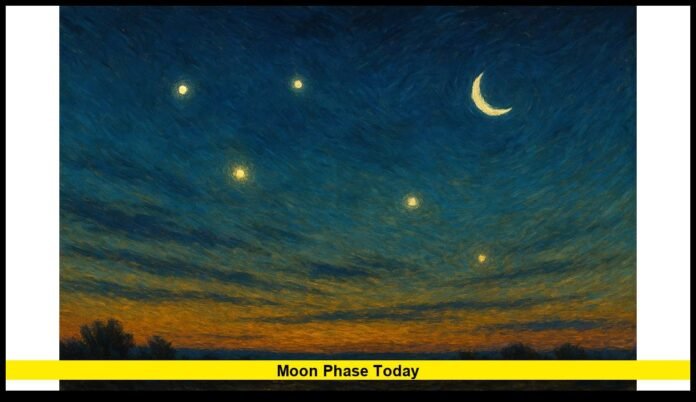

Moon phase today is a waning crescent, glowing faintly with about 6% illumination in the pre-dawn sky. On this date, September 19, 2025, the Moon is reaching the final stretch of its monthly cycle. For early risers and stargazers, the crescent offers a subtle but breathtaking display, especially as it appears alongside Venus and the star Regulus.
Unlike the dazzling brightness of a full moon, the waning crescent whispers its beauty—quiet, delicate, and fleeting. Yet this phase holds significance both astronomically and culturally, marking a transition toward the New Moon on September 22, 2025.
Understanding the Waning Crescent Phase
The Moon passes through a cycle lasting about 29.5 days, shifting from New Moon to Full Moon and back again. The waning crescent arrives at the tail end of this sequence.
Key details for September 19, 2025:
- Phase: Waning Crescent
- Illumination: Roughly 6.2%
- Position: Rises shortly before sunrise, low in the east
- Next Phase: New Moon on September 22, 2025
At this stage, the Moon is positioned nearly between Earth and the Sun. Because of this alignment, only a slim curve of reflected sunlight is visible. The rest of the lunar disk remains in darkness, faintly lit by a phenomenon called Earthshine.
What Makes the Waning Crescent Unique
Each lunar phase carries its own personality. The waning crescent is sometimes overshadowed by the more photogenic full moon, but it offers distinctive experiences:
- Soft Glow: Its delicate curve adds a sense of mystery to the dawn sky.
- Perfect for Stargazing: With less moonlight flooding the atmosphere, stars and planets become easier to spot.
- Enhanced Shadows on the Moon: The angle of sunlight reveals fine details in craters, mountains, and valleys near the lunar edge.
For those with telescopes or even binoculars, the waning crescent reveals lunar textures in dramatic contrast.
The Waning Crescent and Venus Occultation
What makes today’s waning crescent particularly exciting is its close dance with Venus, often called the “morning star.” On September 19, 2025, in certain regions, the Moon will actually cover Venus, creating an occultation.
- Regions with Occultation: Asia, Europe, parts of Africa, Canada, Greenland, and Russia.
- Visual Impact: To the eye, Venus will disappear behind the Moon’s edge, only to reemerge minutes later.
- Conjunction Elsewhere: In areas where occultation is not visible, the Moon and Venus will appear very close together, less than a degree apart.
Adding to the spectacle, Regulus, the brightest star in Leo, forms a trio with the Moon and Venus. Together, they create a rare and stunning arrangement in the dawn sky.
Observing Moon Phase Today
Watching the waning crescent is all about timing and preparation.
- Best Time: Around two hours before sunrise, when the Moon is just above the eastern horizon.
- Viewing Direction: Look east to east-northeast.
- Tools: Naked eye viewing is enough, but binoculars reveal finer details. A small telescope highlights craters and lunar rilles with striking clarity.
- Bonus Tip: In darker areas away from city lights, you may also catch a glimpse of Earthshine—a subtle bluish-gray glow on the Moon’s shadowed portion.
Lunar Features Visible in the Crescent
The waning crescent offers some of the most dramatic shadows on the Moon. Today, observers might notice:
- Grimaldi Crater: A dark basin near the equator, best seen when sunlight grazes its rim.
- Bailly Crater: One of the Moon’s largest craters, heavily eroded but beautifully detailed in this light.
- Rimae Sirsalis: A long lunar channel, visible as a dark line stretching across the surface.
- Southern Polar Features: Craters like Drygalski show up in striking relief.
These areas appear sharper than they do under the full moon, where light floods the surface and flattens shadows.
Cultural and Historical Significance
Throughout history, the waning crescent has symbolized endings, reflection, and preparation for renewal. In many lunar-based calendars, the sighting of the crescent determines the close of a month.
- Islamic Calendar: The crescent moon plays a crucial role in marking months, especially significant for festivals and observances.
- Chinese and Hindu Traditions: The lunar calendar also influences religious ceremonies and harvest festivals, with crescent sightings guiding rituals.
- Folklore: In some cultures, the waning crescent is seen as a time to let go of old habits and prepare for new beginnings.
Even in modern times, the symbolism of this phase resonates—closing cycles, resting, and preparing for fresh starts.
Scientific Insights from the Crescent Phase
The waning crescent is more than just a beautiful sight; it offers valuable scientific data:
- Earthshine Studies: By measuring the glow on the dark side of the Moon, scientists learn about Earth’s reflectivity, which connects to climate monitoring.
- Lunar Geography: The angle of sunlight provides excellent conditions for mapping craters, valleys, and mountain ranges.
- Planetary Alignment Research: Observing events like occultations helps astronomers refine orbital calculations of both the Moon and planets.
This shows how even the faintest lunar phases contribute to science and discovery.
Global Viewing Highlights
Where you are in the world determines exactly what you’ll see of the waning crescent today.
- India and Asia: A faint but visible crescent before sunrise, with a chance to witness the Moon close to Venus.
- Europe and Africa: Skywatchers enjoy one of the best views of the Moon–Venus pairing, with occultation in select areas.
- North America: In parts of Canada and Greenland, observers can watch Venus slip behind the Moon.
- Southern Hemisphere: The crescent appears inverted compared to the Northern Hemisphere view, creating a unique perspective.
This worldwide visibility makes the September 19 waning crescent an event for everyone to enjoy.
Upcoming Phases After September 19, 2025
Here’s the timeline for the Moon’s next transformations:
- September 22 – New Moon: The lunar disk becomes invisible, resetting the cycle.
- September 29 – First Quarter: Half of the Moon will shine, excellent for viewing craters and highlands.
- October 6 – Full Moon: The Moon turns brilliant and round, lighting up the entire night sky.
These phases highlight the ongoing rhythm of the Moon, a cycle humans have followed for thousands of years.
Link to the Solar Eclipse
The waning crescent phase also sets the stage for a partial solar eclipse on September 21, 2025. This event happens because the Moon moves between the Earth and Sun, and the nearly New Moon alignment is essential for eclipses to occur.
Thus, today’s crescent is not just a sky treat—it’s part of a larger celestial drama unfolding this month.
Tips for Photographing the Waning Crescent
Photographers often love the challenge of capturing this delicate phase. Here are some tips:
- Use a Tripod: Even slight hand movements can blur images of the thin crescent.
- Low ISO Setting: Keeps the image clean and reduces noise.
- Zoom Lens or Telescope Adapter: Helps capture lunar features in detail.
- Include the Horizon: A crescent above trees, mountains, or buildings creates dramatic compositions.
With Venus so close, wide-angle shots of the trio (Moon, Venus, and Regulus) can make stunning sky portraits.
Why You Shouldn’t Miss Today’s Crescent
The moon phase today is not just another date in the lunar calendar. It offers a rare blend of:
- A fragile, beautiful crescent.
- The chance to witness Venus disappearing behind the Moon in some parts of the world.
- An introduction to the upcoming New Moon and solar eclipse.
It’s a reminder that even the quieter moments in the sky have their own power and elegance.
Final Thoughts
Moon phase today, September 19, 2025, is a gentle waning crescent with only 6% of the surface lit. Though small in appearance, it delivers a grand spectacle thanks to its pairing with Venus and Regulus. Whether you’re an astronomer, a cultural observer, or someone who simply enjoys the serenity of the night sky, today’s Moon offers something to cherish.
As the lunar cycle closes and prepares to begin anew, perhaps it’s the perfect time for reflection. Will you step outside to catch a glimpse of the slender crescent, or wait for the fresh darkness of the New Moon?