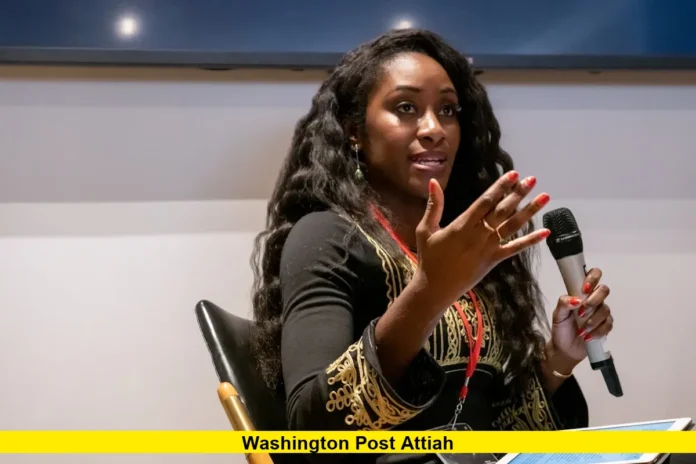

Washington Post Attiah has become one of the most talked-about stories in U.S. media this week. Karen Attiah, a well-known opinion columnist at The Washington Post, confirmed that she was fired after sharing a series of social media posts in response to the death of conservative activist Charlie Kirk. Her dismissal has sparked national debate about free expression, race, and the boundaries of newsroom policies in an era where social media drives much of the conversation.
Karen Attiah’s Firing
Karen Attiah revealed that her termination was tied directly to comments she made online after Kirk was killed. In her posts, Attiah criticized what she described as double standards in America’s reaction to political violence and gun culture. She argued that the public displays of grief and mourning for Kirk overlooked his own controversial rhetoric and that this imbalance reflects deeper systemic issues around race and justice.
According to Attiah, leadership at The Washington Post labeled her remarks “gross misconduct” and accused her of jeopardizing the physical safety of her colleagues. She strongly denies those allegations and insists she was expressing her moral and journalistic right to highlight uncomfortable truths. Attiah also stated that she was dismissed without any prior conversation or opportunity to clarify her position.
A Shift Inside The Washington Post
The firing of Washington Post Attiah did not happen in isolation. It comes during a period of editorial transition at The Post. Under the new direction of Opinion Editor Adam O’Neal, the opinion section has been shifting its focus toward themes of personal liberty, markets, and what insiders describe as a “recalibrated” editorial tone. Attiah had previously clashed with O’Neal about content boundaries, which raises questions about whether the firing reflected more than just her posts.
Observers note that Attiah was the last full-time Black opinion columnist at the paper. Her exit leaves a significant gap in representation, a fact that she has highlighted in her own statements. She argues that her removal contributes to a broader pattern of silencing diverse voices in American media institutions.
The Social Media Posts at the Center
The controversy centers on a string of posts Attiah published shortly after news broke of Charlie Kirk’s death.
- She criticized America’s culture of excessive mourning for figures who, in her view, contributed to divisive rhetoric.
- She emphasized that the nation often shows more compassion for white male political figures than for marginalized groups affected by violence.
- In one of the most widely shared posts, she referenced a remark Kirk allegedly made about prominent Black women, framing it as part of her broader critique of racial hypocrisy.
Attiah maintains that her comments were rooted in facts and moral principle, while her critics argue the tone was insensitive given the timing.
The Broader Fallout in Media
Karen Attiah is not the only figure facing consequences after the Kirk shooting. Across major institutions, employees, commentators, and academics have been disciplined or fired for how they addressed the tragedy on public platforms. The debate is intensifying over how far individuals can go in offering criticism without breaching workplace policies.
This moment highlights a tension in modern journalism: opinion writers are hired for their voice and perspective, yet they remain bound by employer standards that often tighten during moments of national crisis. Attiah’s dismissal illustrates how social media can quickly turn into a professional minefield, especially when commentary intersects with politics, race, and violence.
Reactions to Attiah’s Firing
Public reaction has been sharply divided. Supporters argue that Attiah raised valid concerns about systemic bias and that punishing her for doing so undermines press freedom. Critics counter that The Washington Post was within its rights to enforce professional standards, especially when public statements could affect staff safety or inflame tensions.
Civil rights advocates point to the deeper issue of diversity in media. Losing the last Black opinion columnist at a major national newspaper sends, in their view, a discouraging message about inclusion and the willingness of powerful institutions to tolerate uncomfortable critiques of race and politics.
Inside the journalism world, the firing has reignited long-running debates: Are columnists employees bound to corporate rules, or independent voices granted latitude to challenge power even if it risks backlash?
Issues Raised by the Case
The firing of Washington Post Attiah brings several major issues into sharper focus:
- Free Speech vs. Workplace Policy
How much freedom should opinion writers have to voice controversial takes without fear of professional consequences? - Editorial Direction
With new leadership steering The Post’s opinion section, does this signal a narrowing of ideological diversity? - Representation and Diversity
What message does it send when one of the last high-profile Black female voices at a leading paper is dismissed after speaking about race? - Social Media Boundaries
Are the standards for misconduct clear, or are they being applied inconsistently depending on the individual and the political climate?
Why the Story Resonates
This case resonates far beyond one columnist or one newspaper. It cuts into the heart of how America manages its debates over race, violence, and politics in a digital age. Karen Attiah’s firing is being closely watched by other journalists, academics, and corporate employees who also navigate the thin line between personal expression and institutional policy.
It also speaks to the fragility of representation. When the voices of minority writers are removed during moments of national crisis, it fuels perceptions that diverse perspectives are tolerated only when convenient. For many, that is the most troubling takeaway.
Looking Ahead
Karen Attiah has made clear she will continue to write and speak publicly, likely through independent platforms. She has already framed her firing as part of a broader cultural battle over who gets to critique America’s power structures and how. Meanwhile, The Washington Post faces ongoing scrutiny over whether its decision was about policy enforcement or about silencing a dissenting voice.
As the dust settles, the Attiah case will likely become a reference point in media ethics debates for years to come. It forces both journalists and readers to wrestle with difficult questions: What should the limits of opinion writing be? Who decides those limits? And at what cost to representation and public trust?
The Washington Post Attiah story has stirred powerful emotions and debates. Whether you see the firing as justified or as an overreach, it raises questions that touch the future of journalism, free speech, and representation in America. What do you think about where the line should be drawn? Share your thoughts and let the conversation continue.