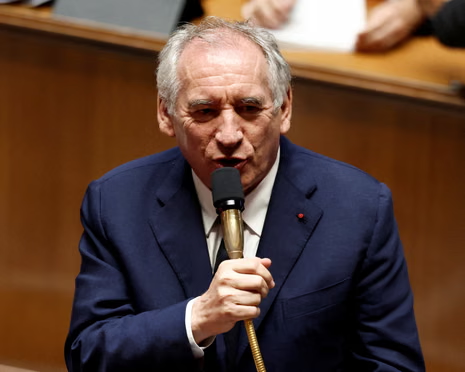

The French government prime minister, François Bayrou, has been forced out of office after a dramatic no-confidence vote in the National Assembly. The decision, delivered on September 8, 2025, marks another major upheaval for President Emmanuel Macron, who now faces the difficult task of appointing a new head of government amid deep political instability.
France, Europe’s second-largest economy, has endured repeated shakeups in leadership over the past two years, and this latest development signals a growing crisis at the heart of French politics. For audiences in the United States, the turmoil carries global significance, as France plays a critical role in NATO, the European Union, and the global financial system.
A Stunning Fall for the Prime Minister
François Bayrou, who took office in December 2024, had promised to stabilize the country’s fractured political landscape. Instead, his government collapsed in spectacular fashion when lawmakers rejected his controversial budget package.
The vote in the National Assembly was decisive: 364 lawmakers opposed Bayrou, while only 194 supported him. This overwhelming defeat left him with no choice but to resign, making him the fourth French prime minister to fall under President Macron since early 2023.
For Macron, the constant turnover in leadership has become a glaring symbol of political fragility. Each appointment has been met with hope for renewal, only to unravel within months due to mounting pressure from both the left and the right.
The Budget Gamble That Backfired
At the center of Bayrou’s downfall was his bold but divisive budget plan. Designed to reduce France’s public debt—now hovering around 114% of GDP—the proposal called for sweeping spending cuts. Among the most controversial measures were:
- Elimination of certain public holidays.
- Freeze on government hiring and spending increases.
- Reduction of subsidies for local governments and cultural programs.
- Austerity measures affecting pensions and social benefits.
Bayrou’s strategy was uncompromising. Rather than negotiate with opposition parties, he staked his government’s survival on a confidence vote. This gamble, however, ended in a crushing defeat, as lawmakers across the political spectrum united against what they described as an “unrealistic and unfair” plan.
Why It Matters Beyond France
For U.S. readers, the downfall of the French government prime minister is more than just a domestic issue in Europe. France is a central player in global politics, and its internal instability carries ripple effects far beyond its borders:
- Global Markets: France’s debt crisis and political turmoil affect investor confidence in the euro, with potential consequences for U.S. financial markets.
- NATO and Security: As a key NATO ally, France’s ability to maintain leadership in European defense is crucial at a time of heightened tensions with Russia.
- Diplomatic Challenges: France has been a vital partner for the United States in addressing crises in Ukraine, the Middle East, and Africa. Leadership uncertainty weakens its capacity to act decisively.
- Energy and Trade: French policy decisions directly influence EU-wide stances on energy security, climate policies, and trade agreements—all areas of interest to Washington.
The political crisis in Paris, therefore, is not an isolated drama but a development with international stakes.
Macron’s Dilemma: What Comes Next?
President Emmanuel Macron now finds himself under enormous pressure. With Bayrou gone, he must quickly select a new prime minister capable of surviving France’s turbulent political environment. The challenge is steep, given that no party holds a clear majority in the National Assembly.
Macron’s options are limited:
- Appoint another centrist ally: But repeated attempts at this strategy have failed.
- Seek a coalition partner: Yet deep ideological divides make cross-party cooperation unlikely.
- Call for new elections: A risky move, as polls suggest far-right leader Marine Le Pen could gain ground.
Each path comes with heavy risks. For Macron, whose presidency has been weakened by years of strikes, protests, and declining approval ratings, the wrong move could accelerate the erosion of his political authority.
A Nation in Political Deadlock
The collapse of Bayrou’s government is not just about one man—it reflects deeper structural problems in French politics. Since losing his parliamentary majority in 2022, Macron has struggled to pass legislation without resorting to constitutional workarounds.
Key points of the current crisis include:
- Four prime ministers ousted in less than two years.
- No stable governing majority in the National Assembly.
- Mounting public unrest, with regular strikes and demonstrations.
- Budget gridlock, as lawmakers refuse to accept austerity measures.
For many French citizens, the political chaos has eroded trust in the system. Analysts warn that unless stability is restored soon, France could face prolonged paralysis that undermines both domestic governance and its role on the global stage.
Implications for Europe and the United States
France’s instability raises serious questions about the future of European unity. As one of the EU’s strongest voices, France has traditionally partnered with Germany to set the direction for the bloc. Yet with Paris consumed by political turmoil, that leadership role is weakened.
For the United States, the timing is particularly sensitive. Washington depends on French cooperation in areas such as:
- Coordinated sanctions against Russia.
- Counterterrorism operations in Africa.
- Climate negotiations at the international level.
- Defense commitments within NATO.
Uncertainty over who will be the next French government prime minister makes it harder for allies to plan long-term strategies with Paris.
Political Instability at a Glance
| Issue | Current Situation |
|---|---|
| Public Debt | Around 114% of GDP, among the highest in the EU |
| Budget Plan | €44–€52 billion in proposed cuts, rejected |
| Vote Outcome | Confidence lost, 364 against vs. 194 in favor |
| Macron’s Options | Appoint new PM, seek coalition, or call elections |
| Public Sentiment | Rising anger, protests, and calls for change |
A History of Rapid Turnover
Since 2023, France has seen an unprecedented rate of prime ministerial turnover. Elisabeth Borne, Gabriel Attal, and Michel Barnier all served short-lived terms before Bayrou’s appointment in late 2024. Each fell victim to the same problem: an inability to secure enough support in the National Assembly.
Bayrou’s ouster highlights how fragile Macron’s presidency has become. Despite winning re-election in 2022, his weakened parliamentary standing has left him dependent on fragile alliances and vulnerable to frequent no-confidence votes.
Looking Ahead
In the coming days, all eyes will be on President Macron’s next move. He has two weeks to appoint a new prime minister, though the process may be delayed by behind-the-scenes negotiations. The choice he makes will be crucial not just for France but for its partners abroad.
If Macron chooses a caretaker figure, political paralysis may continue. If he risks dissolving the Assembly and calling new elections, France could see even more dramatic shifts in power. For the United States and its allies, the outcome will determine whether France remains a reliable partner during a time of global uncertainty.
Final Thoughts
The fall of François Bayrou as French government prime minister underscores the depth of France’s political crisis. What happens next will shape not only the country’s future but also its role on the world stage. With global markets, NATO security, and international diplomacy at stake, the repercussions extend well beyond Europe.
France now stands at a crossroads, and the decisions made in Paris in the coming weeks will resonate far and wide. Stay tuned and share your perspective on how this turning point in French politics might influence the global balance.