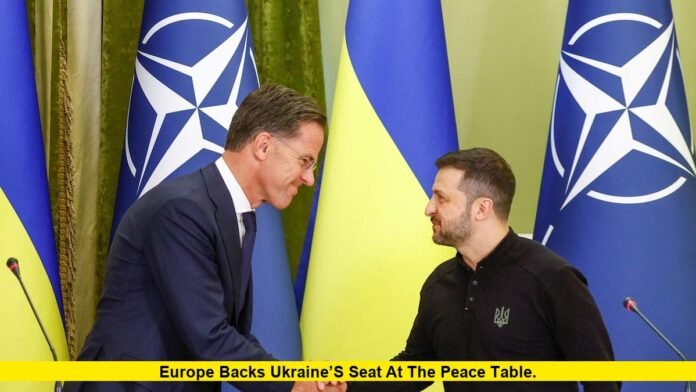

European leaders are sending a clear signal ahead of high-stakes negotiations: Ukraine must be directly involved in any peace talks about the war. The stance comes as diplomatic activity intensifies in the run-up to a planned meeting between U.S. and Russian leaders, where potential settlement terms are expected to be discussed.
Kyiv’s Role Becomes a Red Line
For weeks, speculation has swirled that a major powers’ deal could be struck without Ukraine physically at the table. That idea has now met firm resistance. European officials argue that any credible agreement requires not just consultation with Kyiv but its active participation in every stage of the process.
President Volodymyr Zelenskyy has been equally blunt, stating that no plan involving the ceding of Ukrainian territory will be accepted. His government maintains that excluding Kyiv from talks would not only undermine the legitimacy of any agreement but could also embolden Moscow to push for terms that ignore Ukraine’s security needs.
Coordinated Diplomatic Push
In recent days, senior European ministers have met with Ukrainian representatives to align on a unified counterproposal to Russian ceasefire suggestions. Their shared position outlines:
- A ceasefire before negotiations begin, to stop civilian casualties.
- Reciprocal military withdrawals rather than unilateral land handovers.
- Binding international security guarantees for Ukraine.
- Continued economic and military support until a durable settlement is reached.
This approach is designed to counter what they see as a dangerous shortcut: freezing the conflict through concessions, which could leave Ukraine vulnerable to renewed attacks in the future.
Russia’s Offer Rejected
Moscow’s latest signals suggest it wants a ceasefire tied to Ukraine surrendering control of certain occupied regions. While such a deal might quickly stop the fighting on paper, European and Ukrainian officials warn it would set a precedent that territory can be seized by force.
The consensus emerging in European capitals is that any settlement must be balanced — halting the war while preserving Ukraine’s sovereignty. Otherwise, the conflict could merely pause, only to reignite under worse conditions.
The Broader Strategic Picture
This diplomatic moment reflects deeper strategic currents. For Europe, backing Ukraine’s full involvement is about more than solidarity — it’s about shaping the post-war order. If Ukraine’s voice is sidelined, it would signal that smaller nations’ fates can be decided over their heads, a message many European states find unacceptable given their own histories.
There’s also the question of trust. Ukraine’s armed forces have fought for more than two years to defend their territory. Negotiating a settlement without them would risk alienating the very people tasked with implementing and upholding it.
Fighting Continues as Talks Advance
On the ground, clashes persist along multiple frontlines. Drone and artillery exchanges continue, with both sides reporting interceptions and strikes. For civilians in contested regions, these daily dangers underscore why a robust, enforceable agreement — rather than a rushed political deal — is so critical.
The urgency of diplomacy is matched by the reality of war. Every day without a formal ceasefire risks more loss of life, yet every poorly constructed peace risks collapse.
Analysis: Why Inclusion Matters
Insisting on Ukraine’s presence in peace talks is not just symbolic — it’s a safeguard. Without direct participation, there’s no guarantee that the terms agreed will reflect Kyiv’s priorities or address its security threats.
Past conflicts show that agreements made without the affected nation’s full buy-in often unravel quickly. In this case, exclusion could leave Ukraine with obligations it never consented to, while Russia could claim legitimacy for gains made through force.
For Europe, this is also about credibility. Having pledged unwavering support, leaders now need to ensure that their backing translates into real influence over the outcome. Allowing others to dictate terms without Ukraine present would undermine years of diplomatic and material investment.
As the upcoming U.S.–Russia meeting approaches, Europe’s message is unmistakable: Ukraine’s future cannot be decided in absentia. The question now is whether that principle will hold when the world’s most powerful negotiators sit down at the table.
For those following the conflict, the coming days could prove decisive — and worth watching closely. Share your views on whether this united front will be enough to secure both peace and justice for Ukraine.