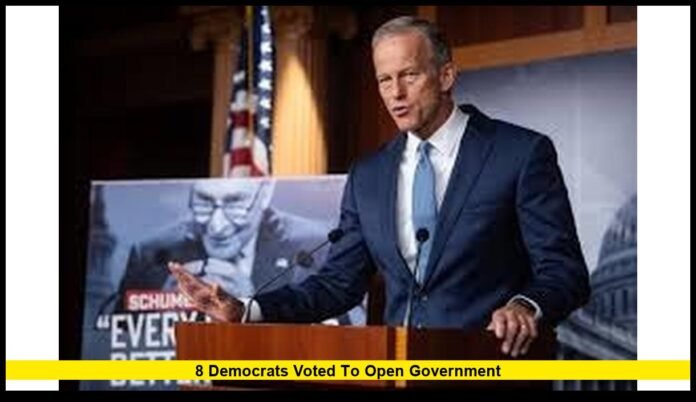

In a defining moment for Washington politics, 8 Democrats voted to open government, breaking from their party’s leadership to end a record-breaking federal shutdown. Their decision marks one of the most significant acts of bipartisanship seen in recent years—one driven by the urgent need to restore services, pay federal workers, and stabilize an economy shaken by weeks of government closure.
A Vote That Changed the Shutdown’s Course
Late Sunday, November 9, 2025, the Senate moved forward on a bipartisan government funding bill that would reopen shuttered agencies and provide back pay to hundreds of thousands of federal employees. The procedural vote succeeded with crucial support from eight Democratic senators who crossed party lines to join Republicans.
The bill includes temporary funding to operate federal agencies through January 30, 2026, ensuring that essential services—from food assistance programs to air traffic control—resume immediately. It also guarantees back pay for workers affected by furloughs and sets a date for a separate vote next month on extending key Affordable Care Act (ACA) tax credits.
The Eight Senators Who Broke Ranks
Here are the eight members of the Senate Democratic caucus who voted to advance the bill:
- Catherine Cortez Masto (Nevada)
- Jacky Rosen (Nevada)
- Jeanne Shaheen (New Hampshire)
- Maggie Hassan (New Hampshire)
- Tim Kaine (Virginia)
- Dick Durbin (Illinois)
- John Fetterman (Pennsylvania)
- Angus King (Maine, Independent who caucuses with Democrats)
Their votes created the margin needed to move the legislation forward, breaking through a weeks-long impasse that had left federal workers unpaid and many public services suspended.
Why These Democrats Crossed the Aisle
Each of these senators faced a difficult choice—whether to stand firm with party leadership or prioritize the economic toll of a continued shutdown. In statements after the vote, most pointed to one overriding concern: the growing hardship among their constituents.
For senators from states like Virginia and Illinois, where large numbers of federal workers live, the pressure to act was immense. In Nevada and Pennsylvania, business closures and delayed payments were hitting families hard. These senators framed their votes not as defiance, but as duty—arguing that reopening the government was the most responsible path forward.
Many also highlighted the inclusion of a December vote on ACA tax credits as a key factor. While the current bill did not extend the healthcare subsidies, it guarantees a vote before they expire, giving Democrats leverage to fight for the credits without holding the government hostage.
The Stakes and the Compromise
The vote represents both a victory and a compromise. By supporting the funding measure, the eight Democrats ensured immediate relief for workers and reopened public services—but they did so without securing all the policy guarantees progressives demanded.
| What the Democrats Achieved | What They Conceded |
|---|---|
| End to the shutdown and back pay for workers. | Delay in securing permanent ACA tax credit extensions. |
| Restoration of government services, including food aid and national parks. | Possible criticism from progressive groups for yielding leverage. |
| Demonstration of bipartisan cooperation during crisis. | Risk of internal party tension ahead of 2026 elections. |
The compromise reveals the tension between idealism and pragmatism that often defines Congress during high-stakes negotiations.
How the Vote Affects the Shutdown
The measure’s advancement signals the beginning of the end of the federal shutdown that began on October 1, 2025. With Senate approval achieved, the legislation now heads to the House, where both moderate Democrats and Republicans are expected to support final passage.
Once signed into law, the bill will:
- Reopen all federal agencies immediately.
- Provide back pay to furloughed workers.
- Resume critical services, including food assistance, air safety programs, and housing aid.
- Schedule a December vote on healthcare subsidies under the Affordable Care Act.
This sequence of actions will bring long-awaited relief to millions of Americans who have been caught in the shutdown’s economic ripple effect.
Inside the Political Fallout
The eight Democrats who voted yes are now at the center of a storm within their own party. Some progressives view the move as a premature compromise, arguing that Democrats should have held out for a stronger deal on healthcare and social policy.
However, moderates and centrists within the party have defended the decision, saying it demonstrates leadership and accountability. They point out that the shutdown’s prolonged effects—unpaid federal employees, delayed benefits, and economic strain—had become politically and morally untenable.
For these senators, the choice was clear: governance had to come before gridlock.
Profiles of the Eight Democrats Who Voted to Open Government
- Catherine Cortez Masto (Nevada): Emphasized the economic struggles facing Nevada families during the shutdown. She stated her vote was about “putting people above politics.”
- Jacky Rosen (Nevada): Noted that federal workers and small businesses in her state were suffering, and “every day of inaction was a day too long.”
- Jeanne Shaheen (New Hampshire): Helped negotiate the December vote on ACA subsidies and described reopening as a “necessary first step.”
- Maggie Hassan (New Hampshire): Supported bipartisan cooperation to ensure continuity of government and avoid deeper financial fallout.
- Tim Kaine (Virginia): Representing a state with tens of thousands of federal workers, he said his priority was “getting paychecks back in people’s hands.”
- Dick Durbin (Illinois): As the Senate’s second-ranking Democrat, his support for the bill added significant weight, signaling a shift toward pragmatic compromise.
- John Fetterman (Pennsylvania): Called the vote “a stand for working families” and urged Congress to focus on “real problems, not political games.”
- Angus King (Maine): Long known for his centrist approach, King emphasized bipartisan responsibility, saying, “The government belongs to the people, not the parties.”
The Bigger Picture: What This Means for Washington
This vote is more than a procedural step—it reflects a potential shift in how Congress approaches shutdowns and partisan deadlocks. For years, both major parties have used shutdown threats as leverage in policy fights. But the decision by these eight Democrats suggests that voters’ patience for political brinkmanship is wearing thin.
By choosing to act, these senators reinforced a message that governance must continue, even amid disagreement. Their decision may encourage more lawmakers to cross party lines in future funding battles, especially when ordinary Americans bear the brunt of inaction.
Potential Long-Term Impacts
- Restored public trust: Ending the shutdown may help rebuild faith in Congress’s ability to govern responsibly.
- Moderate momentum: The success of this bipartisan move could strengthen centrist influence within both parties.
- Future policy debates: The upcoming December vote on ACA subsidies will test how long this bipartisan spirit lasts.
- Electoral consequences: For the eight Democrats, this vote may boost support among independents and moderates but could invite primary challenges from progressives.
- Economic stability: Reopening the government restores confidence among businesses, federal contractors, and families dependent on federal programs.
A Defining Test for Party Unity
Within the Democratic Party, the decision by these eight senators underscores a growing divide between the progressive and centrist wings. Some Democrats insist that holding firm would have yielded stronger concessions, while others argue that extending the shutdown further would have damaged public faith in government.
Their choice has reignited an internal debate: Is compromise a sign of weakness—or of leadership? For now, the answer depends on what happens next in the House and whether the ACA vote materializes as promised.
Conclusion
When 8 Democrats voted to open government, they did more than help end a shutdown—they demonstrated that leadership sometimes means breaking from the crowd. Their votes reflected a belief that the nation’s needs come before partisan calculation, and that the cost of inaction had become too great.
In the weeks ahead, Washington will continue to debate whether this was bold pragmatism or political risk. But for millions of Americans returning to work and receiving long-delayed paychecks, the results are already tangible.
What do you think—did these eight senators make the right call, or should they have held out longer? Share your opinion below and stay informed as this story continues to unfold.