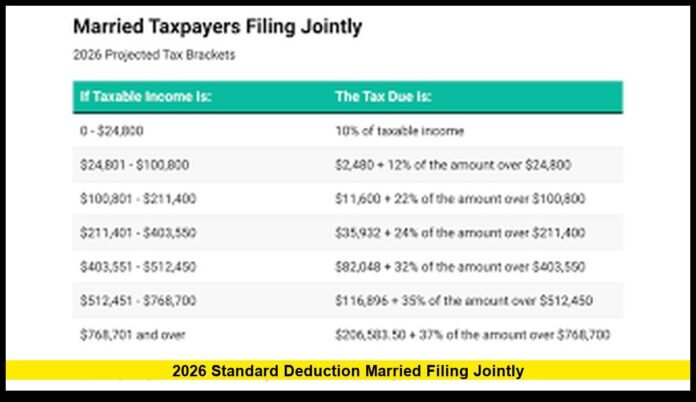

The 2026 standard deduction married filing jointly is a key federal tax figure that directly affects how much income married couples in the United States can shield from taxation. For the 2026 tax year, the confirmed standard deduction for married couples who file a joint return is $32,200, a figure shaped by inflation adjustments and federal tax law. This deduction applies to income earned during 2026 and impacts tax returns filed in 2027, making it one of the most important numbers for household tax planning.
For millions of married households, this deduction sets the foundation of their federal income tax calculation. It influences withholding decisions, budgeting strategies, retirement planning, and long-term financial choices. Understanding how it works, who benefits most, and how it fits into the broader tax structure is essential for accurate and stress-free filing.
Understanding the Standard Deduction for Joint Filers
The standard deduction is a fixed dollar amount that reduces adjusted gross income before federal income tax rates are applied. By choosing this option, married couples avoid the need to track and report individual deductible expenses such as medical costs, mortgage interest, or charitable contributions. For many households, this streamlined approach reduces paperwork while still delivering meaningful tax savings.
For married couples filing jointly, the standard deduction is set significantly higher than for single filers to reflect shared living costs and combined financial responsibilities. In the 2026 tax year, the standard deduction is $32,200, allowing couples to shield a substantial portion of their income from taxation before tax brackets are calculated. This adjustment reflects inflation-related increases designed to preserve purchasing power over time.
The deduction works by lowering taxable income rather than reducing tax owed dollar-for-dollar. While it does not generate a refund on its own, the impact can be considerable. A lower taxable income often means falling into a lower tax bracket or owing less tax overall, which is especially beneficial for households with steady wages, retirement income, or fixed earnings.
Additional benefits may apply in certain situations. Married couples where one or both spouses are age 65 or older or legally blind can qualify for extra standard deduction amounts, further increasing the income excluded from taxation. These enhancements make the standard deduction particularly valuable for retirees and older households.
Overall, the standard deduction remains a cornerstone of federal tax filing for joint filers. Its simplicity, inflation adjustments, and broad applicability continue to make it the preferred choice for many married couples seeking to reduce their tax burden without the complexity of itemizing deductions.
Confirmed 2026 Deduction Amount and Filing Status Context
For the 2026 tax year, the standard deduction amounts are structured by filing status to maintain balance and fairness across taxpayers. Married couples filing jointly receive the highest deduction among standard filing categories.
The key figures are:
- Married Filing Jointly: $32,200
- Single: $16,100
- Married Filing Separately: $16,100
- Head of Household: $24,150
The joint filer deduction is exactly double the single filer amount. This alignment helps prevent tax disadvantages related to marital status and ensures that households with two earners are not penalized under the tax system.
Why the 2026 Increase Matters for Married Couples
The increase in the standard deduction for 2026 plays an important role in protecting married couples from the effects of inflation. As everyday costs continue to rise—particularly for housing, healthcare, utilities, food, insurance, and transportation—household budgets are stretched even when income remains flat. Without inflation-based adjustments, couples could be pushed into paying more taxes simply because prices increased, not because they became more financially secure.
By raising the standard deduction, the tax code helps offset these pressures by allowing couples to exclude a larger portion of their income from taxation. This adjustment helps preserve purchasing power and ensures that families are not penalized for cost-of-living increases beyond their control. For many married households, the higher deduction results in noticeable tax savings, often amounting to several hundred dollars compared to earlier years, depending on income level and tax bracket.
The 2026 increase also makes tax filing simpler for a broader group of couples. With a higher standard deduction, fewer households find it beneficial to itemize deductions in order to lower their tax liability. This reduces complexity, paperwork, and the need to track detailed expenses throughout the year, while still delivering meaningful tax relief.
Overall, the increase reinforces the purpose of the standard deduction as a stabilizing tool in the tax system. It helps married couples manage rising costs, maintain financial balance, and benefit from a tax structure that adjusts alongside economic conditions rather than lagging behind them.
How the Deduction Reduces Taxable Income
The standard deduction reduces taxable income by lowering the portion of earnings that are subject to federal income tax. After gross income is calculated and adjustments are applied, the standard deduction is subtracted to arrive at taxable income. This step occurs before tax brackets are applied, making the deduction one of the most powerful tools for reducing overall tax liability.
For instance, if a married couple earns $90,000 in combined income during the 2026 tax year, subtracting the $32,200 standard deduction reduces their taxable income to $57,800. Federal tax rates apply only to this smaller amount, not the full earnings, which can significantly lower the total tax owed. In many cases, this reduction can also prevent a portion of income from being taxed at higher marginal rates.
This structure explains why the standard deduction often delivers more consistent value than individual deductions taken separately. Instead of relying on multiple smaller write-offs that may be limited or phased out, the standard deduction provides a guaranteed reduction in taxable income. For many married couples, especially those without large deductible expenses, this straightforward approach results in meaningful tax savings with minimal complexity.
Impact on Middle-Income and Working Families
Middle-income and working families often experience the greatest benefit from the standard deduction because their financial profiles typically do not support extensive itemized deductions. Limits on state and local tax deductions, fewer mortgage interest write-offs, and changing housing trends mean that many households in this income range gain more value from the flat standard deduction than from itemizing individual expenses.
For working families with children, the standard deduction plays an important supporting role alongside tax credits such as the child-related and education credits. By reducing taxable income upfront, the deduction can shift more earnings into lower tax brackets before credits are applied. This sequencing often results in a lower overall tax bill and can enhance the effectiveness of credits that depend on income thresholds.
This layered structure—deductions first, credits later—helps smooth tax outcomes for families balancing wages, childcare costs, education expenses, and everyday living needs. By lowering taxable income and supporting access to credits, the standard deduction contributes to greater financial stability and predictability for middle-income and working households navigating annual tax obligations.
Additional Deduction for Age and Blindness
Married couples filing jointly may qualify for additional standard deduction amounts if one or both spouses meet specific eligibility criteria related to age or visual impairment. For the 2026 tax year, an extra $1,650 deduction is allowed for each spouse who is age 65 or older or legally blind at the end of the tax year.
These additional amounts are applied on top of the base standard deduction and can significantly increase the total income excluded from taxation:
- If one spouse qualifies, the standard deduction increases by $1,650
- If both spouses qualify, the increase totals $3,300
When both spouses meet the requirements, the total standard deduction for 2026 rises from $32,200 to $35,500. This higher threshold allows older couples to protect more of their income before taxes are calculated.
This enhanced deduction is particularly valuable for retirees and near-retirees who rely on fixed or limited income sources such as Social Security, pensions, or withdrawals from retirement accounts. As healthcare expenses and living costs continue to rise with age, the additional deduction helps offset financial pressure and supports long-term household stability for older married couples.
Relevance for Retired and Near-Retirement Couples
For retired and near-retirement married couples, the standard deduction plays a central role in managing federal income taxes. Many retirees depend on a mix of Social Security benefits, pension payments, and withdrawals from retirement accounts, all of which can contribute to taxable income depending on total earnings and filing status. The standard deduction often offsets a substantial portion of this income, reducing the amount subject to taxation.
When combined with age-based additional deductions, the impact can be even more significant. In some cases, these deductions are large enough to reduce taxable income to very low levels or eliminate federal income tax liability altogether. This makes the 2026 standard deduction an essential consideration in retirement income strategies, particularly when deciding how much to withdraw from traditional retirement accounts each year.
Couples approaching retirement also benefit from using the standard deduction as a planning benchmark. Understanding how much income can be received before triggering federal taxes helps households time withdrawals, manage required distributions, and coordinate income sources more efficiently. By factoring the deduction into long-term projections, near-retirees can better anticipate future tax exposure and build more predictable, tax-efficient retirement plans.
Standard Deduction vs. Itemized Deductions in 2026
Married couples filing jointly in 2026 generally choose between the standard deduction and itemized deductions based on which option results in a lower tax bill. While itemizing is still available, it only provides an advantage when total eligible deductions exceed the $32,200 standard deduction. For many households, reaching that threshold has become increasingly difficult.
Itemized deductions may include expenses such as mortgage interest on qualifying home loans, eligible medical costs that exceed the applicable income threshold, approved charitable contributions, and certain casualty or disaster-related losses that meet strict requirements. However, many of these deductions are limited, capped, or subject to eligibility rules that reduce their overall value.
As a result, fewer married couples benefit from itemizing than in past decades. Caps on deductions and changes in housing and spending patterns mean that even households with mortgages and charitable giving often fall short of the standard deduction amount. For these couples, itemizing adds complexity without delivering additional tax savings.
Because of its size, reliability, and simplicity, the standard deduction remains the preferred choice for most married couples in 2026. It provides a guaranteed reduction in taxable income without extensive recordkeeping, making it both a practical and financially efficient option for joint filers.
Effect on Withholding and Tax Payments
The standard deduction plays an important role in determining how much federal income tax a married couple ultimately owes, which directly affects paycheck withholding throughout the year. Employers calculate withholding based on information provided on Form W-4, using default assumptions about filing status and deductions unless employees make adjustments. When withholding does not accurately reflect the standard deduction, the result can be underpayment or overpayment of taxes.
Married couples with two incomes are especially vulnerable to withholding mismatches. Without proper coordination, each employer may withhold as if their paycheck represents the household’s only income, leading to insufficient total withholding. Aligning withholding settings with the 2026 standard deduction helps ensure that taxable income is estimated correctly across both earners.
Reviewing withholding periodically—particularly after income changes, job switches, or major life events—can prevent surprises at tax time. Accurate withholding allows couples to meet their tax obligations without facing unexpected balances due or unnecessarily large refunds. By keeping more income available throughout the year, proper withholding also improves monthly cash flow and supports better day-to-day financial planning.
Relationship Between the Deduction and Tax Credits
The standard deduction and tax credits serve different purposes but work together within The standard deduction and tax credits play distinct but complementary roles in the federal tax system. The standard deduction reduces taxable income before tax rates are applied, while tax credits directly reduce the amount of tax owed after that calculation. When used together, they can significantly lower a married couple’s overall tax liability.
Married couples commonly benefit from several types of credits, including child-related credits, education-related credits, and incentives tied to retirement savings. Many of these credits are subject to income limits or phaseouts, meaning eligibility or credit value depends on reported income levels.
By lowering taxable income upfront, the standard deduction can help keep household income within qualifying ranges for these credits. This interaction increases the likelihood that couples receive the full value of available credits rather than reduced amounts. In practice, this layered structure—deductions first, credits second—allows married couples to maximize tax benefits while maintaining a simpler filing approach.
Filing Jointly Versus Separately
To receive the full 2026 standard deduction of $32,200, married couples must file a joint tax return. When spouses choose to file separately, each is limited to a $16,100 standard deduction, which is exactly half of the joint amount. This split often reduces the overall tax benefit available to the household.
In most cases, filing jointly results in a lower combined tax liability. Joint filers generally benefit from wider tax brackets, access to a broader range of credits, and more favorable phaseout thresholds. Filing separately may be appropriate in specific circumstances, such as managing separate financial liabilities or unique income considerations, but it commonly leads to higher total taxes and disqualification from several valuable credits.
Eligibility to file jointly is determined by marital status as of December 31, 2026. Couples who are legally married by the end of the year are treated as married for the entire tax year, regardless of when the marriage occurred. Understanding this distinction is essential when choosing the most tax-efficient filing status for the year.
Planning Ahead Using the 2026 Deduction
Early awareness of the 2026 standard deduction allows married couples to make informed financial decisions throughout the year rather than waiting until tax season. When couples understand how much income will be excluded from taxation, they can plan more effectively and reduce uncertainty around their final tax outcome.
- Adjusting retirement contributions:
Knowing the size of the standard deduction helps couples decide how much to contribute to retirement accounts such as employer plans or individual retirement accounts. By coordinating contributions with the deduction, couples can better control taxable income and potentially stay within lower tax brackets. - Timing income and expenses:
The standard deduction provides a benchmark for planning when income is received or expenses are paid. Couples may choose to delay or accelerate certain income or deductible expenses to ensure more earnings fall within the income protected by the deduction. - Reviewing eligibility for credits:
Many tax credits depend on income thresholds. Because the standard deduction reduces taxable income before credits are applied, understanding its impact helps couples determine whether they are likely to qualify for child-related, education, or retirement-related credits. - Aligning withholding with expected tax outcomes:
Using accurate deduction figures allows couples to adjust payroll withholding so it better reflects their expected tax liability. Proper alignment helps avoid unexpected balances due at filing time and prevents over-withholding that could strain monthly cash flow.
Using current and accurate standard deduction figures improves financial forecasting, supports better cash-flow management, and reduces surprises during the filing season.
Common Misconceptions About the Standard Deduction
Many taxpayers misunderstand how the standard deduction works, which can lead to missed planning opportunities or incorrect assumptions during filing. One common misconception is that the standard deduction is intended only for low-income households. In reality, it applies across a wide range of income levels and provides meaningful benefits to middle-income, higher-income, and retired households alike.
Another frequent misunderstanding is the belief that claiming the standard deduction replaces or cancels out other tax benefits. The deduction does not eliminate eligibility for tax credits, income adjustments, or retirement-related incentives. Instead, it operates earlier in the tax calculation process by reducing taxable income before credits and other benefits are applied.
Some taxpayers also assume that itemizing deductions is always more advantageous or more “advanced” than taking the standard deduction. For many married couples, especially under the 2026 limits, the standard deduction delivers greater tax savings with far less complexity. A clear understanding of how the standard deduction fits into the broader tax structure leads to more informed decisions, fewer filing errors, and better overall tax outcomes.
Why Staying Updated Matters
Tax figures such as the standard deduction are adjusted regularly, often on an annual basis, to reflect economic conditions and inflation. Relying on outdated deduction amounts can lead to inaccurate tax estimates, flawed financial projections, and missed planning opportunities. Even small discrepancies can result in unexpected tax bills or inefficient use of income throughout the year.
Staying informed about the confirmed 2026 standard deduction ensures that married couples base their decisions on accurate and current information. Whether estimating tax liability, adjusting withholding, or planning retirement contributions, using the correct deduction amount supports better budgeting and financial forecasting.
Accurate knowledge of current tax figures allows households to plan with confidence, avoid surprises during filing season, and make informed choices that align with their long-term financial goals.
Long-Term Significance of the 2026 Deduction
The 2026 standard deduction for married couples filing jointly represents a continuing effort to keep the tax system aligned with real-world economic conditions. By adjusting the deduction to account for inflation and rising living costs, the tax code helps prevent households from paying higher taxes simply due to changes in prices rather than increases in actual purchasing power.
This built-in adjustment supports long-term household stability by automatically reducing taxable income without requiring couples to navigate complex calculations or maintain extensive records. The simplicity of the standard deduction encourages compliance, reduces filing errors, and allows taxpayers to focus on broader financial planning rather than administrative burdens.
Over time, these annual adjustments have a meaningful impact on household financial outcomes. By consistently shielding a portion of income from taxation, the standard deduction influences savings rates, retirement readiness, and overall financial resilience. For married couples, the 2026 deduction is not just a yearly figure—it is part of a long-term framework that shapes how families plan, spend, and build financial security.
Final Perspective for Married U.S. Taxpayers
The 2026 standard deduction for married couples filing jointly, set at $32,200, remains a central pillar of federal tax planning for U.S. households. By reducing taxable income before tax rates are applied, it delivers consistent and meaningful tax relief while simplifying the filing process for millions of married taxpayers.
This deduction benefits a wide range of households, from working families balancing wages and child-related expenses to retirees managing fixed incomes and retirement withdrawals. Its structure allows couples to lower their tax liability without complex calculations or extensive recordkeeping, making tax compliance more straightforward and predictable.
A clear understanding of the 2026 standard deduction empowers married couples to make informed financial decisions throughout the year. Whether adjusting withholding, planning retirement income, or estimating future tax exposure, this knowledge helps households approach tax season with greater confidence, stability, and control over their financial outcomes.
How do you expect the 2026 standard deduction to affect your household taxes? Share your thoughts and stay informed as tax season approaches.