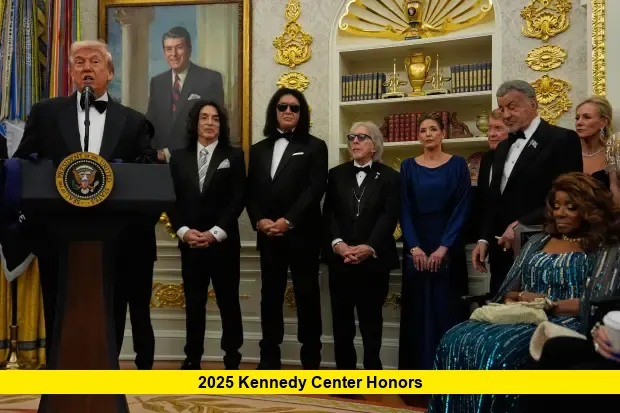

2025 Kennedy Center Honors: A Bold, New Chapter in American Culture
The 2025 Kennedy Center Honors marks a dramatic reimagining of one of America’s most prestigious arts awards. Under new leadership, the 48th annual class pays tribute to a bold, eclectic group of artists — a mix of country, rock, disco, Broadway, and Hollywood royalty. With the 2025 Kennedy Center Honors, audiences brace for what could be the most watched and talked-about awards night in decades.
This year’s honorees include country legend George Strait, disco icon Gloria Gaynor, hard-rock pioneers KISS, Broadway and film star Michael Crawford, and Hollywood action-movie icon Sylvester Stallone. Their careers span decades and genres, underscoring a deliberate shift in what the Kennedy Center now celebrates: mainstream appeal, cross-generational fame, and broad public recognition.
In many ways, 2025 redefines what it means to be honored by the Kennedy Center — setting an entirely new tone for America’s cultural institution.
A Realignment at the Top: Governance, Power, and Control
A leadership shake-up
Early in 2025, the governing structure of the John F. Kennedy Center for the Performing Arts was overhauled. The previous board of trustees was dismissed en masse and replaced with members closely aligned with the current administration. Shortly thereafter, the new board voted Donald J. Trump — then serving as President of the United States — as chair.
This move constituted a significant break from prior practice, where the arts institution operated under a mix of bipartisan oversight and arts-centered leadership. The shift signaled a new era: one where political control and cultural influence are deeply intertwined.
Selection and Personal Involvement
On August 13, 2025, Trump personally announced the five-member class of honorees, saying he was “about 98 percent involved” in their selection. This is a departure from tradition; historically, a bipartisan committee curated the honorees. This year, the slate reflects the chair’s personal tastes and vision.
In public remarks, Trump suggested he had rejected many potential honorees for being “too woke.” He framed the chosen class as embodying values he supports: broad popularity, nostalgia, and uncontroversial mass appeal.
The 2025 Class: Who Made the Cut — and Why It Matters
George Strait: Country Royalty with Record-Breaking Legacy
George Strait stands among the most successful country artists ever. With decades of chart-topping hits and record-breaking album sales, he exemplifies timeless appeal. In selecting him, the Center recognizes a career rooted deeply in Americana and traditional values — a fitting emblem of mainstream culture.
Gloria Gaynor: Disco, Resilience, and Cultural Resonance
Gloria Gaynor earned fame with her anthem “I Will Survive,” a song that transcended its disco roots to become a symbol of resilience. Her inclusion nods to a broader pop-cultural legacy, celebrating not just musical prowess but an era when disco helped shape an inclusive, expressive American identity.
KISS: Rock Spectacle and Cross-Generational Influence
KISS brought theatrics, pyrotechnics, and unapologetic rock swagger to stages worldwide. With decades of influence, they’ve built a devoted fan base that crosses generations. Honoring KISS signals a recognition of rock’s foundational role in shaping popular culture — and a nod to showmanship as a driving force in entertainment.
Michael Crawford: Broadway Gravitas and Global Impact
As the original lead in the long-running musical The Phantom of the Opera, Michael Crawford helped define Broadway’s global reach. His voice and stage presence made the show an icon of theatrical grandeur. His inclusion reminds audiences that the performing arts go beyond pop and film — they include dramatic, classical, and theatrical excellence.
Sylvester Stallone: Hollywood’s Tough Guy Icon With Staying Power
From Rocky to Rambo, Sylvester Stallone has embodied grit, resilience, and an American underdog spirit. With a career spanning decades, he remains a symbol of enduring popularity. Selecting him underscores a preference for larger-than-life personas, mass appeal, and cinematic legacy that resonates broadly.
What’s New: Format, Venue, and Medallions — Changes With Symbolic Weight
Medals Reimagined
For the 48th Honors, the traditional medallion was redesigned. The new medallions come from a different vendor, marking an end to decades-long tradition with the original makers. The redesigned medals — with updated ribbon colors and styling — reflect a break with the past and a deliberate re-branding under new governance.
A White House Ceremony
In a move unheard of until now, the medal presentation took place in the Oval Office of the White House. The sitting president personally handed out the awards — a historic first. Deviation from the traditional venue underscores the new administration’s willingness to imprint its identity on the Kennedy Center’s most iconic event.
Presidential Hosting of the Televised Gala
When the awards gala airs in December, it will be hosted by Trump himself — marking the first time a sitting president has performed that role. The shift from arts-community presenters to a political figure further blurs the lines between culture and politics within the institution.
Why the 2025 Kennedy Center Honors Spark Debate and Reassessment
A Shift From Artistic Diversity to Broad Appeal
Historically, the Honors celebrated a wide spectrum of artistic voices: from avant-garde jazz musicians and dancers to filmmakers and poets. The 2025 lineup leans heavily toward mainstream, high-visibility artists — rock stars, country legends, blockbuster movie icons. For many, this signals a narrowing of the institution’s mission from artistic diversity to commercial sensibility.
Politics at the Forefront of Culture
With a political figure at the helm, decisions that once belonged to an art-centered committee are now directly influenced by ideology and personal taste. The choice of winners, the design of the ceremony, and even medallions reflect that shift. Critics see the 2025 Honors as emblematic of culture increasingly shaped by politics rather than creative merit.
Nostalgia Over Innovation: What Is Being Celebrated — and What Is Left Out
The 2025 class looks backward — to decades past of rock, disco, country, and classic Hollywood. By honoring legacy and nostalgia, the new leadership may be prioritizing comfort and familiarity over innovation, experimentation, or emerging voices. That raises broader questions about who gets recognized, who gets silenced, and what values get elevated in today’s arts landscape.
What to Expect: The Gala, Broadcast, Reactions
The live gala is scheduled for December 7, 2025, at the Kennedy Center in Washington, D.C. The televised show will air on CBS and stream on Paramount+, giving millions across the country access to the tributes. With a lineup like this — combined with the novelty of a presidential host — ratings could easily soar.
Expect performances and tributes: hits from KISS, classic country from George Strait, disco flashbacks for Gloria Gaynor, theatrical nods for Michael Crawford, and cinematic homage for Stallone. The show will likely emphasize spectacle, nostalgia, and broad entertainment values — potentially winning viewers and drawing critics.
Public reaction is bound to be mixed. Fans of honorees will celebrate their favorites. Others will question the shift away from supporting diverse, avant-garde, or lesser-known creators. The new format invites scrutiny and debate about what the Kennedy Center represents — and whether this new direction honors heritage, popularity, or both.
What This Means for the Future of American Cultural Institutions
The 2025 Kennedy Center Honors arrival under new management may be a turning point. With political control over a flagship performing arts institution, the merging of cultural accolades and political branding becomes explicit.
If this model continues, future Honors — and the broader programming of the Kennedy Center — may prioritize artists who epitomize mainstream success, generational nostalgia, and minimal controversy. Artistic innovation, risk-taking, and culturally diverse voices could become increasingly marginalized.
This moment forces a larger question: should cultural institutions primarily reflect artistic merit and diversity — or should they conform to broader political and popular expectations? The answer could shape not just the Kennedy Center, but how America values and preserves its arts heritage.
In the years ahead, the choices made by the Kennedy Center under current leadership may determine whether the institution remains a broad reflector of artistic culture — or becomes a curated showcase of selective mainstream icons.
Share your thoughts below on whether this new direction at the Kennedy Center is a renaissance — or a retreat. Stay tuned for the show and its full cultural impact.