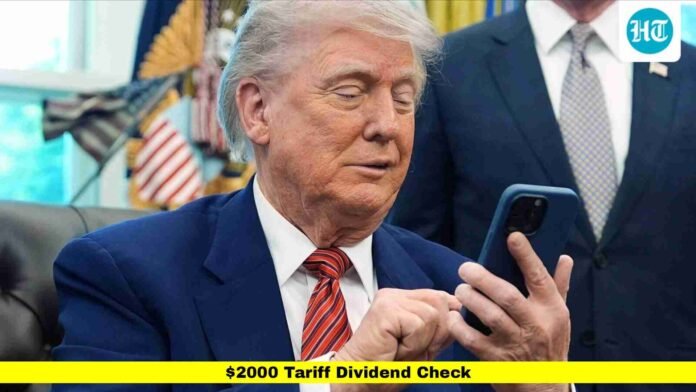

The $2000 tariff dividend check has become one of the most talked-about economic topics in the U.S. this month. Social media platforms like TikTok, X (formerly Twitter), and Facebook have exploded with claims and questions about whether the federal government or former President Donald Trump’s campaign has promised new financial relief tied to tariffs or “dividend” payments. While no official program currently exists under that name, the term has become shorthand for a proposed policy that could share tariff revenue directly with American citizens.
Understanding the $2000 Tariff Dividend Check Concept
The term “$2000 tariff dividend check” is being used to describe a potential plan in which revenue collected from tariffs—especially on imports from China—could be redistributed to Americans in the form of direct cash payments. The idea gained attention after renewed discussions on trade policy and Trump’s economic proposals resurfaced in 2025.
The phrase mirrors previous economic relief efforts such as stimulus checks, which were distributed during the COVID-19 pandemic. However, this concept differs because it’s tied to import tariffs rather than government-funded stimulus programs. Essentially, the government would collect tariffs from foreign goods and share part of that money back with U.S. citizens as a “dividend.”
Key Points Summary
✅ Proposed $2000 tariff dividend check refers to redistributing tariff revenue to citizens.
✅ The idea gained traction following Trump’s trade remarks in late 2025.
✅ No official government program or payment has been approved or distributed.
✅ It’s linked to potential 2025 trade policies focusing on China and other import-heavy nations.
✅ The concept reflects growing interest in using tariffs to directly benefit American households.
Origin of the Tariff Dividend Proposal
The renewed interest in tariff-based payments began when Trump and his team started discussing aggressive trade policies for 2025. During campaign appearances, Trump hinted at tariffs being used not only to strengthen American manufacturing but also to provide financial benefits to citizens.
While he did not specifically use the term “tariff dividend check,” supporters and online commentators began circulating the phrase, suggesting that the plan could include a $2000 payment funded by tariffs on imported goods. This led to viral social media posts and online speculation.
How the $2000 Tariff Dividend Check Would Work
In theory, a tariff dividend system would operate by collecting tariffs from imported goods—essentially a tax paid by foreign exporters—and distributing a portion of those revenues back to U.S. citizens.
If structured as proposed by supporters, it might work as follows:
- Tariff Collection: U.S. Customs would collect tariffs on imports from countries with high trade surpluses with America.
- Revenue Allocation: A specific percentage of that revenue would be set aside for public distribution.
- Payment Distribution: Citizens would receive a flat dividend, possibly around $2000, as a one-time or annual benefit.
While this framework sounds appealing, economists caution that tariffs can also raise domestic prices, which might offset any financial benefit from a direct payment.
Current Reality: No Official Tariff Dividend Program Exists
As of now, there is no verified federal or state initiative issuing a $2000 tariff dividend check. Neither the Treasury Department nor the Internal Revenue Service (IRS) has announced any related program or payment schedule.
The concept remains part of ongoing policy debates and campaign discussions. However, Americans should be cautious of scam websites or social media posts promising immediate sign-ups or “claim forms” for such checks, as none have been officially sanctioned.
Public Reaction and Viral Trends
Public interest in the $2000 tariff dividend check surged after influencers and political commentators began discussing it online. Videos claiming to show proof of government announcements went viral, though most were later proven to be misinterpretations of campaign speeches or economic proposals.
Nevertheless, the idea resonates strongly with working-class Americans struggling with inflation and higher living costs. Many see the idea of a “tariff dividend” as a way to make foreign importers, not taxpayers, shoulder the financial burden of relief.
Economic Perspective: Could Tariffs Fund Such Payments?
Economists are divided on the practicality of using tariffs to finance direct payments. Tariffs do generate significant revenue—billions annually—but they also tend to raise the cost of goods for consumers.
According to analysts, if tariffs on China and other trading partners were increased significantly, annual revenue could theoretically reach hundreds of billions of dollars. However, distributing $2000 per person to all American adults would cost more than $500 billion—a massive figure that would require extensive tariff hikes or additional government funding.
In short, while the math might work under specific conditions, the economic side effects could be severe, including:
- Increased consumer prices.
- Trade retaliation from other nations.
- Disruption of global supply chains.
- Inflationary pressure on essential goods.
Political Dimension: Trump’s Economic Strategy and Campaign Promises
The tariff dividend check narrative aligns with Trump’s long-standing trade philosophy—prioritizing American production, taxing imports, and reducing dependency on foreign manufacturing. His previous tariffs on Chinese goods were intended to protect U.S. industries, and now, his 2025 discussions suggest expanding this policy.
Supporters argue that such a program would be an innovative way to make tariffs work for the American people. Critics, however, claim that it oversimplifies the economic impact of tariffs and risks triggering trade conflicts that could harm long-term growth.
Nonetheless, the messaging of a “$2000 tariff dividend” fits neatly into Trump’s populist approach—an easy-to-understand, direct economic benefit that appeals to middle- and lower-income Americans.
Comparison to Past Stimulus Programs
To better understand how a $2000 tariff dividend check would differ from prior financial assistance programs, consider this comparison:
| Program Type | Funding Source | Distribution Agency | Purpose |
|---|---|---|---|
| COVID Stimulus Checks | Federal budget (deficit spending) | IRS | Economic relief during pandemic |
| Child Tax Credit | Tax credits | IRS | Support for families with children |
| Tariff Dividend (Proposed) | Tariff revenue | Treasury or new agency | Return of tariff earnings to citizens |
The key difference lies in the funding source—tariff revenue instead of borrowing or taxation. This is why proponents call it a “dividend” rather than a “stimulus.”
Possible Timeline if Implemented
If the policy were to move forward under a future administration, several steps would need to occur:
- Legislative Approval: Congress would need to authorize a tariff redistribution plan.
- Revenue Assessment: The Treasury would calculate tariff collection totals.
- Eligibility Setup: Guidelines would determine who qualifies—citizens, taxpayers, or residents.
- Payment Issuance: Direct deposits or checks could be sent out via IRS or Treasury systems.
Given these requirements, even with strong political will, such a plan would likely take several months or even years to roll out.
Why the Term “Tariff Dividend” Appeals to Many Americans
The term “dividend” suggests a sense of ownership and shared national wealth. Supporters argue that tariffs are paid by foreign producers, meaning Americans would benefit from international trade without directly increasing taxes.
The idea has gained emotional traction because it feels like a fair trade—if foreign goods flood the U.S. market, the profits and taxes from them should return to American wallets. It’s an appealing narrative during a time of economic uncertainty.
Social Media Misinformation and Awareness
While discussions about a $2000 tariff dividend check have spread widely, misinformation has also proliferated. Some social media posts falsely claim that payments have already started or that registration portals are live. Users should verify such claims through official government channels, as there is no confirmation of any active payout.
The IRS has also reminded citizens to avoid sharing personal details with unverified sites promising checks, as scammers often exploit trending financial rumors.
Economic Outlook and Future Possibilities
Looking ahead, the tariff dividend check debate could become a central talking point in upcoming U.S. elections. As candidates focus on domestic economic security, proposals like these might evolve into concrete policy discussions.
Even if no direct payments are issued, the broader conversation about using tariff revenue for public benefit is reshaping trade policy discussions. Economists and policymakers are now exploring whether a balanced version of this system could strengthen the economy without driving inflation.
Final Thoughts
The $2000 tariff dividend check may not be a confirmed government initiative yet, but it reflects a growing desire among Americans for tangible economic benefits derived from trade policy. The idea symbolizes an ongoing shift toward direct economic nationalism—where citizens expect a share of the profits from America’s trade stance.
Whether or not the proposal becomes reality, it has already influenced political messaging and economic debates for 2025 and beyond. As the conversation continues, citizens are watching closely for official announcements or concrete policy actions.