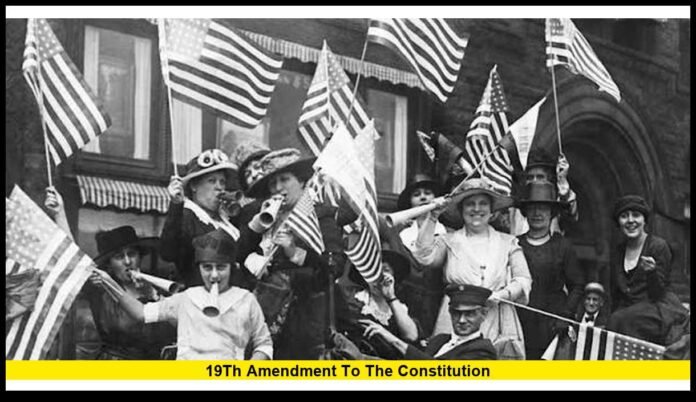

The 19th Amendment to the Constitution remains one of the most important milestones in the history of voting rights in the United States. More than a century after its ratification, the amendment continues to define a basic constitutional protection: the right to vote cannot be denied or limited by the federal government or a state because of sex.
The amendment became part of the Constitution in 1920 after a lengthy national campaign. Its adoption followed decades of organizing, political pressure, public demonstrations and state-level battles over women’s voting rights.
In 2026, the amendment is receiving renewed attention as the National Archives features it in its permanent Rotunda display in Washington, D.C. The display places the document among some of the country’s most important founding and constitutional records.
What the Amendment Changed
Before 1920, voting rules differed considerably from state to state.
Some states had already allowed women to vote in certain elections or under specific conditions. Others continued to prevent women from voting because they were women.
The amendment established a nationwide constitutional protection against that form of discrimination.
Its language is concise. It provides that the voting rights of U.S. citizens cannot be denied or abridged by the United States or any state on account of sex.
The second section gives Congress enforcement authority.
That wording created an important constitutional barrier. States could no longer maintain a voting prohibition based solely on sex.
The change affected the entire structure of American political participation.
Women were no longer dependent entirely on individual state governments to recognize their right to vote.
A Campaign That Lasted for Generations
The successful ratification in 1920 was the result of a movement that had developed over many decades.
Women’s rights advocates began publicly demanding greater political and legal equality during the 19th century. Voting rights became one of the movement’s central goals.
The campaign involved many different organizations and personalities.
Activists held conventions, circulated petitions, published newspapers and pamphlets, organized public meetings and lobbied lawmakers.
Some activists concentrated on changing state laws. Others believed that only a constitutional amendment could provide nationwide protection.
The movement also changed over time.
Early advocates often worked through traditional political channels. Later activists adopted more visible demonstrations and direct political pressure.
These different approaches eventually helped build enough support for congressional action.
The First Federal Proposal
The idea of a federal constitutional amendment did not suddenly appear in 1919.
A proposal for women’s suffrage was introduced in Congress in 1878.
For decades, lawmakers considered versions of the proposal without reaching the necessary congressional approval.
That long period illustrates the difficulty of changing the Constitution.
Supporters needed not only public support but also enough votes in Congress and, afterward, ratification by three-fourths of the states.
The proposal therefore remained a national political issue for generations.
By the early 20th century, however, the political environment had begun to shift.
Several states had already expanded women’s voting rights, creating millions of potential women voters before nationwide constitutional protection existed.
The Movement Gains Momentum
The suffrage campaign became increasingly prominent during the 1910s.
New organizations brought younger activists into the movement and adopted more aggressive political strategies.
Public demonstrations became more common.
Activists also increased pressure on members of Congress and the White House.
The issue eventually reached the national political agenda with greater urgency.
President Woodrow Wilson moved toward supporting a constitutional amendment.
That shift was important because presidential backing could influence members of Congress and state lawmakers.
The movement still faced strong opposition, but the political balance was changing.
Congress Approves the Proposal
The House of Representatives approved the proposed amendment on May 21, 1919.
The vote was 304 to 90.
The Senate approved it on June 4, 1919, by a vote of 56 to 25.
With congressional approval complete, the proposed amendment moved to the states.
This began another difficult phase.
Approval by Congress did not automatically change the Constitution.
The proposal needed ratification from three-fourths of the states.
At the time, the United States had 48 states, so 36 states were required.
The national suffrage campaign now focused heavily on state legislatures.
The Ratification Battle
Supporters had to persuade lawmakers across the country to approve the amendment.
The process was closely watched because several states remained uncertain.
Each ratification brought the proposal closer to the constitutional threshold.
Opponents continued organizing against it, while supporters worked to secure enough legislative votes.
The final battle took place in Tennessee during August 1920.
Tennessee became the 36th state to approve the proposal.
That decision supplied the final ratification needed to complete the constitutional process.
The Tennessee Vote
The Tennessee legislature became the center of national attention during the final stage.
Supporters and opponents gathered in Nashville as lawmakers debated the proposal.
The vote in the state House of Representatives proved decisive.
Representative Harry Burn initially opposed ratification. During the final vote, however, he changed his position and voted in favor.
Burn later said that his mother had encouraged him to support women’s voting rights.
His vote helped Tennessee approve the amendment.
The state’s ratification on August 18, 1920, provided the necessary 36th approval.
The amendment was then formally certified by Secretary of State Bainbridge Colby on August 26.
That certification marked its official addition to the Constitution.
Why August 26 Is Significant
August 26 has become closely associated with the adoption of women’s voting rights.
The date represents the formal certification of the amendment.
It also provides a clear marker for understanding when the constitutional change became official.
The distinction between August 18 and August 26 is important.
August 18 was the date Tennessee supplied the required ratification.
August 26 was the date the amendment received formal certification.
Both dates are therefore central to its history.
The First Presidential Election After Ratification
The presidential election of 1920 became the first national presidential election held after ratification.
The election took place on November 2.
Women across the country could now participate under the new constitutional protection.
Warren G. Harding defeated James M. Cox in the presidential contest.
The election demonstrated the immediate political significance of the amendment.
Political parties and candidates now had to address an electorate that included women nationwide.
The change was not simply symbolic.
It altered the size and composition of the American voting population.
The Limits of the Constitutional Change
The amendment represented a historic achievement, but it did not remove every obstacle to voting.
This point remains essential when discussing its legacy.
The amendment specifically addressed discrimination based on sex.
It did not eliminate voting restrictions based on other factors.
African American women, particularly in the South, continued to face discriminatory practices that prevented or discouraged voting.
Poll taxes and literacy tests were among the barriers used against Black voters.
Intimidation and other discriminatory practices also affected access to the ballot.
As a result, ratification did not mean that every woman could immediately exercise voting rights freely.
The constitutional guarantee was significant, but enforcement and broader voting-rights reforms remained necessary.
African American Women and the Suffrage Movement
African American women were active participants in the long struggle for political rights.
Black women created organizations, participated in civic campaigns and advocated for voting rights in their communities.
They also confronted discrimination within the broader suffrage movement.
For many Black women, voting rights were connected to a much larger struggle for equal citizenship.
The adoption of the amendment provided an important constitutional foundation.
However, discriminatory state practices continued limiting voting access for many Black citizens.
Later civil rights efforts became critical in challenging those barriers.
The Voting Rights Act of 1965 represented a major federal response to discriminatory voting practices.
That later legislation helped strengthen the practical enforcement of voting rights.
Key Figures in the Campaign
The movement included generations of activists rather than one single leader.
Elizabeth Cady Stanton became an influential early advocate for women’s rights.
Susan B. Anthony devoted much of her public life to the fight for women’s voting rights.
Sojourner Truth brought the experiences of Black women into the broader struggle for equality and rights.
Ida B. Wells became a prominent advocate for both racial justice and women’s political participation.
Carrie Chapman Catt played an important role during the final push for ratification.
Alice Paul became associated with more confrontational tactics during the later stages of the campaign.
These activists did not always agree on strategy or priorities.
Their approaches ranged from state-level organizing and lobbying to demonstrations and direct political pressure.
Together with countless less-famous organizers, they helped sustain the movement over generations.
Carrie Chapman Catt’s Role
Carrie Chapman Catt became one of the leading figures in the final campaign.
She headed the National American Woman Suffrage Association during a critical period.
Her strategy emphasized coordinated efforts to secure ratification across the states.
Once Congress approved the amendment, state-level organization became the immediate priority.
Every undecided state mattered.
The campaign required careful political work because supporters needed to reach the constitutional threshold.
Tennessee ultimately supplied the decisive vote.
Alice Paul’s Approach
Alice Paul represented another important part of the movement’s final phase.
She and her supporters used demonstrations and public pressure to demand action.
Members of the National Woman’s Party picketed outside the White House.
Some activists were arrested during their protests.
These actions attracted considerable public attention and increased pressure on the federal government.
The suffrage campaign therefore combined traditional political organizing with highly visible demonstrations.
The National Archives and the Amendment in 2026
The document’s historical importance remains visible today.
In 2026, the National Archives expanded its permanent Rotunda presentation to include the amendment.
The change is especially significant because visitors can see the original constitutional document rather than only reading about its history.
The Rotunda has long displayed foundational American records.
The addition of this document gives the history of women’s voting rights a more prominent place within that presentation.
The move also comes during the nation’s 250th anniversary year.
That broader commemoration has increased attention on important documents connected with American constitutional development.
The amendment’s permanent display offers a direct connection between the nation’s constitutional history and the expansion of political participation.
Why the Amendment Still Matters
The constitutional protection remains in force today.
No repeal has occurred.
Its language continues to prohibit the federal government and states from denying or abridging voting rights on account of sex.
That principle remains relevant to the country’s constitutional framework.
The amendment also provides an example of how difficult constitutional change can be.
The process began with proposals introduced decades before ratification.
It required sustained activism, congressional approval and state-by-state ratification.
The final result took generations to achieve.
Its history demonstrates that major constitutional changes can emerge from long-running public movements.
Important Dates
The most important dates include:
- 1878: A federal women’s suffrage amendment was introduced in Congress.
- May 21, 1919: The House approved the proposal.
- June 4, 1919: The Senate approved it.
- August 18, 1920: Tennessee became the 36th state to ratify it.
- August 26, 1920: The amendment received formal certification.
- November 2, 1920: The first presidential election after ratification was held.
- 1965: The Voting Rights Act strengthened federal protection against discriminatory voting practices.
- 2026: The National Archives added the amendment to its permanent Rotunda display.
The Lasting Legacy
The amendment changed the constitutional position of women in American elections.
Its adoption meant that voting rights could no longer be denied solely because a voter was a woman.
That change reshaped national political participation.
Yet its legacy also highlights the difference between constitutional rights and their practical exercise.
Many women continued to encounter barriers after 1920.
The amendment addressed one specific form of discrimination, while later legal and civil rights battles addressed additional obstacles.
Understanding both sides of that history provides a clearer picture of what happened in 1920.
The amendment was a major constitutional breakthrough, but it was also one stage in the longer development of voting rights in the United States.
More than 100 years later, its words remain part of the Constitution, while its original document now receives a prominent place in the National Archives.
The history continues to matter because it shows how persistent political organizing can produce a lasting constitutional change.
The story of this constitutional milestone remains a powerful part of American history—share your thoughts and stay informed about its continuing significance.