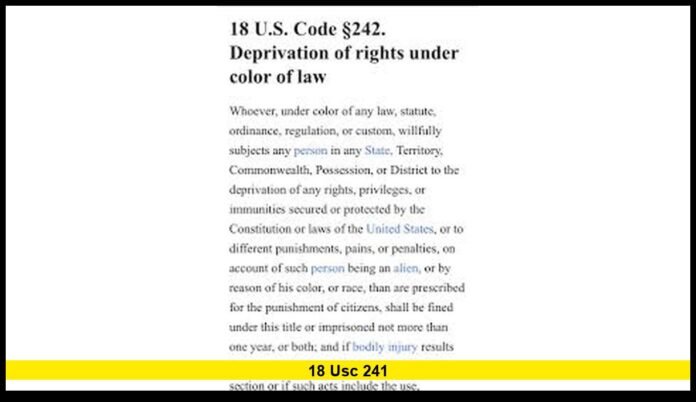

18 USC 241 stands as one of the most powerful criminal statutes in the U.S. Code for protecting constitutional freedoms from coordinated interference. As of today, the law continues to play a central role in federal civil rights enforcement, particularly in cases involving organized efforts to intimidate voters, obstruct lawful civic participation, or deny individuals the full protection of federal law.
Enacted to safeguard core democratic and constitutional guarantees, this statute makes it a serious federal crime for two or more people to join together with the intent to injure, threaten, oppress, or intimidate someone in the exercise of rights secured by the Constitution or by acts of Congress. Its scope is broad, but its purpose is precise: to stop conspiracies that aim to strip Americans of legally protected freedoms.
Legal Meaning and Scope
18 USC 241 criminalizes conspiracies that target federally protected rights. The focus is not on isolated misconduct, but on coordinated action. The government must show:
- An agreement between at least two individuals.
- A shared objective to interfere with a protected right.
- Knowing and voluntary participation in that agreement.
The statute covers rights such as:
- The right to vote in federal elections.
- The right to have one’s vote counted without intimidation.
- The right to equal protection of the laws.
- The right to due process.
- The right to participate in federal proceedings without coercion.
- The right to serve as a juror or public official free from unlawful threats.
The law reaches conduct that involves physical force, threats of violence, economic pressure, or other forms of intimidation, provided the intent is to interfere with a federally secured right.
Why Conspiracy Matters Under Federal Law
Unlike many criminal statutes that focus on completed acts, conspiracy law recognizes the danger posed by coordinated planning itself. Under 18 USC 241, the unlawful agreement is the core of the offense. Prosecutors are not required to prove that the planned deprivation succeeded, only that the defendants knowingly joined a plan designed to violate protected rights.
This structure allows federal authorities to intervene before harm fully unfolds and to address organized schemes that, if carried out, would undermine the foundations of constitutional government.
Penalties and Sentencing Structure
The statute carries substantial criminal penalties, reflecting the gravity of civil rights violations.
Base penalties include:
- Federal imprisonment of up to ten years.
- Fines imposed under the federal sentencing framework.
Aggravated penalties apply when the conspiracy results in serious bodily injury or other extreme outcomes:
- Life imprisonment if the conduct leads to kidnapping or aggravated sexual abuse.
- Life imprisonment or capital punishment if the conspiracy results in death.
Sentencing courts consider the scope of the conspiracy, the vulnerability of the victims, the degree of planning, and the actual harm caused or intended.
Modern Areas of Enforcement
In contemporary practice, federal prosecutors apply this law across several critical areas.
Election Integrity
One of the most visible applications involves conspiracies to interfere with the voting process. This includes:
- Coordinated intimidation of voters.
- Organized threats against poll workers.
- Schemes to obstruct ballot counting or certification.
- Group efforts to prevent lawful access to polling places.
The statute protects not only individual voters but also the institutional processes that ensure free and fair elections.
Civil Rights and Equal Protection
The law is also used when conspiracies target individuals based on race, religion, national origin, or other protected characteristics, with the goal of denying equal access to housing, employment, education, or public accommodations secured by federal law.
Judicial and Government Processes
Conspiracies aimed at jurors, witnesses, judges, or federal officials fall within its reach when the intent is to obstruct the administration of justice or to interfere with lawful governmental functions.
How Courts Interpret the Law
Federal courts require clear proof of intent. The government must establish that the defendants understood the right at issue and deliberately sought to interfere with it. Mere association, parallel conduct, or shared political views are not enough.
Key principles guiding interpretation include:
- The protected right must arise from the Constitution or federal statute.
- The defendants must act with specific intent to interfere with that right.
- Participation can be proven through communications, planning, coordination, and mutual support.
Courts also emphasize that lawful advocacy, protest, and political organizing remain fully protected, even when controversial or disruptive, so long as they do not cross into coordinated intimidation or coercion targeting protected rights.
Relationship to Other Civil Rights Crimes
18 USC 241 operates alongside other federal statutes, each addressing different dimensions of rights protection.
- It targets group-based schemes.
- Related provisions address individual misconduct by officials acting under governmental authority.
- Other laws focus on violence, threats, or obstruction tied to specific federal functions.
Together, these statutes form an integrated framework designed to protect both individual liberty and the democratic system itself.
Historical Foundations and Continuing Purpose
The origins of the statute lie in the post–Civil War period, when Congress sought to dismantle organized campaigns that used terror and intimidation to suppress newly recognized rights. Although the social context has evolved, the core concern remains the same: preventing coordinated efforts to nullify constitutional guarantees through fear, force, or coercion.
Over time, judicial decisions have affirmed that the statute adapts to new forms of conspiracy, including those organized through modern communications technologies. The law’s enduring relevance stems from its focus on intent and coordination rather than on any single method of interference.
Role in Federal Policy and Enforcement Strategy
Today, the statute is a key component of the Justice Department’s civil rights and public integrity mission. It is routinely evaluated in investigations involving:
- Organized extremist activity targeting civic participation.
- Coordinated harassment campaigns aimed at public officials.
- Group efforts to undermine the lawful functioning of democratic institutions.
Investigations often rely on digital evidence, financial records, travel data, and witness testimony to establish the existence of an agreement and a shared unlawful purpose.
Safeguards Against Overreach
The law’s broad language is balanced by constitutional safeguards:
- Prosecutors must meet a high burden of proof.
- Defendants are entitled to full due process.
- Courts scrutinize intent, not merely impact.
- First Amendment protections remain intact for lawful speech and assembly.
These limits ensure that the statute targets genuine conspiracies to violate rights, not lawful political disagreement or robust public debate.
Why the Law Continues to Matter
In an era of rapid information flow and organized online networks, the ability to coordinate intimidation or obstruction has increased. The statute provides federal authorities with a means to address these modern threats when they cross the line into conspiratorial efforts to deny legal rights.
Its continued enforcement signals that constitutional protections are not merely symbolic, but actively defended through the criminal justice system.
Public Understanding and Legal Clarity
Accurate understanding of this law is essential. It does not criminalize ideology, belief, or peaceful advocacy. It addresses intentional, coordinated action designed to interfere with rights guaranteed by federal law.
By focusing on agreement, intent, and protected rights, the statute draws a clear boundary between lawful expression and criminal conspiracy.
Conclusion
18 USC 241 remains a cornerstone of federal civil rights protection. Its application today reflects a long-standing commitment to ensuring that no group, no matter how organized, can lawfully conspire to strip individuals of the freedoms guaranteed by the Constitution and by acts of Congress.
Follow ongoing developments closely and share your perspective in the comments as the legal system continues to confront organized threats to fundamental rights.