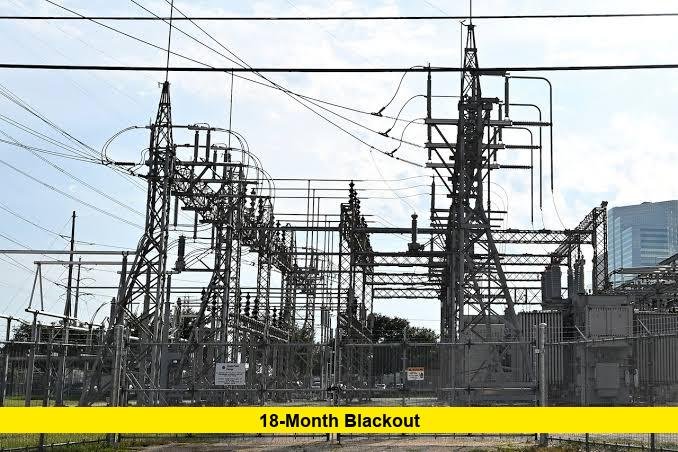

The 18-month blackout warning has attracted renewed attention in the United States after recent reports revisited concerns about vulnerabilities in the nation’s electric grid and the potential consequences of a coordinated attack on critical power infrastructure. The warning is linked to former Federal Energy Regulatory Commission Chairman Jon Wellinghoff and analysis conducted after the 2013 attack on the Metcalf electrical substation in California.
However, there is an important distinction between an expert’s worst-case scenario and a forecast of an actual event. There is no basis in the reporting to describe an 18-month nationwide blackout as something that is currently scheduled or inevitable.
The 18-month figure refers to a potential recovery scenario in which multiple strategically important electrical facilities were simultaneously disabled and replacement equipment was difficult to obtain.
Disclaimer: This article discusses a hypothetical worst-case scenario involving the U.S. electric grid. The 18-month figure should not be interpreted as a prediction, warning of an imminent nationwide blackout, or an announced government forecast. Information in this article is presented for news and informational purposes and distinguishes reported facts from hypothetical scenarios.
Why the 18-Month Blackout Story Is Trending
The latest discussion centers on the vulnerability of America’s high-voltage electricity infrastructure.
The issue received significant attention following the 2013 Metcalf substation attack in California. During that incident, gunmen fired at electrical equipment at a Pacific Gas and Electric facility near San Jose, damaging 17 transformers.
The facility took weeks to recover, although the broader power system continued operating.
The incident demonstrated how physical attacks could damage critical electricity infrastructure and prompted further consideration of the potential consequences of attacks on multiple facilities.
Former FERC Chairman Jon Wellinghoff subsequently discussed a much more severe hypothetical scenario involving the simultaneous loss of strategically important substations across the country’s major electrical interconnections.
That scenario is the basis for much of the discussion surrounding the phrase “18-month blackout.”
Is an 18-Month Blackout Happening in America Today?
No evidence presented in the current reporting indicates that the United States is experiencing an 18-month nationwide blackout.
The phrase can be misleading when removed from its original context.
The 18-month figure is associated with a hypothetical scenario involving catastrophic damage to multiple critical grid facilities. It is not a timetable announcing that the U.S. power grid will shut down for 18 months.
A local or regional power outage also does not automatically indicate that the country is moving toward such a scenario.
Americans should therefore be cautious about social-media posts claiming that an 18-month blackout has been confirmed or is about to begin.
Where Did the 18-Month Figure Come From?
The discussion traces back to analysis of the U.S. electric grid’s vulnerability to physical attacks.
The concern is that the nation’s electricity system depends on a relatively limited number of highly important transmission facilities. Some substations and transformers play much more significant roles than ordinary neighborhood electrical equipment.
If several strategically important facilities were damaged at the same time, restoring electricity could become substantially more difficult.
The scenario discussed by Wellinghoff involved nine strategically important substations spread among the country’s three major electrical interconnections.
The important point is that this was a hypothetical vulnerability assessment, not a prediction that nine substations would be attacked.
Why Large Transformers Matter
One of the biggest concerns in a severe grid-disruption scenario is the availability of replacement transformers.
Large high-voltage transformers are specialized pieces of equipment. They are not typically interchangeable with ordinary electrical components, and manufacturing and transportation can take considerable time.
Recent discussions about grid resilience have therefore focused on the availability of these large transformers and the broader supply chain required to replace them.
If numerous critical transformers were destroyed simultaneously, utilities could face a combination of engineering, manufacturing, transportation and installation challenges.
That is one reason a theoretical recovery period could extend much longer than the duration of an ordinary power outage.
The 2013 Metcalf Attack and What It Demonstrated
The Metcalf incident remains an important reference point in discussions about physical grid security.
In April 2013, attackers fired extensively at the substation, damaging transformers and forcing the utility to take emergency measures.
Despite the severity of the attack, the wider electricity network did not collapse.
The incident therefore should not be viewed as evidence that a nationwide blackout is inevitable. Instead, it demonstrated that important electricity infrastructure can be vulnerable to physical damage.
The distinction becomes particularly important when comparing a single-site incident with the much more extreme scenario involving simultaneous attacks on multiple critical facilities.
Why the U.S. Has Multiple Power Interconnections
Another important part of the discussion is the structure of the American electricity system.
The continental United States does not operate as one perfectly unified electrical network. The country’s major power system is divided into large interconnections, including the Eastern Interconnection, Western Interconnection and Texas Interconnection.
These systems have substantial independence from one another.
That structure is one reason why an event affecting a single region does not automatically cause electricity to disappear throughout the entire country.
For a truly nationwide failure to develop, an unusually severe chain of failures would have to affect critical parts of multiple systems.
Is America’s Power Grid Vulnerable?
The underlying concern about grid resilience is real even though an 18-month nationwide blackout is hypothetical.
America’s electric infrastructure includes equipment that has been operating for decades. Utilities must continuously balance maintenance, modernization, replacement and growing electricity demand.
The electricity system is also becoming increasingly important to industries such as data centers, advanced manufacturing and artificial intelligence infrastructure.
Higher electricity demand can place additional pressure on generation and transmission systems.
At the same time, utilities must protect critical infrastructure against extreme weather, equipment failures, cyber threats and physical attacks.
These challenges make grid reliability an ongoing national issue.
Could an 18-Month Blackout Really Happen?
A prolonged national blackout is theoretically possible under an extreme combination of circumstances, but that is very different from saying it is expected to happen.
The 18-month figure is best understood as a potential recovery estimate associated with a catastrophic scenario involving extensive damage to critical grid infrastructure.
Such a scenario would require multiple failures or attacks and significant difficulty restoring key equipment.
It should therefore not be interpreted as a prediction of America’s future power supply.
The distinction between risk assessment and prediction is particularly important when reporting on infrastructure-security issues.
Why the Story Is Causing Concern
Power is fundamental to nearly every part of modern American life.
A prolonged outage could potentially affect:
- Hospitals and medical facilities
- Water and wastewater services
- Telecommunications
- Internet connectivity
- Banking and financial systems
- Fuel distribution
- Grocery and food supply chains
- Transportation
- Manufacturing
- Heating and cooling
- Emergency services
Because modern infrastructure depends heavily on electricity, a major grid disruption could have consequences far beyond simply losing household power.
That is why grid resilience and infrastructure security remain important policy issues.
Does a Local Blackout Mean an 18-Month National Blackout Is Coming?
No.
Weather-related outages, equipment failures and regional transmission problems are fundamentally different from the hypothetical scenario described in discussions about an 18-month blackout.
The United States experiences power outages for many reasons, particularly during severe storms, hurricanes, wildfires, extreme temperatures and equipment failures.
Utilities generally work to isolate affected areas and restore service as quickly as possible.
A regional outage therefore should not automatically be connected to claims about a nationwide grid collapse.
What Americans Should Know About the 18-Month Blackout Warning
The most important takeaway from the latest discussion is that the 18-month blackout is a hypothetical worst-case scenario, not an announced event.
There is no reason to interpret the current media coverage as confirmation that the entire United States is about to lose electricity for 18 months.
Instead, the story highlights concerns about the physical security and resilience of America’s electric infrastructure.
The underlying questions are legitimate: How quickly could critical substations be repaired after a coordinated attack? How many replacement transformers would be available? Could utilities move electricity around damaged areas? And how resilient would interconnected systems be during an unprecedented crisis?
Those questions are relevant to national infrastructure planning even if the extreme scenario never occurs.
18-Month Blackout Latest Update
The renewed attention surrounding the 18-month blackout warning is largely focused on an older worst-case grid vulnerability scenario rather than a newly announced nationwide power emergency.
Former FERC Chairman Jon Wellinghoff’s analysis has again become a topic of discussion because it illustrates the potential consequences of simultaneous attacks on strategically important electricity infrastructure.
However, the scenario should not be presented as a prediction that the United States will experience an 18-month blackout.
The country’s electric grid faces genuine challenges, including aging infrastructure, increasing electricity demand, extreme weather risks and the need to protect critical facilities. Those challenges make preparedness and grid modernization important, but they do not establish that a nationwide 18-month outage is imminent.
What the 18-Month Blackout Story Means
The 18-month figure describes a hypothetical worst-case recovery scenario—not a confirmed blackout, not a scheduled outage and not proof that America is about to go dark.
Readers should rely on verified information from government agencies, utilities and established news organizations when evaluating claims about major power-grid emergencies.
What do you think about the latest U.S. power-grid warning? Share your thoughts below and stay updated as verified information develops.